How do you define what blue is? What even IS colour? Turns out, the quest to define colours was happening along with a standardisation crisis and a dictionary crisis at the venerable Merriam-Webster. Lexicographer and author Kory Stamper tells us all about it, and about her new book True Color.
Timestamps
- Start: 0:00
- Intros: 1:17
- News: 12:40
- Related or Not: 33:34
- Chat with Kory Stamper, author of True Color: 50:43
- Words of the Week: 1:41:58
- Comment from Lauretta: 2:04:57
- The Reads: 2:08:14
- Outtakes: 2:16:48
Listen to this episode


Video
Full episode
Patreon supporters
Thanks to all our patrons! Here are our patrons at the Supporter level.
Very similar; ones and twos
- Stan → tan (distance 1)
- Amir → amber (distance 2 from here on down)
- Chris L → cerise
- Kory is here → corn
- Rach → peach
- Lucy → puce
- Ben and Rene → red
- Manú, Sam, and Tony → tan
- Whitney → white
Threes
- Amy → amber
- Aldo → aqua
- Keith and Nigel → beige
- Luís → blue
- Rodger → copper
- John K → corn
- Daniel, Kevin, and O Tim → denim
- Xekri → ecru
- Elías → flax
- Helen → green
- Larry → grey
- Diego → indigo
- James C → jade
- Mignon → linen
- Martha → maroon
- Fiona → pink
- Iztin → tan
- Kelly and Steele → teal
Fours
- Amanita → amaranth
- Andy B and Rachel → amber
- Ayesha, Joanna, Kathy, Laura D, and Lyssa → aqua
- Hedvig → beige
- Nasrin → carmine
- Colleen and Wolfdog → celadon
- Sydney → cyan
- Nikoli → gold
- Ignacio → indigo
- Rosemary → rose
Getting to be a bit of a stretch
- Meredith and Faux Frenchie → amaranth (distance 5)
- Kristofer → bistre (distance 5)
- John Mac → coral (distance 5)
- gramaryen → gamboge (distance 5)
- Molly Dee → gold (distance 5)
- Johntroy → tomato (distance 5)
- Pharaohkatt → charcoal (distance 6)
- Ariaflame → chocolate (distance 6)
- Canny Archer → cinnabar (distance 6)
- LordMortis → apricot (distance 7)
- Sonic Snejhog → olivine (distance 8)
- Linguistic Chaos → indigo (distance 11)
- Andy from Logophilius → asparagus (distance 14)
And our newest patrons:
- At the Friend level: Hannah
- And our newest free members: Myf, Stuart W, Greg17, Modo di Bere, and Torsten
Become a Patreon supporter yourself and get access to bonus episodes and more!
Become a Patron!Show notes
Photo finally solves the black and blue/white and gold dress debate
https://www.9news.com.au/world/photo-finally-solves-the-black-and-blue-white-and-gold-dress-debate/15465485-dad8-45d2-8da0-8d20558b5013
Visual field | XKCD
https://xkcd.com/1080/
Why are blue and indigo shown as separate colors on some spectrums?
https://www.quora.com/Why-are-blue-and-indigo-shown-as-separate-colors-on-some-spectrums/answer/Rob-Brown-13
What Is Indigo and Why Is It in the Color Wheel?
https://handwovenmagazine.com/what-is-indigo/
English Language Bill
https://www.legislation.govt.nz/bill/government/2026/198/en/latest/#LMS1493976
English doesn’t need protecting in New Zealand – but other languages do
https://theconversation.com/english-doesnt-need-protecting-in-new-zealand-but-other-languages-do-276951
The debate NZ should really be having about language policy
https://theconversation.com/the-debate-nz-should-really-be-having-about-language-policy-277074
Lālanga | YouTube
https://www.youtube.com/@lalanga5233
China’s new language law to criminalise advocacy of ethnic minority rights
https://www.tibetanreview.net/chinas-new-language-law-to-criminalise-advocacy-of-ethnic-minority-rights/
Callers to Washington state hotline press 2 for Spanish and get accented AI English instead
https://apnews.com/article/washington-dol-spanish-accent-ai-3a1b8438a5674c07242a8d48c057d5a3#
Washington roasted for using AI feature with heavily accented English instead of actual Spanish on state helpline
https://fortune.com/2026/03/02/washington-state-accented-english-with-spanish-accent-amazon-web-services/
True Color: The Strange and Spectacular Quest to Define Color–from Azure to Zinc Pink, by Kory Stamper
https://www.penguinrandomhouse.com/books/555914/true-color-by-kory-stamper/
Himba color perception
https://languagelog.ldc.upenn.edu/nll/?p=18237
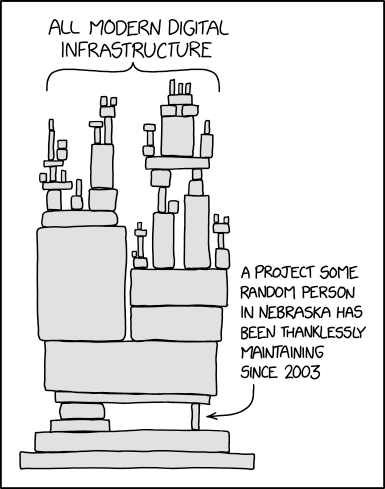
Dependency | XKCD
https://xkcd.com/2347/
The vibe coding hangover is upon us
https://www.fastcompany.com/91398622/the-vibe-coding-hangover-is-upon-us
Microsoft gets tired of “Microslop,” bans the word on its Discord, then locks the server after backlash
https://www.windowslatest.com/2026/03/02/microsoft-gets-tired-of-microslop-bans-the-word-on-its-discord-then-locks-the-server-after-backlash/
Microsoft Bans the Word “Microslop” on Copilot Discord, Gets So Humiliated That It Locks Down the Whole Server
https://futurism.com/artificial-intelligence/microsoft-bans-word-microslop-discord-lock
There’s a Grim New Expression: “AI;DR”
https://futurism.com/artificial-intelligence/aidr-meaning
How we discovered three poisonous books in our university library
https://theconversation.com/how-we-discovered-three-poisonous-books-in-our-university-library-98358
Transcript
[Transcript provided by SpeechDocs Podcast Transcription]
DANIEL: Are you getting rid of all those recordings?
BEN: Am I getting rid of them? No, I don’t think I am. I think there’s a big folder with hundreds of my audio just sitting there.
DANIEL: Massive WAV files just sitting there.
BEN: They’re not that massive. I just do a thing where every couple of years, I’m like, “Hmm. I seem to be running out of room, maybe I should clear some stuff. No, no. I’ll buy another 2-terabyte solid state drive.”
DANIEL: Oh, nice.
BEN: And now, I’ve got like four of those just sitting there, beavering away.
DANIEL: Humming away. [LAUGHS]
HEDVIG: We have a lot of external hard drives. We have a spreadsheet to organise our external hard drives.
BEN and DANIEL: Wow.
DANIEL: You could take all of your drives and make like a RAID network or something.
BEN: You could take all of your drives and then hack them and make like cool music. Like, [SCATS ALONG WITH DANIEL]. Daniel and I are the same kind of broken. Isn’t that interesting?
[BECAUSE LANGUAGE THEME]
DANIEL: Hello and welcome to Because Language, a show about linguistics, the science of language. I’m Daniel Midgley. Let’s meet the team. First up is Ben Ainslie. Hello, Ben Ainslie.
BEN: Hello.
DANIEL: So, tell me your spiciest take on colour, because that’s the subject of this episode.
BEN: I’m not sure if I have a spicy colour take. The closest I’ve got for you, Daniel, is… I don’t know if you’re aware of this. On the day that we are recording this episode, it is the Hindu Holi festival day today, like today. And I went to do my workout in the park across the road from my house and there is a thousands-of-persons-strong Holi festival rave colour event taking place. So, just by virtue of doing some push-ups on the grass, I have partaken in the colour festival. So, that was really neat and really fun.
DANIEL: Thank you. Also, we have Hedvig Skirgård. Hedvig, do you have a spicy take on colour?
HEDVIG: A spicy take on colour? Well, this week, I had the blue dress colour illusion explained to me.
BEN: Had you not come across it before? The whole blue and black?
HEDVIG: No, no…
BEN: Oh, okay.
HEDVIG: No, no. I had come across the blue dress on the internet that people argued is white and gold versus blue and black. And what I had not fully grasped was how, what is the reason for it.
BEN: Oh, like the scientific colour science that was going on there.
HEDVIG: Yes.
BEN: Oh, cool.
HEDVIG: And that boggled my mind and it made me think in general about the fact that I’ve heard before, which is that colour exists as photons that hit your eye and stuff and bounce off things but you also have assumptions yourself about what colour things are. And the first time you see something, whatever colour you think that thing is, then it’s very hard to change. So, if someone has a grey sweater and you see them in a greenish light and you think it’s green, you could see it in a blue light later and it definitely doesn’t look green, but in your head, you’ll be like, “Oh, that’s the green sweater they wore last time.”
BEN: So, there’s like a weird anchoring bias that happens.
HEDVIG: Yeah. And I think that’s… I don’t know if that’s my spicy take, but it really… Yeah, colour, it’s just nonsense, isn’t it?
DANIEL: [CHUCKLES] It’s nonsense.
BEN: Can we take just one second for anyone who hasn’t fallen down the rabbit hole of colour science… what is it? Hic sunt dracones, like be very careful because colour is bonkers. It’s so crazy. Like, when you first discover there’s additive colour and subtractive colour, you’re like, “Oh, wow, that’s a lot more complicated than I thought.” And then, you dig into the math and physics and science of that and it’s just… You so quickly get into territory where like, “I need a doctorate to understand.”
DANIEL: That’s going to be a theme of our episode today.
HEDVIG: It’s nonsense and it’s mind-boggling, but it’s also, like, what everyone who’s sighted… like, that’s what… we look at things all day.
BEN: Yeah, yeah, yeah. [LAUGHTER] There’s so much information.
HEDVIG: So much information all the time.
DANIEL: Yeah. The boxes in my peripheral vision up there, they look red to me, but that’s not because I’m seeing red. I don’t have any colour vision in my peripheral vision. There’s nothing there. It’s just that my brain is reminding me that’s red. It kept little track of those boxes, even when I’m not looking at them. There’s no red appearing to me. Brain says, “That’s red.”
BEN: Okay, this honestly is like the never-ending packet of Tim Tams or something because that’s the fact that we don’t see colour in our peripheral vision, that’s a new piece of colour information for me. It never ends. There is always deeper to fall.
HEDVIG: I’ve been trying to catch things. I’ve been trying to introduce things into my peripheral vision that are a certain colour to see if I will track them as grey until they come into the middle, but the problem is it’s very hard to surprise yourself.
BEN: Yeah, you can’t… One can’t tickle oneself.
DANIEL: You can fool oneself, but you can’t surprise yourself. Okay, so my hot take on colour is that indigo is a scam, and it doesn’t belong in the rainbow or the mnemonic.
BEN: I’ve always thought this. I’ve always thought in ROYGBIV, there’s essentially a whole third of ROYGBIV that is kind of one colour, which is purple. [LAUGHS]
DANIEL: Exactly. [LAUGHS] What’s going on is Isaac Newton had mystical ideas about the number seven. And because he was the one who was writing about colours so much, he said, “I’m just going to slide indigo in there.” Indigo is really important. It’s dye stuff, we need it.
BEN: Are you being serious? Like, he was a magical thinker as well as being an absolute genius?
DANIEL: He was. He was both.
HEDVIG: Oh, that’s really common though.
DANIEL: People are complicated.
BEN: And here I was thinking he was just very smart.
DANIEL: Yeah, well, he was both. Now that I’ve read this and researched this for this episode, I find that it’s not actually as spicy as I thought. Isaac Asimov once said, “It is customary to list indigo as a colour lying between blue and violet, but it has never seemed to me that indigo is worth the dignity of being considered a separate colour. To my eyes, it seems merely deep blue.”
BEN: Now, can we… I want to… Because I can see Hedvig is gearing up. All right, so…
HEDVIG: Okay, what do you think? What do you think? What am I going to say?
BEN: I just want to very quickly state that indigo, if we are talking about colour from the perspective of a painter or a person who decorates interiors or does design or something, indigo absolutely deserves its own name and all that kind of stuff. Like, if we’re talking about colour to the degree where there’s burnt sienna and oxblood and all that kind of stuff: indigo, 100%. But when we’re talking about the gradations of the colour spectrum, indigo does not deserve a place on that podium. [LAUGHS] And I feel like Hedvig was gearing up to being like, “It is so different. It was so different. It’s so different.”
DANIEL: I think I know what she’s going to say.
HEDVIG: Yeah, I think Daniel knows what I’m going to say. I don’t think Ben knows what I’m going to say, which… Daniel, what am I going to say?
BEN: We know each other very well, which is a marker of good kinship.
HEDVIG: We also know certain facts well, I think.
BEN: Okay, so lay it on us, come on.
HEDVIG: No, Daniel says what I’m going to say, and I’m going to see what it is.
DANIEL: Well, I thought you were going to say something like there aren’t seven colours, but there aren’t six colours either. Different languages carve up the colour map different ways. [BEN LAUGHS]
HEDVIG: Yes. And in particular, Russian famously does two different entire words for light and dark blue, which sort of in some of these maps onto what people are saying is blue and indigo. Because I would argue that orange and yellow barely deserve to be distinguished.
BEN: Madness. Madness.
DANIEL: [LAUGHS] Madness in English! Madness in English. I mean, three primary colours, three secondary colours. Six. It shouldn’t be ROYGBIV. It should be ROYGBP, blue, purple.
BEN: But Daniel, Daniel, Daniel are we doing that thing? I saw a great TikTok recently, and I realised we have not yet begun the show, and we are going for a new world record of just faffing about. But are we doing the thing… I saw a great TikTok recently where it’s just like, try in your head replacing the phrase “music theory” with “Western musical tradition circa 1500” whenever you’re talking about music. And are we doing the same thing for colour right now? [LAUGHS]
DANIEL: Absolutely. Absolutely.
BEN: Yeah. So, we shall bear this in mind. I have a feeling that this show is going to be one big game of like, “Oh, fuck. There goes another assumption about colour.”
DANIEL: Maybe. Maybe because we’re talking colours on this episode. Ben, I’m going to ask you if you were writing a dictionary entry for BLUE, how would you define BLUE?
BEN: Oh, don’t make me do the mask.
HEDVIG: This one’s easy, Ben.
BEN: Okay. A dictionary entry for the colour BLUE would be… Well, you could go wavelength, right? You could say it’s the perceived colour of light which vibrates? No. Which has a wavelength of a certain range. I don’t know what blue is off the top of my head. Is it like 700 KHz or something?
DANIEL: I do not know.
BEN: Okay. Micrometers or something. It’d be micrometers, wouldn’t it? That’s one way to do it.
DANIEL: That’s one way.
BEN: What an unsatisfying way to do it because that doesn’t actually give a person any information whatsoever. So then, my brain would say, “Okay, do you then say things that are very typically blue, like the sea or the sky or something like that?” Or like a blue jay, or a superb fairy-wren if you were here in Western Australia.
HEDVIG: I have a decorative plate with superb fairy-wrens.
BEN: They’re so pretty.
DANIEL: So, you’ve got two things here. You go mathematical, or you start listing objects. That would work.
BEN: Yep.
DANIEL: Or you could start describing it in terms of other colours, but BLUE is hard. Like, you can do that with CERULEAN, but not necessarily with BLUE.
BEN: Like, the primaries get really tricky. Also, if you describe things in the world, that’s really not very helpful for people who don’t have vision, famously.
DANIEL: Well, for this episode, we’re having someone who writes dictionaries and who has a lot of knowledge about this history, especially as it pertains to the Merriam-Webster Dictionary. It’s Kory Stamper, and her new book is True Color.
It’s the story of how this attempt to define colours was taking place against a larger effort to say what colour even was. And at the same time, there was an effort to standardise colour, largely as a result of the war effort because if you ordered olive drab uniforms from Germany and from Italy, you might get totally different colours, and that might be a problem. So, colours at this time were beginning to be a hot topic for dictionaries and for everyone, and we’re going to be talking to Kory about it.
BEN: This is very exciting. I am very keen to find out more. Actually, it’s one of those things… I don’t think I could ever go and be a font nerd the way you are, but I fear, I’m afeared that were I left alone to my own devices, I could potentially become a colour nerd.
DANIEL: Mm. You might. You might.
BEN: Yeah.
DANIEL: We’re rocketing through this year, and that means that pretty soon we’ll be starting up some live shows in addition to bonus episodes, in addition to normal episodes, in addition to Discord access, in addition to the good feeling that comes from supporting your favorite language podcast. So, I’d just like to make a special invitation to you to join us, as have our latest patrons. You know what I’m doing? I’m taking them out of the back end of the show. I’m sticking them up right here. Yeah.
BEN: You know what?
HEDVIG: Oh, that’s cute.
BEN: That’s one of those… That’s like the upside-down fridge. Why the flip have we not been doing that from the start?
DANIEL: Exactly. So, I’d like to say a big happy thank you to our latest patrons at the Friend level, Hannah. And our newest free patrons, Myf, Stuart W, Greg17, Modo di Bere, which is a podcast about drink and language, Hi, Rose, how’s it going? And Torsten. You can join us, that’s patreon.com/becauselangpod.
BEN: Bam. Well, now that we have congratulated just the coolest cats in town, what’s going on in the news?
DANIEL: It’s time to play Good Thing or Bad Thing because something’s been going on in New Zealand.
BEN: Oh, no. That’s normally such a unified source of good things, why?
DANIEL: Well, here’s the thing. A bill has been put forward in New Zealand Parliament to make English an official language of New Zealand. And here’s the text of the bill. It says, “English is an official language of New Zealand.”
BEN: Okay.
DANIEL: That’s the wording.
BEN: Oh, and this is the question, is this a good thing or a bad thing?
DANIEL: Now, there is a policy statement. “Legislative recognition of the status of English as an official language will not affect the status or use of Te Reo Māori and New Zealand Sign Language as the two other official languages of New Zealand.”
BEN: Okay.
HEDVIG: Oh, are they going to be at the same level as English, or are they going to be official minority languages?
DANIEL: Well, let’s talk about official in New Zealand. Te Reo Māori is an official language of New Zealand since 1987.
BEN: Okay, so hold on, hold on, hold on.
DANIEL: Yep.
BEN: I feel like we’ve got… So, whenever we do language law stories, I think we need to do a little bit of a reminder about how — speaking of the standardisation of colour — how not standardised this is. So, different countries can say different things in different ways, and they can mean very different things.
So, this is a bill that wants to make English an official language of New Zealand. So then, the first question becomes, did it already have official languages? Which you’ve just answered, it had Te Reo as an official language. Did it have any other official languages prior to this point?
DANIEL: New Zealand Sign Language, which has been official since 2006.
BEN: And those were the only two.
DANIEL: Well, this is where things get a little bit gnarly.
BEN: [LAUGHS] Okay.
DANIEL: The question is, is English an official language of New Zealand? It is considered one of the three official languages, but it is de facto official, which I guess means it’s widely considered official, but no one voted for it and this bill would make it officially official, for real.
BEN: Okay.
HEDVIG: So, for example, there’s probably somewhere stated that law text should be in English. They probably have some sort of policy or convention that things that goes on in the parliament should happen primarily in English and that the written record of what happens in parliament should be in English, which is one of the things that often official does.
DANIEL: I think it just happens.
BEN: Interesting.
HEDVIG: Right. It’s the case of when something is so obvious and you’re swimming in the water, you don’t feel the need to state that’s the way it is. So, if that’s the case, then is this either just a small little mission to make something explicit that was implicit, or is this some sort of dog whistle thing?
DANIEL: That was the question.
BEN: It can’t help but be a dog whistle, right? The only possible reason you would bring this up is for that reason. What I think is actually really adorable, if I’m being completely honest, is that this is… I’m inferring New Zealand’s version of cranky right-wing politics, and it’s the mildest thing ever. [LAUGHTER] It’s so chill, because it’s basically being like, [WITH AN ACCENT] “Oh, well, bloody hell, English should be an official language as well as the two minority languages that we’ve actually already acknowledged legally and this won’t change that, of course, but we want a place too.” It’s actually very adorably conservative. compared to the insanity we are seeing elsewhere in the world, this just seems fucking quaint by comparison. [LAUGHS]
DANIEL: An older time, and it’s the kind of thing that might sound reasonable to most people. But this discussion needs to be viewed in the light of the implicit narratives and presuppositions, what are…
BEN: Conservatives are in power in New Zealand? Am I wrong in thinking that?
DANIEL: Oh, this is something I should know and I don’t right now.
BEN: I think their conservative party is New Zealand Parliament. Let’s see if I can infer what the colours mean from this little diagram. Yeah, Nationals. Nationals are the ruling party.
DANIEL: Just for info, this legislation is being proposed by the Nationals and by New Zealand First.
HEDVIG: I was going to bring up New Zealand First, which if you had to guess what kind of politics they’re into. Do you want to guess?
BEN: [LAUGHS]
DANIEL: I just know that anybody who supports an English language bill is going to be right wing.
BEN: Yeah.
DANIEL: Without even knowing the name of the party.
HEDVIG: Ben, I know you’re Australian and you have like a very little/big brother relationship to New Zealand and you were like, this is so cute and stuff, but New Zealand First is very open…
BEN: They are New Zealand. Sorry, when I say they, New Zealand is struggling with many of the same issues that Australia is struggling with, and that other places are struggling with. It’s a weird time politically though, because we look to America where the conservatives have not only won power but are engaged in a salted-earth campaign of control and command and just a level of fascistic exercise that we have not seen in a really long time. Like, it makes Margaret Thatcher look not as intense, and she was a very intense human being.
And then meanwhile, in Australia we are seeing… So, what Hedvig is alluding to is that in Australia, for those outside of Australia, we have an actually quite burgeoning ultra-right movement happening in Australia, but that is happening within the context of our conservative parties getting annihilated nearly across the board in every state and federal election we’ve had for a while. Like, the most recent federal election in Australia was… I don’t even know. Like, decimated doesn’t actually feel like enough of a word, because that means killing one in ten. They got…
DANIEL: No, it doesn’t. Obliterated.
BEN: Obliterated. Yes.
DANIEL: The Liberal Party in Western Australia got so few votes that they had to disincorporate as an entity.
HEDVIG: And that’s very similar to what’s happening in a lot of Europe as well. That’s happening to the party called the Liberals in Sweden right now. It’s not fully decimated, but it’s happening in Germany to a certain extent. So, it’s a common story across what we might describe as the European or Western world, or whatever we want to call it.
BEN: But what I suspect Hedvig was alluding to is that there is actually a really big danger there. So, it feels really good that “progressive” parties although I’m sure this is true in Europe as well as Australia, progressive is actually a very generous term for what ends up being a very center-right system of left government. They can rest on their laurels now, content to be like, “Yay, we won really handily.” And meanwhile, some really awful and concerning things are growing in the shadows.
And so, these New Zealand First in New Zealand, One Nation in Australia are growing in power and popularity, and the implications in the 5-to-10-year timeline are very worrying. Because if they do become the new conservative face of our politics, then there is going to be something really yucky that we will have to contend with for decades.
DANIEL: Yep, for sure.
HEDVIG: And a survival strategy of a lot of these sort of classical conservative parties is to enter into coalitions with the further right. So, that’s what is currently the ruling party is in Sweden. And it is maybe I don’t know enough about New Zealand politics, but the Nationals and New Zealand First together suggesting that English is going to be an official language does smell a little bit of that. It’s not the… I’ll openly say I don’t think it’s the worst thing they could suggest if English is already a de facto language.
BEN: And this is what I meant by being kind of quaint, yeah.
HEDVIG: But it is clearly some sort of dog whistle.
DANIEL: You’re right. It is not the most concerning thing, but it takes place against a concerning backdrop and it does reveal some narratives, like, “Why would you need to enshrine English as an official language when it’s the de facto official language? Well, this reveals a belief that whatever the current status of English is in New Zealand, it’s not enough. And that’s why it needs this kind of protective status. Well, why would you think that unless you were doing something a bit dog-whistle-y? I mean, English is spoken in New Zealand by 96% of the population. And yet, 96% isn’t enough? What would be enough? [CHUCKLES]
So, there are some really good articles. There’s one by Sidney Wong, Andreea Calude, and Jesin James in the conversation — link in the show notes for this episode — where they argue that a better use of resources instead of trying to pass this would be focusing on the threat to heritage languages which have non-dominant status. We’re seeing more languages being spoken, not less. And so, that’s one thing that we should be working on, is preserving heritage languages, maybe also working on helping the process of learning English become easier and more fair.
HEDVIG: Yeah, yeah, for sure. And I can recommend, so the New Zealand, I forget which ministry it is, but they do these beautiful weeks every year. So, they have Samoan Language Week, Tongan Language Week, Tokelauan Language Week and other language weeks all throughout the year. And they do little promotional campaigns. People do little episodes in different languages and it’s really cute.
DANIEL: No matter what country you’re in, you should be paying attention when people try to do this kind of English official thing, who’s promoting it? And who are they trying to benefit? And this isn’t getting any better when we look over at China, which is our next news story given to us by Diego. This is in the Tibetan Review. They’re having currently the 14th National People’s Congress, opened on March 5th. It says, “The law will require ethnic minorities to use Mandarin Chinese as their main language of instruction, overturning decades-old policies that date back to the era of Mao Zedong.”
BEN: See, now this is some proper authoritarianism. When I said this seems quaint in the previous story, I’m like, “Yeah, this is what heavy-handed language policy looks like.”
DANIEL: Yep. Can you guess what they’re appealing to in an effort to stomp out other minority languages? Take a guess.
HEDVIG: What are they appealing to?
BEN: Other than nationalism.
DANIEL: How are they selling it?
HEDVIG: Are they saying that these poor minorities can’t go to university otherwise? Something like that? Also, by the way, do we think that there are communities that… I suspect they’re already feeling the pressure from Han Chinese.
DANIEL: Oh, it’s happening. Oh, yeah.
HEDVIG: I’m not… I feel like this is… Yeah.
BEN: I’m guessing that was a no, because Daniel wasn’t like, ding-ding-ding. I’m going to guess that it’s like, oh, if they don’t speak Mandarin, they’re a burden on the state and we have to expend resources.
DANIEL: It’s not even that specific. It’s really vague. So, first of all, it’s “forging a sense of community in the Chinese nation.”
BEN: Okay. So, nationalism. Yeah. Yeah. Yeah.
HEDVIG: Mhm.
DANIEL: National unity, right?
BEN: Yeah.
DANIEL: And in fact, the legislation also threatens people and organisations “who engage in acts that undermine national unity and progress or incite separatism.”
HEDVIG: What’s special here is that the People’s Republic of China has had explicit policies for quite a long time that, at least on paper, seem to value and highlight the cultural diversity within China. China’s a really big country. And if you look at the central west, yes, there are a lot of people who speak Mandarin and are Han Chinese. But especially as you get further… Sorry, if you look east. If you get further west, you get a lot of different people who live in that really big country. And for a while, that was a source of pride, with these 55 recognised ethnic minorities. And a lot of the national news outlets would be like, “Oh, this cultural group is celebrating this festival. Look at their beautiful clothes,” and showcasing that to the world, like, “Look at us. We are diverse and yet we are unified. And isn’t that beautiful?”
BEN: Can I be weird? That’s surprising to hear. That is not something that I was aware of as a feature of Chinese civic unity. I had assumed it was like, “We are Chinese. Chinese is this,” and stuff that deviates from that is not necessarily… So, I’m…
HEDVIG: I think it’s been going on at the same time.
BEN: Okay. No, no, no, I’m not saying you’re wrong. I welcome this information. To the stupid white outsider’s perspective, what I pick up on mostly is this sense of unity. So, it’s interesting to know that from the inside, there is actually this sense of at least a modicum of celebration of diversity.
HEDVIG: Well, whenever I’ve seen it, it seems quite put on and like artificial…
BEN: Performative. Right. Okay.
DANIEL: Paper thin.
HEDVIG: And paper thin. But it’s been a source of marketing or branding as like, “This is a way that we are different from the US,” or something, that we blah, blah, blah, something like that. Now, someone who’s an expert on Chinese cultural history will point out how I’m wrong, but it’s at least been a part of some of the branding for a while. And it has been, like Daniel said, it has been inscribed in law that there are 55 ethnic minorities with a right to their culture and language for a really long time. And so, maybe in practice, that hasn’t really been the way people’s lived experience. So, maybe this is another case of policy updating to what is actually happening. But it is noteworthy that they want to change it on paper as well.
DANIEL: Mm-hmm. Well, let’s just finish up with a story from James. You know how in some places when you dial up official service like a government service, it says press 1 for English. For Spanish, for example, press 2. Well, this story takes us to Washington State, where when you call the Washington State Department of Licensing and you press 2 for Spanish, here’s what you get.
BEN: Oh, no. I’m so worried.
RECORDING: [IN ENGLISH WITH WHAT COULD BE TERMED A STRONG HISPANIC ACCENT] Thank you for calling the Department of Licensing Customer Support Center. For assistance with scheduling a driver licensing office appointment, cancelling the next existing appointment, or questions about an upcoming appointment, please press uno.
BEN: Oh, no.
DANIEL: Please press uno.
HEDVIG: I was… Yeah, please press una or uno, I didn’t hear, but that’s nice. There was one Spanish word. One more than be briefly.
DANIEL: Suddenly, I understand Spanish. I’m either really good at Spanish, or something happened just then.
BEN: Oh, no.
HEDVIG: That’s very funny and terrible.
DANIEL: Yep.
BEN: And it’s funny if you don’t only speak Spanish, in which case it’s very unfunny.
DANIEL: The story was broken by Washington resident, Maya Edwards, and there’s a story in the Associated Press. She says, “It was hilarious to us in the moment because it was so absurd. But at the same time, it has real accessibility issues for people who call in every day and need to speak in a different language other than English.” It’s been taken down. The agency has since apologised and says that it fixed the problem. But it’s another example of presumably AI slop that has made its way into government services.
BEN: I just think how much water was used for that bad solution.
HEDVIG: Sorry, wh… wh… sorry. Okay.
DANIEL: I’m saying it’s AI because I don’t think that they got a person to say, “Hey, we need something in Spanish, could you please do that?” “Sure, I can do that.”
HEDVIG: I don’t think an AI would do that either. I think if you ask one of these large language models to translate something into Spanish…
BEN: So, you reckon this is… Do you think this a case of like, “Oh, no worries, Steve, I know a lady.” And then, the lady goes rogue?
HEDVIG: Yeah.
BEN: No, no. [LAUGHTER]
HEDVIG: There’s no way… I don’t talk to large language models with speech, so I don’t know what they do.
BEN: Let’s lay this out here.
HEDVIG: Okay.
BEN: One way or another, a breathtaking lack of checking took place here. Because whether it was AI or it was someone getting like old Mrs Sanchez or whatever to do this, who puts a thing on a public-facing phone distro, which presumably handles thousands of calls every single day, thousands and thousands and thousands of calls? What’s the population of Washington, Daniel, off the top of your head?
DANIEL: Millions.
BEN: Yeah, it’d be somewhere between like, what, three and five million?
DANIEL: Three to five million, about.
HEDVIG: Okay.
BEN: And for those…
HEDVIG: I hear a quiz.
BEN: Yeah, okay. Fact checkers.
DANIEL: Here goes Hedvig! Thank you.
HEDVIG: Washington state?
BEN: Yes.
DANIEL: Yes, yes, please.
BEN: And in a place like America, even in… we know Seattle’s really cool and groovy and you can get around without a car, but in every other part of Washington, you need a car to be an adult… Seven, eight.
HEDVIG: Eight.
BEN: Eight million.
DANIEL: Eight million. That’s a lot. Seattle’s big.
BEN: So, to put a thing out on a call system that handles potentially eight million citizens’ worth of inquiry calls… and licensing centers get slammed. I’m sorry, I don’t care where you live, any time you call a licensing center, you are waiting because there are so many calls. So, I know I’m ranting, but the idea you would put a thing on this system without checking it is mind-boggling. So, whether it was AI or like someone’s shitty white fucking Spanish teacher from high school or whatever, this is appalling.
DANIEL: The story is in the AP that this is an AI voice. They don’t say why they think it’s an AI voice. Maybe there’s an assumption going on there. I would like to know more, but I would love to see how this gets out. Oh, my god.
BEN: I would love to know what sad intern-type human who got handballed this gig is just fronting up in front of some cameras and being like, [SHEEPISH VOICE] “Oh, yeah. Thinking about it now, I can see how it wasn’t a very good idea. Sorry.”
DANIEL: [IN AN ANGRY VOICE] Steven…!
BEN: Yeah. [LAUGHS]
HEDVIG: Or is it…? My kindest idea is they were like, “We need a Spanish person to say this.” They got a Spanish speaker. They didn’t tell them what they were supposed to do. They gave them the text on paper in English and said, “Can you read this out?”, thinking they’re obviously going to know that we want them to say it in Spanish. They said it the way they did and no one checked it.
BEN: In a situation as baffling as this, that is the best answer I’ve been provided so far. That’s the closest I could come. It’s not a great solution, but it’s certainly less bad than the others we’ve had.
DANIEL: Well, I would love to know more than this. I guess we’re playing a game of Slop or Not. But I vote slop. What do you vote, Ben?
BEN: Yeah. I’m thinking AI is involved in… The sticky, sloppy fingers just are involved in some way.
DANIEL: Yeah, got to be. Got to be.
HEDVIG: I don’t think so. I don’t think…
DANIEL: Hedvig says not.
HEDVIG: …an AI would do that. I think it would say things in Spanish.
DANIEL: She’s taking the outside chance, okay.
BEN: Remember, Hedvig, AI is only as good… Well, not even, but AI can only be as good as we prompt. And if some doofus was doing some bad prompting…
HEDVIG: Yep. No, that’s possible. I’m going to go against the stream. I’m contrarian.
BEN: Okay, okay.
DANIEL: We may never know. We may never know.
BEN: Yes, we will, Daniel. You’re on the case.
DANIEL: Okay, I’ll be on the case. But that’s the news. And now it’s time for everyone’s favorite game, Related or Not.
[RELATED OR NOT THEME FROM CAMDEN]
DANIEL: There we go.
HEDVIG: That’s very cute. Did he say entomology?
DANIEL: No, etymology.
HEDVIG: Okay.
DANIEL: I think.
HEDVIG: [LAUGHS] Everyone write in and tell me if you thought Camden said ETYMOLOGY or ENTOMOLOGY, because entomology, I believe, is the study of insects.
DANIEL: It is. Yeah, but that was Camden. And now, this is also Camden bringing us on SpeakPipe, the magic of SpeakPipe, bringing us a pair of words. Are you ready?
CAMDEN: Hey, gang. This is Camden Parks calling from Illinois. I’ve got a couple of words for you. There’s TROLL, T-R-O-L-L, by which I mean you get in a boat, you go slowly out onto the lake, and you pull a line behind you, usually at some depth, in the hopes of catching a big old bass or walleye. And then, there’s TRAWL, in which you get in a boat and you go out onto the ocean, pulling a big old net behind you, usually at some depth, and you’re hoping to pull up a whole bunch of fish. TROLL and TRAWL. Are those two related? Thank you much.
HEDVIG: I feel a set-up, Camden. This seems sus.
BEN: Can we first establish that it is in this moment right now, today, that I learned that it’s not called trolling when you drag a lure behind a boat? I have spent my entire life thinking that action is still called trawling, not called trolling.
DANIEL: It’s trolling. Mm-hmm. And you know what? I’m throwing in an extra, what about a TROLL, the fantasy creature?
BEN: Oh, no, don’t… boo.
HEDVIG: I swear we’ve done that one before.
BEN: Okay.
DANIEL: Have we?
BEN: Ooh, TROLL, TRAWL. TROLL, TRAWL.
DANIEL: Well, let’s just focus on trolling, the two methods of fishing trolling, dragging a line through the water, and trawling. I might have a TROLL-TRAWL merger.
BEN: Hang on a second.
DANIEL: No.
BEN: Hang on a second.
DANIEL: What?
BEN: I’m about to have my mind blown wide open.
DANIEL: I know, right?
BEN: Does this mean that people who intentionally rage-bait other people online…
HEDVIG: Yes, yes.
BEN: …are called trolls, not because they behave like a nasty, awful beast, but because they are trying to lure people?
HEDVIG: Yes.
DANIEL: Yes, correct.
HEDVIG: Because they’re throwing out bait.
DANIEL: [LAUGHS] It may be a combination of both. We’re not sure.
BEN: It’s okay, Ellis. I’m just having a moment because I’ve learned some new information. I was so upset that I drew my child from across the apartment. Admittedly, the apartment is about seven steps across, but still.
HEDVIG: Yeah. But Minecraft is a very powerful thrall.
DANIEL: Oh. In fact, I would even say it might be a bit of a thrill.
BEN: Stop it, all of you. I cannot handle any more, okay?
DANIEL: Okay. Okay.
BEN: One mind blow per episode is what I can comfortably accommodate.
DANIEL: Oh, you’re… Oh, no.
HEDVIG: Ben, have you ever heard something like, “Oh, trolling behind her was her child?”
BEN: No. Perhaps, I’ve always heard that as TRAILING.
HEDVIG: Right. Sorry. Yes. So, this is where I think… yeah, I think TRAILING comes in.
DANIEL: Okay, focus. Focus, people. Let’s focus on TROLL and TRAWL, the two methods of fishing.
BEN: I’m going to go related.
DANIEL: I can go first. You’re related, huh?
BEN: Sorry, Daniel, my bad.
DANIEL: No, no, you go ahead.
BEN: Yeah, I think just the mouth sounds are so similar. I’m basically going related because I spent my entire life thinking they were one word. So, I’m just desperately hoping that my lived experience is reflective of the reality of what’s happened here.
DANIEL: There’s that phrase again.
BEN: My lived experience?
DANIEL: Yep.
BEN: Okay.
DANIEL: Okay, cool. I’ll go next. I’m going to say not related, and I’ll tell you why. There was one thing that tipped me. There’s a Christmas carol which uses the word TROLL. You know the one?
BEN: No.
HEDVIG: No.
DANIEL: [SINGING] Troll the ancient Yuletide carol. Fa la la la la.
BEN: Never once knew that word was there.
DANIEL: And why is it there? What is it doing? Well, to TROLL, I know this because I looked it up long-long time ago for a Christmas thing. To troll is to roll. You roll the song along, maybe in a round, which is another round thing that rolls around. So, I can see how TROLLING in a boat is like rolling along and I just feel like TRAWLING is going to be that little bit different.
BEN: Okay, interesting. Hedders, what do you got?
HEDVIG: Fun fact as my other fun fact besides the “There are lots of languages in the world, and one of them does this,” is my other thing that comes up in Related or Not which is something Swedish, something something, which is that tra-la is like when you go [SCATS], you’re tra-la. That’s the act of doing that.
DANIEL: Tra-la-la, we do that too.
HEDVIG: Tra-la-la, exactly. So, that sounds like what you just said about the carols. I think that Camden wouldn’t pose this question unless they weren’t related. I think he’s been out around the waters and learned these two words weren’t related. I think it’s really fun.
BEN: Oh, you’re metagaming.
HEDVIG: Or possibly. Exactly. Or he’s metagaming us. Which means that thinking about what Camden thinks is basically useless because… [LAUGHTER]
BEN: We have got a hit-to-miss ratio of exactly zero on this. We’ve metagamed so many times and we never come up winning or losing definitively.
DANIEL: Right when it started.
HEDVIG: It’s like a Steve Moffat character arc. People are just flipping and you’re just like, “Well, I no longer know anyone’s intentions.” It’s useless. TROLL-TRAWL, I’m going to say not related, but I don’t feel strongly about it. I don’t think the ogre is related to either.
DANIEL: I don’t either. I don’t think so. Okay, well, so Hedvig and I both said not related. Ben says related. And the answer is they’re not related. They’re not. So, TROLL means to drag. And by the way, it is related to the singing in a full rolling voice. They’re just singing or rolling around or trundling about. And that’s what you’re doing when you’re dragging a line. However, TRAWL comes from Latin tractus, like extract, when you pull something out or intractable, can’t be drawn.
HEDVIG: Like tractor beam.
BEN: Yeah, but how the fuck did a W get in there?
DANIEL: That’s an interesting question, actually.
BEN: W is just standing out like a sore thumb.
HEDVIG: Well, W’s are just a way in English of modifying vowels. They don’t mean anything.
BEN: [LAUGHS] I love how spicy and low-key offensive that take is. Like, your W is a garbage letter that doesn’t do anything.
DANIEL: Well.
HEDVIG: Are you talking…
DANIEL: I don’t even think we can blame French for this one because there’s no W. [BEN LAUGHS] Not this time.
HEDVIG: No. It’s pure English nonsense. Yeah.
DANIEL: Yep. Okay, well, so one for us, Hedvig. And now, Hedvig, this one comes from you. I pulled this one…
HEDVIG: Is it one of the ones…?
DANIEL: …from you on the Discord?
HEDVIG: So, what I do is I collect these from my friends at Friday beers and I don’t look up the answer.
BEN: Ah, gotcha, gotcha.
HEDVIG: So, if Daniel has also not looked up the answer, then I need five minutes to look up the answer.
DANIEL: No, I have looked up the answer, but I wrote my impressions first.
HEDVIG: Okay, but I just want it on the record that I also probably don’t know what the right answer is.
BEN: Yeah, yeah.
DANIEL: Good to know.
BEN: And I’m actually guessing.
BEN: Especially considering the question was initially brought up when you were a few sheets to the wind as well, which can make even…
HEDVIG: Well, it’s also just I asked people, like, “What do you guys think would be fun pairs to have Related or Not?” And then, they say stuff. And I’m like, “Great.” And then, I type it into Discord and then I forget about it.
DANIEL: And do you remember the words that you typed in this time?
HEDVIG: No, because I sent in several, I believe. I think it’s INFANT, INFANTRY, ELEPHANT and another one… it was French ENFANT.
HEDVIG: Oh, yeah. French word for child.
DANIEL: So, the words are INFANT, INFANTRY, ELEPHANT, and ENFANT.
BEN: Okay. Wow, that’s a lot. There’s a lot of possible answers to this. Like, the different pairs that might be related and stuff. How can we simplify this? Can we just have three possible…
DANIEL: Let’s say one’s the odd one out.
BEN: So, INFANT and ENFANT, I think, are clearly related. Like, clearly English as a language was like, “Oh, all of these fancy French ruling people keep calling their babies ENFANT. I guess it must be an INFANT then.” So, those two seem very clearly related to me. The question is it INFANTRY or ELEPHANT? I’m thinking INFANTRY is related, something about little toy soldiers or something like that. So, I’m going ELEPHANT is the odd one out.
DANIEL: I agree. I’m having trouble deciding what the INFANTRY has to do with it. It’s not a baby tree. It’s an infant, a tiny…
BEN: Stop it. That was a terrible dad joke.
DANIEL: What do you think, Hedvig?
HEDVIG: And I swear I haven’t looked it up. I think that it has to do with being able to walk.
BEN: Ah.
HEDVIG: Infantry are the walking…
BEN: Walking soldiers?
HEDVIG: They’re the ones who aren’t on horses in an army. And I think an infant is when they stop just purely lying around and turning their head, and they’re actually moving around a little bit.
BEN: Ah, this is… I’m liking this. I hate my answer now. [LAUGHS]
HEDVIG: I swear, this is not me looking up, this is me going off Latin classes from the Hedvig brain. And that makes me think that ENFANT is the odd one out. ELEPHANTS, big ‘ole legs.
BEN: Walking thing, big walking guy.
DANIEL: Does it change your answer if I tell you that the word INFANT comes from infans, meaning unable to speak?
BEN: Oh, shit. That probably means it’s not related to ENFANT.
HEDVIG: Fuck. But then…
BEN: Goddamn it.
HEDVIG: I mean, so you wanna…
BEN: How willing are we to accept that the information that Daniel has could in fact be wrong? That’s what I want to know.
HEDVIG: No, no, no. I think that… Oh, this is pre-Daniel-revealing-answers Daniel.
DANIEL: Yes, it is. Just reading my notes. I thought maybe the soldiers were children, or considered to be like children in some way.
BEN: Oh, because they were lower class or lower importance people.
DANIEL: But I didn’t go further than that. So, you’re sticking with it, Hedvig?
HEDVIG: Yeah, I’m sticking with ENFANT being the odd one out.
BEN: Okay. I’m sticking with the ELEPHANT. I’m going for it.
DANIEL: The odd one out is ELEPHANT, which comes from Greek elephas, which means, it’s just the word for ELEPHANT or it’s also the word for ivory.
BEN: Wait, wait, wait. I don’t find that answer very satisfying, Daniel.
DANIEL: Why not?
BEN: Because we often don’t stop the word chain with, like, “It was the word for ELEPHANT.”
DANIEL: I’m sorry, but it just was. And it doesn’t go back to the speaking thing, which is what INFANT means. So, ENFANT and INFANT are the same word. And then, INFANTRY, the word was chosen because they weren’t the cavalry, who had a lot of experience and would probably be older. They were just foot soldiers. They were young. The original word was a youth. Because INFANT went from a baby who couldn’t speak to a young person, and that’s the way that meaning jumps. So, ELEPHANT was the one.
BEN: INFANTRY literally translates to group of young people.
DANIEL: Group of babies. There’s a storm of babies going across destroying and pillaging with their binkies in their mouths.
BEN: Wow. It’s so interesting to me that it’s not just that it’s related. It’s like the whole word, INFANT, is right there in it, and it just chucked an R-Y at the end.
DANIEL: Yep. Didn’t take very long to get there at all.
BEN: Yeah. Wow.
DANIEL: Okay, last one. Quick one. CLANDESTINE. Does it have anything to do with a CLAN? With DESTINY? Neither? Or both?
BEN: CLANDESTINE.
DANIEL: I could see both. Maybe a family was going to do something secret.
BEN: Nah, I’m thinking neither. Unrelated.
DANIEL: Mm-hmm. Okay.
BEN: I’m feeling CLANDESTINE, just smacks of romance. Clandest-een or something like that.
DANIEL: [LAUGHS] Yeah.
BEN: Whereas CLAN, it feels a lot more guttural and hard like I’m feeling like a Norse or a Germanic… Like, clan came. Feels more that. Destiny, on the other hand, mm.
DANIEL: It’s giving you tremors?
BEN: Unclear. But I’m going unrelated.
DANIEL: Okay. Hedvig?
HEDVIG: CLANDESTINE, I don’t think it’s related to DESTINY, but I do think it’s related to CLAN, because I think they’re both secret things.
BEN: Ah, oh, true. Ooh.
DANIEL: Dang it. Okay, I said neither, and now it’s time to put cards on the table. So, the word, CLAN, let’s start off with CLAN, because that one comes from… it’s Gaelic clann, eventually. This is weird. Etymonline says that it comes ultimately from Latin planta, which is offshoot. That CLAN and PLANTA, that’s very interesting.
BEN: That sounds hard.
HEDVIG: Like a branch of a family tree.
DANIEL: Yes, that makes sense. Okay, very good. However, Latin clandestinus is the root of CLANDESTINE. And here they’ve got CLAM, meaning secretly, from Latin celare, to hide. Different word. It’s not CLAN. It’s not DESTINY. Neither one related.
BEN: Yes. Yes. Yes. Yes.
DANIEL: Ben, I’d say you did pretty well. Did you get all three of those?
BEN: No, I got the first one wrong.
DANIEL: Oh, the first one was wrong. That’s right.
BEN: TROLL and TRAWL.
DANIEL: Little note there. This is a note from Gareth. You remember the last time we did WAKE, to wake up and wake the funeral?
BEN: Yeah. Yep, yep.
DANIEL: Gareth says, “Unless I misunderstood — perfectly possible — I have to disagree with your assessment of WAKE, verb meaning to not sleep, and WAKE, noun meaning a gathering to watch a corpse overnight. I believe these two are etymologically related, both springing from the proto-Indo-European root, *weg-. Compare the modern German word wachen, which means both to wake and to watch. Respectfully yours, Gareth.” All right, so.
BEN: Have we said that Proto-Indo-European is off the cards for this game? I feel like we have.
HEDVIG: No.
DANIEL: We have said no such thing.
BEN: Okay.
HEDVIG: What? That’s the… Our best-case scenario is that Daniel tells us if Indo-European language is the Proto-Indo-European root.
DANIEL: Yeah, that’s the fallback. And you know what? He’s right. I can’t argue with the Proto-Indo-European reconstruction. Actually, you can, but I won’t. I think what I was thinking was that the path was super indirect. The WAKE-up version arose from a convergence of two different words, but the WAKE that you attend was from a different Old English word. And at the time, I thought that was different enough. But I suppose if we go back far enough, they do go back to the same Proto-Indo-European word, which would have meant something like a state of wakefulness. So, thank you, Gareth. And I’m awarding retrospective points. Wheeew.
HEDVIG: Wait, wait.
BEN: Wait, so does that mean I won?
HEDVIG: So, do I get points because… Yeah. [LAUGHS]
DANIEL: Yeah. What did we?… Well, that depends on what we said. And I don’t know yet because I didn’t go back and review. I’m too embarrassed.
HEDVIG: Okay.
DANIEL: But thank you, Gareth, for keeping us solid.
BEN: Very much so.
HEDVIG: Thank you, Gareth, for the points I hope I’m gonna get.
BEN: And any time that we find out that Daniel was wrong is a very good day.
DANIEL: Yes, indeed.
[MUSIC]
[INTERVIEW BEGINS]
We are speaking with one of our favorite people, lexicographer and author of True Color: The Strange and Spectacular Quest to Define Colour from Azure to Zinc Pink. It’s Kory Stamper. Hey, Kory.
KORY: Hey, Daniel. How are you?
DANIEL: Good. It’s good to see you again. It’s been a while.
KORY: It’s good to see you. Yeah, it has been a while.
DANIEL: It was episode 18, Swearin’ Time.
KORY: That’s right, yeah.
DANIEL: Remember?
KORY: I do remember. Less cuss words in this book, sadly. So, if people want their cuss word fill, they’ll have to go back to episode 18.
DANIEL: Well, that’s just a skill issue, is what that is.
KORY: [LAUGHS] That’s true.
DANIEL: This is your third time with us and that means that you are an honorary cohost and you get to crash any episode you want.
KORY: Woo-hoo. Great.
DANIEL: Mm-hmm. Yeah, so that’ll be fun. All right, well, you’re writing about colour. Has colour had a fascination for you, and why?
KORY: It only had a fascination for me through dictionaries, in a weird way. So, in 2010, I was working at Merriam-Webster, and Merriam-Webster was rewriting their unabridged dictionary, and I was responsible for checking to make sure that all of the entries were rendering okay on the website. And that’s when I started finding these very weird color definitions that seemed so [DANIEL LAUGHS] out of… They start fine. They start the way you expect a moderate red. And then, they just go off the rails.
And the thing about the way they were written was, the way that they were constructed they each have these sort of comparative colors, and the comparative colors were things like — I’ve never heard of any of these — fiesta, or copen, or aloma. I don’t know what those are. So, that’s where my fascination with color really began, it was through the dictionary, and then it just kind of went everywhere, as you would expect.
DANIEL: Right. I want to tell you a story about my life. Once upon a time, when I was very small, one of my sister’s friends came to visit, and she was blind.
KORY: Oh, wow.
DANIEL: And I was talking to her. I was just this little kid. I think I might have been 6 or 7.
KORY: Yeah, yeah. 6-7. [LAUGHS]
DANIEL: Sorry. That was unintentional.
KORY: No, it’s fine. It’s fine.
DANIEL: Yep.
KORY: It’s good.
DANIEL: It’s all over at the moment.
KORY: That’s what language is. It’s fine. [LAUGHS]
DANIEL: That’s what it does. Well, for some reason, I was trying to describe a page in my picture book to her, and I got to, I think one of the people is wearing a red robe. And she said, “What’s red?”
KORY: What’s red? [LAUGHS]
DANIEL: That was a rough question. Little tiny me, she was very patient with me, but little me had a difficult time saying, “What is red?” I know things that are red, but that’s not red itself.
KORY: Yeah, yeah. And that doesn’t help someone who has low or no vision. [LAUGHS] It’s like, well, red is, I don’t know, red is the color of blood. Do you know what the color of blood looks like [LAUGHS]? Yeah.
DANIEL: Red is apples. Wait, But not all apples. Oh, hang on.
KORY: [LAUGHS] Right. Exactly.
DANIEL: So, it seems really hard to write a definition for colours, but a number of strategies come to mind. Shall I just run through them?
KORY: Go for it.
DANIEL: Okay. And I got some of these from True Color as well. So, I’m kind of pulling from the book here. Number one, you could just start naming things that are that colour, but as we’ve already seen, that doesn’t always work.
KORY: Right.
DANIEL: You could go super scientific, but you lose the public.
KORY: Right.
DANIEL: And I think this was obviously before internet colour. So, I couldn’t just tell my sister’s friend, “Oh, well, it’s FFFFFFF.” Right?
KORY: [LAUGHS] Right, yeah.
DANIEL: And you can’t put that into a definition anyway. Can you? Mm.
KORY: I mean, you can put lots of things in definitions. It just depends on who your audience is and what you want them to take away.
DANIEL: Precisely. Well, you could do a colour plate and just say box 326 or something. What else is there?
KORY: I mean, the main strategies are the ones that you’ve already said. The core of any color definition is going to be the genus term. So, that’s going to be, we have our basic color categories, as Berlin and Kay would say. So, there’s 11… I brought up Berlin and Kay, this is a language show. [LAUGHS]
DANIEL: Yeah, we’re five minutes in, awesome.
KORY: But you can… You start with the basic color categories and then you give it basically a descriptor. It’s medium, it’s bright, it’s dark, it’s deep, it’s dull. And that’s kind of the basic that gets people in the right colorimetric country.
DANIEL: Okay, so if I want to say raw umber, then I’m going to say something like…?
KORY: You’re going to say like a medium to dark brown. Right, you go…
DANIEL: So, I got brown, one of my genus terms, and then I just modify it a little bit.
KORY: And then, you modify it. But the problem is any of these defining strategies when you have your genus term and then you try and dig in a little deeper to get a little bit more differentiation, they all have problems.
So, the defining by analogy doesn’t really work well because, as we’ve said, some people have no vision. If we say that orange is the color of carrots, what if carrots by you are purple? [LAUGHS] If I say that yellow is the color of the sun, the sun is not yellow, actually. [LAUGHS] Water is not blue, you know, all these things that we sort of canonically think of as being a particular color are actually, if you look at them, not that color. So, defining by analogy is difficult.
Defining by scientific principles, it really only speaks to scientists, and only speaks to scientists who speak that language. So, I can say blue is the color sensation that results when perceiving light of 476 nanometers, which is true, [LAUGHTER] but is not helpful. You have to know what a nanometer is. You have to know what a color sensation is. So, that speaks really only to physicists who deal with color, not even regular physicists.
DANIEL: And then, you’ve got the difference between the sensation of colour and the colour that’s intrinsic to an object. Wait a minute, I thought the colour was there, but it’s in here? What? What?
KORY: Yes, that’s exactly it. This is the other thing when you start defining colours, part of the problem is the science of color says that color is one thing, and our experience of color says it is exactly the opposite. So, the science of color says objects themselves do not have color. Color is a function of light. So, it’s a function of light, your eye, and your brain. So, the ball is not blue, because that ball has no color itself. The ball appears to be blue, [LAUGHTER] which when you start getting into… If you’re sort of defining and you want to be scientifically rigorous, you can’t say, so this is why we use things like color sensation or why scientists use it, because it’s not a color. Ask a scientist what color is, and you’ll get 17 different answers.
But even if I say color is an attribute of an object, that’s already like, we’re gone. Scientists will throw up their hands and say, “No, you’re ignoring 150 years of color science.” But that’s what people think, and that’s how we want to… Do you want to communicate to normal people who are not color scientists or not?
DANIEL: We often talk about things as they are not, and we know that they’re not. We say the sun came up, but it didn’t come up. So, we do it all the time.
KORY: Yeah.
DANIEL: I was also thinking about how the way we describe colours in terms of other colours sounds kind of circular.
KORY: [LAUGHS] It does.
DANIEL: But then, I thought about that a bit more, and I thought, “Well, no, but maybe that’s okay, because every word in a dictionary is defined in terms of other words.”
KORY: Right. Yeah. And the idea of defining a color in reference to another color is this is an attempt to sort of integrate this particular part of color science, which basically states that all colors exist within relationship to each other. So, the way you perceive a color depends on the colors that are around it. The way that a color is manufactured depends on other color formulas. And that means that if all colors are in relationship to each other, that you can map them. And if you can map them, then you can describe them almost geographically to each other.
And it is a weird concept. It’s so theoretical to most people who… when you think of a bunch of colors, you think of crayons in a crayon box. You think of paint chips at the hardware store. You think of the color picker on your monitor or on Photoshop or on Illustrator. You think of color as just a flat series of colors or a rainbow gradient where there are all the colors but kind of none of the colors at the same time. If you use those color pickers, you’ll know that you spend a lot of time poking in the same general area to find the color you want. But that’s how scientists think of color, they think of color as being in geographical, spatial relationship to other colors.
And so, there could be something there that dictionaries can take, I mean because words are also in relationship to each other too. Words don’t have meaning unless they’re part of context. So, lexicographers are used to the idea of complex networks of individual constituent parts that all affect each other.
DANIEL: They’re like these vast continents taking up semantic space.
KORY: Yeah, yeah.
DANIEL: Now, True Color is the story of colour definition, but it’s also the story of colour standardisation as the world realised that we need to get a grip on what colour is chemically, aesthetically and scientifically. Why was it so important for everyone to figure out how to standardise colour? And what made this so difficult?
KORY: Well, especially when the story of True Color takes place, which is kind of the early 20th century, there were not great printing techniques to get the same color. And the other thing that is very interesting about this story to me is that color standardization really came into the fore, really became a thing, because the US Government got involved, which feels, in our present moment, very tense. [LAUGHS]
But during World War I, on the battlefield, one of the first lethal chemical weapons used was chlorine gas. And chlorine gas was a byproduct of dyestuff manufacture. So, the US government… And this was happening in Germany. Germany sort of ran dye works in the early 20th century. They had like 92% of all dye exports in the world, something insane like that.
DANIEL: Gosh.
KORY: Yeah, that was the thing they did, pharmaceuticals and dyestuffs.
DANIEL: Is that why we… Do lot of colours have German names, like Prussian blue? I know that’s not Germany, but…
KORY: No, no. And in fact, most of the colors that Germany exported at that point were all… They had chemical names. So azo dyes, for instance, or aniline green, which doesn’t mean anything to anybody unless you’re a chemist and you work in aniline dyes. But during World War I, suddenly the dyeworks, which couldn’t export dyes anymore, they were converted into munitions factories and chemical weapons factories. And so, the US Government got very nervous because if you can make something lethal out of something as simple as a black dye, then we need to get our little governmental mitts into all of these areas.
And so, the US Government threw a ton of money at color research, and in the process of that, realized that all of these various parts of our lives that use color which is every part of our life were pretty siloed. So, if I am… Let’s say I’m a procurement officer in the army, and I’m not, thank goodness, but let’s say I am. And I need to get tens of thousands of yards of fabric dyed for uniforms. And I say… I go to a supplier and I say, “I need this in US Army olive drab.” And they say, “Great.” And they deliver me something that’s in US Navy olive drab, which is a different olive drab. Or they give me fashion olive drab, which is a completely different color than US Army olive drab. You see the problem.
Colour names are really unspecific, and they change all the time. Commercially, color names change constantly. And even within sort of what we would think of as more stable places that use colors or in manufacturing or in government standards, they still change all the time. Formulas can change, and the same color name might be applied to that formula. You just don’t know. So, the government decided part of the problem was we needed to standardize these color names and their descriptions.
One of the things that was also a big push in the early 20th century was the US Pharmacopoeia, which is a big list of all of the drugs available. Back in the early 20th century, that didn’t have pictures. You didn’t know… these were given to pharmacists to make drugs and medicines and things like that. And the descriptions of the various powders and tinctures and liquids were all really… You had to be very specific. You had to say, “This particular drug is this kind of brown. And this other drug, which has exactly the opposite effect, is a slightly different brown,” but there was no standardized way to talk about that.
And the descriptions that pharmacists would give were really weird. So, one drug was described as blackish white, which I would call grey, personally, [LAUGHS] but I’m not a pharmacist.
DANIEL: You would call it grey, but is that -ay or -ey? Which were different things.
KORY: Yeah. And is GRAY with an A and GREY with an E, are they the same color? Because when we think about the linguistics of it in America, we’re like, nope, the A and the E are just a spelling variant. But if you look at color standards, GRAY with an A and GREY with an E can describe different colors. So, have we lost that fine color differentiation just because we’re like, “No, American English spelling only,” or, “No, British English spelling only”?
DANIEL: Mm-hmm. So, it sounds like everybody was struggling for parameters. The hunt for what’s the x-axis and what’s on the y-axis and what’s on the z-axis. Yeah, okay.
KORY: Yeah.
DANIEL: And I can think of a few things, like, you’ve already mentioned okay, like a light green or a dark green. So, we’ve got light and dark. We’ve got what else?
KORY: So, this was one of the first things that hooked me into color as a thing. Color actually has three dimensions. It’s a three-dimensional thing. The first dimension is hue. So, is it red, is it orange, is it yellow? And that we actually think of as color itself, but that’s just an attribute of color. It has value. So, it goes light and dark. We have light green, dark green. But it also has something that’s been called everything, it’s got like seven different names, chroma, saturation. Is it really saturated? Is it super, super intense? Or is it very pale and washed out? And so those three, that’s our x, y, and z axes. And so, you’ve got your main hue, brown. You can go up and down the value scale. You say it’s light brown, you can say it’s dark brown. You can go left and right on the saturation scale. It’s a pale brown, or it’s an intense brown or vivid brown.
DANIEL: Rich brown. Mm.
KORY: Yeah. Ooh, rich is good. And then you can go sort of diagonally. It’s like a chessboard. You can just move wherever you want to go. So, if something is washed out, so it’s pale, but it’s also dark, then do you say pale dark brown? That doesn’t make sense to people, right?
DANIEL: Yeah, yeah, yeah.
KORY: We go ugh [CRINGING].
DANIEL: I’m a huge fan of blue, but I’m really into these dark, desaturated blues.
KORY: Yeah.
DANIEL: Ah, so delicious.
KORY: They’re the best. So good. But that’s one of those, like how do you describe that? Because desaturated is also actually a technical term. It’s a term we’re familiar with now because all of our phones have a saturation setting. So, if you take a picture and you hate it and you go into edit, you can change the saturation. But technically, saturation for the color science side refers to something specific that’s not necessarily just, is it bright or vivid? Is it dark and rich? It doesn’t refer to that. Is it light and pale? So then, what you have to do is you have to think if those are our axes, light dark and vivid pale, or rich and pale, then how do we describe combinations of those? How do you do something that’s light but also pale? Or how do you do something that’s light but also saturated? And how do you do that in plain English? How do you do that in a way that makes sense? [LAUGHTER] Because if I say a light saturated red, that sounds contradictory to people because they think of saturation as being… So, saturation is the left-to-right axis and light…
DANIEL: Intense, and vivid. Yep.
KORY: Yeah. So, I could say it’s a light intense red. But intensity implies a depth of color to people. So then, you have to start thinking of, what are other modifiers that make sense? So, bright is one that they landed on. We think of hot pink, bright pink, that is light and it’s saturated. What do you do with something that’s dark and saturated? So, you like those really desaturated dark blues, but think of deep royal blue, which is very saturated. How do we describe that? Because it’s not just dark.
DANIEL: That’s different. Yeah.
KORY: Yeah, so people settle on things like deep or rich. Rich is usually only used for warm colors. Deep is used… So, we already have this schematic in our heads that has to do with how we actually talk about colors in everyday life, but it’s not scientifically accurate and it’s not linguistically accurate. [LAUGHS]
DANIEL: But it tries to be kind of when it can?
KORY: Yeah, yeah.
DANIEL: Then, it works.
KORY: Then, it works. So, when you’re trying to standardize color definitions along with color standards, those things have to be sort of bombproof. A standard is a standard. It’s meant to be the thing that everything keys toward. And you can’t say, “Well, we’re changing… We don’t want to use deep anymore, because we just don’t think that does it. We’re going to use…” I don’t even know because these things are kind of fixed in our brains, but we can’t map them necessarily.
If I say, “Here’s your rainbow colour picker, show me what bright pink looks like,” most people hit the right neighborhood. But if I say, “Show me what a rich blue looks like,” or, “Show me what a deep blue looks like,” the neighborhood’s a lot bigger because…
DANIEL: That’s true.
KORY: …the way we see color is also not even across the color spectrum.
DANIEL: There’s more blues and greens than anything else.
KORY: Yeah. We love a blue and a green, let me tell you. We don’t have nearly as many yellows or reds. We have more bright reds and bright yellows than we do dark reds and dark yellows. We have a lot more dark blues and medium blues than we do the light blues. We have a lot… like green is kind of the only color that’s kind of evenly distributed, but green is very small, and we have a lot of different variations of green.
DANIEL: Yeah. And this is always changing in languages. I just got back from Japan, where the traffic lights are blue. They are aoi.
KORY: Yeah.
DANIEL: And they’re just the same colour as I’ve seen everywhere else. But…
KORY: Yeah. I do language revitalization work with an Algonquian language in the US, and the color that is blue is also used for some greens. And we’re trying to figure out, “Okay, how do we define that? How do I say this word is mostly blues, but also some greens, but not these greens? Not these specific greens.” [LAUGHS]
DANIEL: Oh, man, I love that.
KORY: Yeah. It’s bananas. It’s great. It’s great.
DANIEL: [LAUGHS] So, what I see in the pages of True Color is this struggle that people were having to describe things. How do we make it accessible? How precise do we make it? But there are also characters who are in the dictionary world, but then they move over to the science world, and now they’re kind of in both. And now, we’re going to pull somebody from over here, and we’re trying to get this massive project done. So, could everyone please just send us the slips so that we can get this done? [LAUGHTER]
KORY: Oh, yeah. When we think of dictionaries, well, if any of us ever think of dictionaries and if any of us ever think of people who write dictionaries, we have a very fixed idea in our mind of, like, these are word nerds. These are people that know Chaucer and get on tables and yell in Old English. We think of those people. But big, unabridged dictionaries have a ton of consultants, and particularly scientists who have to work on because I, as aforementioned Chaucer-and-Old-English nerd, don’t know anything about physics or chemistry. And you don’t want me writing those definitions. It would be bad for everyone.
So, there’s a huge group, just this big sweep of outside consultants who help define these really, really technical terms. And what’s interesting is there’s so much overlap in personality type which also means there’s inevitable clash of personality type. People who are very fastidious about the use of language and really sort of, this is my domain and I’m going to tell you what ‘to’ means in a dictionary definition, and I’m going to tell you why we start this with ‘of’ and I’m going to tell you why there’s one space after the boldface colon and not no spaces.
And then, on the other side you have the color scientist who’s like, “Well, I’m going to tell you why color, the definition of color needs to be two pages long. And I’m going to tell you why we can’t easily define light the way you want to define light. And I’m going to tell you that we have to include the nanometer reading of blue inside of the definition. And I’m going to tell you that we’re not defining these stupid fanciful color names because they change all the time. And why do you want anything that’s going to change? Do you want this to be a standard or not?” [LAUGHS]
DANIEL: Now, since you mentioned the personality type that lexicographers are, you’re going to read a footnote in your book. Here it is. Do you know the one?
KORY: I have a sense. Go ahead.
DANIEL: Here it is. You say, “It has been suggested to me that maybe two characters, Oakes and Gove, had a face-to-face conversation about their unusual arrangement rather than setting down their thoughts in a memo. Silly person. Lexicographers always set their thoughts about dictionaries down in a memo, and they do everything they can to avoid any face-to-face conversations in the office. Full stop.”
KORY: [LAUGHS] Yes.
DANIEL: Why are you like this?
KORY: [LAUGHTER] Daniel, the heart wants what it wants, and what it wants is silence. [LAUGHS]
DANIEL: Ah, yes. The heart of a lexicographer desires silence. No water cooler chats, nothing like that.
KORY: No.
DANIEL: That really comes through. That comes through because there’s a culture, isn’t there? And this culture persists.
KORY: Yeah. To be fair, some of it is practical. Defining words is really difficult and takes a lot of weird cogitation that is really, it’s helpful sometimes to have quiet or actually, a lot of the lexicographers I know listen to music, and I used to do this. I would actually listen to music in languages I didn’t know, because it was just a nice background noise, kind of like a cross-frequency to stop my brain from overheating.
But the reality is, if you are really working hard on a definition if I’m almost done with the definition of the adjective, general, and it’s 22 different senses, and someone comes by in the middle of me finishing that sentence and is like, “Hey, did you see the game last night?”, I will do a murder and it will be messy because it just takes a lot of time. When you’re working at the word level and you’re thinking of things like character spaces and you’re keeping this really complex and abstruse stylesheet in your head and you’re trying to say, “Okay, did I… Is 22 senses enough? Or should I collapse two senses into one?” I mean, it’s a lot of brain work, and silence and quiet can help.
Now, it does go to extremes. [LAUGHS] It is nice to talk to people in the office.
DANIEL: It’s true. I was trying to picture you writing a book and having your publishers saying, “You’ve been going for years and you’ve barely turned in anything.” And you’re like, “I’m a lexicographer. That’s how we roll, baby!”
KORY: [LAUGHS] Right, right. What do you mean the project timeline’s not two decades? That’s what I’m used to. I’m used to two decades. [LAUGHS]
DANIEL: Oh, my gosh. But that’s the thing. The third edition of Merriam-Webster must have just been this massive… Just how enormous it is. And we’re just focusing on one thing about colour, and there’s all this churn and all these writings and all these things and this is just one area.
KORY: Oh, yeah. They began planning the third… The third came out in 1961. They began planning for the third in 1945. So, that’s a significant chunk of time. And the number of editors… I mention this in the book. At the front of every print dictionary, you get the staff page. So, you get a page of who’s on staff and what do they do. And then, you get a list of outside consultants.
The list of outside consultants for Webster’s Third is 207 consultants long. But it doesn’t list all of the consultants, for a variety of reasons, but primarily because there was so much churn, and people coming and going on the staff side because of the pressures of producing a book that big. And this is in the analog days, no computers involved unless you are a compositor and you’ve got a giant analog IBM-type machine in the back. Everything’s on slips. You have to cross-reference everything. On this slip, I have to go find the galley if I’m looking at air force blue. I have to go find the galley for azure, and then cerulean. And then, I have to go find the galley for blue and make sure that I’ve used the right language on all of them. And slips went missing, slips got misplaced, galleys got ruined.
I mean it’s just… There’s so much pressure that the staff page on the third doesn’t even list all of the staff who worked on it because some people came and stayed for six months and were like, “Absolutely not,” [LAUGHS] and just immediately left. At various times, there were like… there was one 6-month period where I think 18 editors all left, just 18. I mean…
DANIEL: Out of 200?
KORY: No, at that point that probably would have been maybe 55 or 60 editors, maybe 70 editors. But I mean, that’s the thing, who knows? [LAUGHS] Because the editorial staff numbers changed so drastically from quarter to quarter. And some of that was people would come and go, and some of that was just… it was such a crunch that the recordkeeping and the records are just kind of incomplete. There are times where it’s like, “Well, there should be a quarterly report here, but I can’t find it.” Is that because it’s been misplaced, or is that because no one had time to write a quarterly report to the board of directors?
DANIEL: And I got the impression that there was work that got done, but then it didn’t get included because the old stuff worked its way back in and it shouldn’t have been there. It makes it feel like the definitions of colour in the third edition were just kind of a huge missed opportunity. Is that how it felt to you?
KORY: Yeah, it did feel that way to me. I think once I dug in and realized sort of all of the planning and this actually beautifully contrived system for describing colors that could have really worked, that could have worked had, A, it been consistently used across the life of the product which, I mean, it’s almost a 20-year-long [LAUGHS] lifecycle. So, if it changes, that’s understandable. If there had been the consistency to have the same staff people working with the same color consultants the whole time. If there had actually been color charts in the third that had little squares of color, which was probably the plan, but didn’t happen.
It did feel like there were so many pieces that had there just been a little extra time or a little extra planning or a little extra continuity, it might have changed the way that laypeople like me think of and describe colour. And it would have actually been a huge achievement of science communication, to take this very complex science-based system and have it in one of the major dictionaries used by kind of everybody in America.
DANIEL: Well, fortunately, now we have digital methods of comparing documents, making sure everybody’s on the same page, communicating really quickly. So now, lexicography can really thrive, right?
KORY: [LAUGHS] [MAKES SQUIRMING NOISES] No.
DANIEL: Okay, let’s talk about the state of the discipline, because I know that it’s been tough for everybody and we’ve sort of been watching on Because Language. We’ve been watching with dismay as entire departments collapse. Everyone says, “We should do lexicography again. Gee, this is really expensive and time-consuming.”
KORY: Yep. Yeah. How do we get 15% return year over year with this product that people only use incidentally and will never buy another one again in their entire life? Yeah. The state of… Let me clarify. The state of commercial lexicography is real cruddy. [LAUGHS] But there is so much community-based lexicography that happens in the shadows and that just kind of has been going on. And that kind of lexicography is, A, it’s never going to have a huge reach, it’s never going to make any money. It’s done by people who just love the discipline or just love what they’re doing. And that is actually… Because in my own world, in my own life, I started lexicography in 1998, which is back in the Paleozoic era when dinosaurs roamed the earth and there were lots of dictionary companies around. But even in 1998, there had been major, major companies that had long histories that had closed up shop. So, Funk & Wagnalls was done.
DANIEL: Funk and Wagnalls. American Heritage at that time?
KORY: American Heritage was still going, but Random House dictionaries had just shuttered. And it was… So, we had like five or six commercial companies at that time. By the time I left Merriam-Webster in 2018, there were two left in North America… two and a half because American Heritage had just laid off all their staff and sort of a moribund product that was just kind of coasting.
And now, really the only commercial company that I know of, in the US anyways, that employs lexicographers still is Merriam-Webster. We just have the one. And it’s the same in pretty much everywhere else that I know. The German language programs have all shut down. Programs have shut down in the UK. Obviously, in Australia, you’ve had this huge problem with the Australian National Dictionary being threatened with being shut down. So, commercially, it stinks. And a lot of the reason why that is because there’s a lack of sort of brand awareness. So, the rise of I can Google meaning defenestrate and I just get a definition at the top. It doesn’t matter where it’s from or who wrote it. It’s just there. That’s all I need. I just need that information.
But it’s also the rise of this very weird culture that everything needs to… we’re going to profitsmaxx. [LAUGHS] Dictionaries have never been… Even when dictionaries were profitable, it’s not like anyone was going to be a millionaire, let alone a billionaire writing or selling dictionaries.
So, the loss of commercial lexicography, particularly in our current moment with a lot of misinformation and disinformation, really feels hard to me. The thing that gives me any hope is that there are still people who are doing lexicography, whether they realize that’s what they’re doing or not, in small subdomains.
So, I said I do language revitalization work. There’s a ton of people who are doing lexicography in language revitalization spaces without knowing that’s what they’re doing. They’re documenting language, they’re normalizing spelling and orthography, they’re teaching grammar. There are tons of people in fandoms, in wikis. I mean, these seem small and stupid but actually, if you look at some of the fandom wikis, they’re this absolute amazing engineering, like an architecture of information that’s very lexicographically oriented.
So, the thing that gives me hope is there are still those people around, and all of us still care very much about what words actually mean and the use of words and how to parse the use of words. It sucks that [LAUGHS] commercial lexicography has kind of collapsed in this particular moment.
DANIEL: However, you have a lifetime of skills that you’ve built up. Maybe we’ll have a book from you: How to Lexicography.
KORY: Yeah, sure. I’ll write that book proposal this weekend. [LAUGHS]
DANIEL: [CHUCKLES] Awesome. But before you do, let’s get linguistic for a bit. Do you have a favorite colour misconception?
KORY: Oh, I have so many, but my favorite one is the misapplication of Berlin and Kay. So, for the linguists out there and for the non-linguists out there, Berlin and Kay, 1969, groundbreaking foundational study on color names and their universality. Not just color names, but which color names are considered core. And Berlin and Kay put it what’s the evolution of color names through a culture and a language. So, if you’re interested in color names, you have no doubt heard of this. The first colors that every language has are black and white. Then, you get red. Then, your third one is either blue or green. Your fourth… so it just keeps building.
DANIEL: It’s always going to be, like, red is going to be the next colour, and then it’s always going to be either blue, green, or yellow.
KORY: Yep.
DANIEL: And then, the next one’s going to be whichever one you didn’t pick up last time.
KORY: Whichever one you didn’t pick. Yep.
DANIEL: Brown comes along.
KORY: Yep. And then, your last… I believe there are seven stages that they map. And if you and your language make it to stage seven, then it’s likely you have colors like grey, pink, orange and brown. Those are your last sort of core colors. Berlin and Kay, foundational study and done sort of cross-linguistically across language families. Everyone loved it. 1969, we’re big into linguistic universals. This is where we’re at with the linguistics.
DANIEL: Good times.
KORY: And so misapplied. So misapplied. Because what people took Berlin and Kay’s structure to mean was, and some of this is the way that Berlin and Kay approached it too, and the language they used which I think… you can’t fault them for what they did because they couldn’t have known. But people said, “Okay, so therefore, if a language doesn’t have a name for a color, they can’t see that color.” They equated the visual acuity and evolution, and some people are very clear about that, of various people groups with their linguistic development, with where their language was. So, you get these things like ancient Greeks couldn’t see blue because they don’t have a color word for blue. Or the Himba tribe in Namibia, who have been the subject of a ton of linguistic and particularly color differentiation studies, to the point that I’m sure the Himba hate anybody who’s not Himba coming into Namibia with a camera and a tape recorder. The Himba of Namibia cannot see difference between blue and green because they only have one color word for blue and green.
And this is just all nonsense. [LAUGHS] In part because that first misapprehension, the color misapprehension mistakes color vision with the way that we linguistically carve up color space. And just because you carve up color space in a particular way with particular words doesn’t mean that you can’t see the other colors or differentiate between them. So, when people go on their big like, “Ancient Greeks couldn’t see blue because Homer said the wine-dark seas, and they didn’t have a color word for blue.” It’s like, first, Homer’s a poet so if he’s going to use wine-dark seas, that was a choice he made.
DANIEL: Let him cook.
KORY: Yeah. Seriously, let the man go. [LAUGHTER] And ancient Greek has two core color words for blue. They just carve up blue differently than we do. And we have borrowed both of those color names into English. And one of them is the core name for the word, cyan, which is a blue. And the Himba, the same way. Everyone thinks of the… when you say Himba, blue green, people immediately think of a picture in their head which is 12 squares, 11 of them being what we see as green. But one of them is a slightly different green that the Himba call a different word. So they have two words, burou and dumbu. And so, 11 of those squares are burou and one square is dumbu. And to us, it looks like one color. And the Himba can find the dumbu square right away. And the complement is 11 squares of like a grass green and one square of a sky blue. And those are all burou in Himba. And you know what people think is, “Oh, they call it all the same thing. They can’t see the difference.” No, Himba people can tell that there’s one burou that’s a little different than the other burous. It takes them a little bit.
DANIEL: It’s light burou. [LAUGHTER]
KORY: Yeah, yeah. Come on. Yeah. So that’s my favorite linguistic color misapprehension, is Berlin and Kay’s rubric only refers to linguistic evolution of languages. And also, I will say, has lots of problems linguistically, sort of. It’s Anglocentric, which is not great. [CHUCKLES] And it doesn’t… Actually, there are lots of languages that have more basic color names than that. Russian has two blues, so…
DANIEL: Light blue and dark blue.
KORY: Yeah.
DANIEL: Cиний (siniy) and голубой (goluboy).
KORY: Yep.
DANIEL: That’s right. I tripped over the Himba thing early in my career because there was a BBC video, the one with the circles, colours arranged in a circle. And for some reason, they decided to make the study say what it didn’t really say. And they got actors, people in the tribe, to say, “Oh, I don’t see any difference. It was too hard for me.” And it was a beat-up. It wasn’t right. It was wrong. So, yeah, watch out for that stuff.
KORY: Yeah, yeah, for sure.
DANIEL: One of my favorites is, there’s no such colour as brown. You’ll find a bunch of videos about no such colour as brown. [KORY LAUGHS] It’s not on the colour wheel. Come on, you look at the rainbow, the canonical colours where’s brown? There’s no brown. Doesn’t exist. But of course, it does.
KORY: Yeah. It’s just a shade of orange or yellow or green. Yeah.
DANIEL: It’s dark orange.
KORY: I love those… There is no such color as brown because my answer is always, “Well, if we’re going to go by the rainbow, there’s actually no such color as purple.” Purple’s a non-spectral color. Doesn’t show up on the spectrum. It’s a trick that our eyes and brain do when we see red and blue short and long wavelengths. We visually mentally blend them into a color we call purple. But it’s not a spectral color. Doesn’t show up on the spectrum.
DANIEL: So, purple is actually reddish blue.
KORY: It’s reddish blue. Or bluish red. Who are you to say? [LAUGHS]
DANIEL: Pink suffers the same problem, right, because it’s a light red.
KORY: It’s just light red. Yeah.
DANIEL: Yep. [CHUCKLES]
KORY: Yeah. And people argue constantly about whether black, white, and grey are actually colors. They are all the colors, or they are the absence of color, or they are a function of light. I mean, yeah, but also, [LAUGHS] we’re used to using the words white, black, and grey to refer to a specific color sensation. So, yeah.
DANIEL: Yeah. You can’t fight the public.
KORY: No.
DANIEL: And then, there are misunderstood colours. There are colours that people get wrong. For example, if you ask people what sort of colour is vermilion. Do you get this? They’ll say green.
KORY: Yeah. Oh, yeah. I don’t know why. [LAUGHS] Are people thinking of verdigris, which is navy.
DANIEL: I think they’re thinking verdant or verde or something like that.
KORY: Yeah, something like that. My favorite is always puce and chartreuse, which people confuse. So, you ask people what puce is and they will always say green. And puce is actually a dark purplish red. If you ask people what chartreuse is, they’ll say like a burgundy. And I think because… I think chartreuse goes… Chartreuse is a light green.
DANIEL: Chartreuse is weird.
KORY: It is weird. It’s like a really vibrant yellow green. It looks almost like bile… Yeah. It’s kind of the color of bile.
DANIEL: We’ve got cushions that are chartreuse in the next room, but ours are really yellow, and that’s called chartreuse. It tends toward the yellow side. But I think most chartreuses are kind of the vivid greeny yellow.
KORY: Yeah. Yeah. I mean, it’s a range of colors, but it’s definitely not a range of colors that includes red. I think that people go red with chartreuse because it’s a French word. And they think chartreuse, maybe they know the Chartres Cathedral.
DANIEL: Cerise…?
KORY: Yeah. Or maybe they’re thinking like, “Oh, it’s French,” and it sounds French. And what’s France known for? It’s known for wine. So, it’s a burgundy color.
DANIEL: From the Chartreuse region. But it has to be from the Chartreuse region. Otherwise, it’s just sparkling green. [LAUGHTER]
KORY: Yeah, exactly. Yeah.
DANIEL: And I can never remember mauve. I can never remember mauve.
KORY: Oh, yeah. It sits in a neighborhood for me. But if I had to pick it out from like fuchsia, magenta, mauve, I say mauve because I’m a hick. But if I had to pick it from that neighborhood, I don’t know that I could.
DANIEL: It’s bubblegum, isn’t it? It’s just bubblegum, kind of.
KORY: It’s a little darker than bubblegum.
DANIEL: Darker than bubblegum. Okay. All right, good.
KORY: It’s closer to magenta, [LAUGHS] which doesn’t help if you don’t know what magenta is.
DANIEL: That’s all right. That’s all right.
KORY: See, we’ve come full circle. We don’t know how to define color names.
DANIEL: We’ve dealt with that problem. We don’t know how to define colour names. But in True Color, we get a pretty good start. And by reading True Color, you’ll know why it’s very difficult to define colour names.
KORY: Yeah, it’s true. Very true.
DANIEL: Well, the book is True Color: The Strange and Spectacular Quest to Define Colour from Azure to Zinc Pink. It’s available now from Knopf. I’m talking to the author, Kory Stamper. Kory, how can people find you? Or do you want them to?
KORY: You can find me on Bluesky if you do social media. I’m just Kory Stamper there. And I do have a website, korystamper.com, which I have recently just revamped.
DANIEL: Have you?
KORY: In fact, I have a blog post ready to post this weekend.
DANIEL: That’s very exciting. [LAUGHS]
KORY: I know it’s pretty bad when I’m like, the most exciting thing that’s happening this weekend is I’m blogging. But there it is, I’m blogging.
DANIEL: Don’t… It’s 2008 again. This is a wonderful thing. It’s a bygone art.
KORY: That’s right.
DANIEL: Kory Stamper, thank you so much for coming on the show and having a chat.
KORY: Thanks so much for having me.
[MUSIC]
[INTERVIEW ENDS]
DANIEL: And now it’s time for Words of the Week. This first one was suggested by Jill via SpeakPipe. We’re getting a lot of SpeakPipes. This is really great, isn’t it? Love it.
BEN: Oh, that’s fun.
DANIEL: Let’s hear Jill.
JILL: Hi, this is Jill from Montreal. I wanted to suggest a Word of the Week that I heard on an AI podcast. I believe it was Better Offline. Recently, CLAUDE CODE HANGOVER, which I hadn’t heard before, and I googled and there weren’t that many results for that, but I got tons of results for VIBE CODING HANGOVER, which I thought was a really interesting one. Because I’ve been hearing about vibe coding quite a lot and I believe you guys have talked about that before too. But VIBE CODING HANGOVER was a new one, so I thought I would send it along and love the show. Thanks a lot and have a great day. Bye.
DANIEL: Thanks, Jill.
BEN: Canadian’s such a lovely variety of English. I really like it. They always just sound so nice.
HEDVIG: So, the second word she said was VIBE CODING HANGOVER, but first she said a slightly different version. What was that?
DANIEL: CLAUDE CODE HANGOVER.
HEDVIG: Oh, yeah, yeah. So, Claude is…
BEN: Oh, one of the AIs.
HEDVIG: …an agentic AI that some people use for code stuff. And VIBE CODING, for remembering, is when you don’t actually write your programming software code yourself, but you ask computers to do it for you. And if you do it for… Well, this is a controversial issue. And we have in the past admitted to, like, “Oh, if you’re doing something very simple, or you’re trying to just bug-check something, and you know what you’re doing and you know what’s happening, maybe it’s not the worst thing in the world.” However, if you do it and you don’t know what’s happening, and you just copy-paste, and the code grows and the large language model famously is not very good at large structures, and if you are programming something big, you need everything to be making logical sense together and follow good principles. So, I’m guessing that VIBE CODING HANGOVER is similar to backlog in that you’re making work for yourself in the future. Is that it?
DANIEL: Yeah.
BEN: I’m also wondering if the VIBE CODING HANGOVER is also the thing of a bunch of stuff got built and is out there and now it’s starting to fuck up, and the people who built it aren’t able to effectively figure out why it’s fucking up, because they don’t actually have a good understanding of how it worked in the first place. Just that it worked.
DANIEL: This is an article from Mark Sullivan in Fast Company, “Even as enterprise execs hope the tools will speed up their software production, many in the development community are finding that while vibe coding may be great for slapping together demos, it’s not so great for building secure, reliable, and explainable software. And the problems created by AI-generated code may only surface long after the software has shipped.” Yikes.
HEDVIG: We are at a state with software design for those who don’t engage with it directly where… how do you explain it? There are a lot of people who are involved in making software work, and there’s a lot of sort of basic functionalities, like the ability to add files together or do basic operations sometimes rely on a small bit of software that someone wrote in the 1990s. And if that starts updating, or if the dependencies aren’t maintained anymore, then very big things will fall.
BEN: There’s a very famous XKCD comic about this, and it’s cool.
DANIEL: Yes, there is. Yeah, we’ll put that one up too.
HEDVIG: That is already the world we’re in with just humans running around doing stuff. If we’re also having humans running around who don’t know what they’re doing, doing stuff then we’re sort of in a bad place. We were already kind of maybe not in the best place.
BEN: Can I also throw out that, it can’t have escaped anyone’s attention, but maybe some people don’t think about it very much. The world that we work on, just in terms of office productivity, is now so much more complex from a software perspective than it used to be, right? There is this massive…
Let’s take AI completely off the table for a second. In my workplace there is an SSO sign-on system that is integrated into like I’m going to guess probably 20 different unique pieces of software. And if at any point one of those logins isn’t working, then that chain of software will stop working. And then, it’s a red button emergency for our IT department.
This didn’t used to be the case. Like, you didn’t need to used to be you just needed to be logged on to work on Microsoft Word or database software or whatever. But now, if I go from an AutoCAD software to an Adobe product to something else, there is this really complex constellation of software that is in operation to manage the handoff and the interactions of all of these different pieces of software simultaneously.
I don’t understand how any of that works. I just understand that there is a whole bunch of fucking coding that is taking place to manage what’s going on there and sometimes to not manage what’s going on there. So, a whole bunch of coding has moved towards vibe coding and people using AI and that sort of stuff.
Simultaneously, we have asked so much more from the software development community to try and make all of this cloud stuff and online stuff and all this other stuff that’s, to be honest, not that great and nobody really enjoys using that much work. So, yeah, we are quickly approaching a point where when things break, it becomes a much bigger problem than it used to be. Like, gone are the days where you shipped a product complete.
HEDVIG: Yeah.
BEN: Right. The video game community talks about this all the time. Day one patches and all this sort of stuff. Whereas back in the day, you just had to fuckin’ make it. You had to make it and it had to work, because it was on a fuckin’ cartridge or a disc or something and there were no updates that you could sell. So, we’ve gotten to a point now where it’s like, “Oh, we’ll fix it later.” But that creates awful working conditions for people because you’re some peon in a cubicle and they’re like, “Shit, it’s not working. We’ve got to fix it.”
HEDVIG: Yeah. And what you’re saying is that things are much more integrated and dependent on each other. Like with the modular cassette, there’s a girl I like on TikTok who does videos where she just plays old games from the 1990s on her old Windows and it works.
BEN: Yeah. [LAUGHS]
HEDVIG: Like she just puts in an old disc and plays these old games, and they work. Sometimes, she needs to adjust it a little bit, but generally it works because everything… The things are just in each other…
BEN: Yeah.
DANIEL: They were less demanding.
HEDVIG: And that’s not the way it is anymore. And so, VIBE CODING HANGOVER…
BEN: So, VIBE CODING HANGOVER, I can absolutely understand if you’re working in those spaces, it’s getting gnarly.
DANIEL: Thanks, Jill. Let’s go on to our next one suggested by James on our Discord, MICROSLOP. [CHUCKLES]
BEN: Fun.
DANIEL: This story comes to us via Abhijith MB from Windows Latest, link in the show notes. Microsoft has been jamming generative AI features into everything, especially Copilot. So, users on the official Microsoft Copilot Discord server noticed that their messages were getting blocked if they contained the term MICROSLOP. Okay, well, they started using a zero instead of an O in SLOP. [BEN LAUGHS] That worked for a while until Microsoft locked down the entire Copilot Discord server.
BEN: Love it.
DANIEL: They say that it was… This is according to the article. Microsoft added that blocking terms such as Microslop, along with other phrases in the spam campaign, was not intended as a permanent policy, but a short-term mitigation while the company manages to put additional protections in place. Protecting who, Microsoft? Mm?
HEDVIG: Also, Barbra Streisand effect. We would probably never have heard of this if Microsoft didn’t decide to do something like this. If you just let those silly things run wild, probably fairly often it won’t reach Word of the Week.
BEN: [LAUGHS] Which I’m sure Microsoft is watching with like a keen gaze.
DANIEL: Really, Word of the Week. They’re sweating now.
HEDVIG: Only thing that matters.
BEN: Can I say this? This story makes me feel all warm and cuddly and nostalgic.
HEDVIG: [CHUCKLES] Yeah?
BEN: Yeah.
DANIEL: Why? Microsoft being jerks.
BEN: Yes, when I was a teenager, hating on Microsoft was like an artefact of nerd culture.
DANIEL: We all did.
BEN: It was an obligatory thing that you had and you did. You would refer to Microsoft not as Microsoft but as M$. You hated on them consistently. And if I’m being completely honest, kind of badly irrationally a lot of the time, but this is so reminiscent of the good old days of just jokingly accepting how oligarchical and ridiculous Microsoft was as an entity and how user-antagonistic they were as well. Yeah, this feels good. This feels like a nice cozy jumper that you’ve worn for a long time.
DANIEL: Mm, haven’t put this one on for a while. Well, thanks, James, for that walk down Memory Lane. Hey, while we’re talking about SLOP, we talked about the term FRIENDSLOP with Kelly Wright a couple of episodes ago. And Yvonne writes in, “Hello, Because Language, a new Word of the Week for me that actually seems to be about a year old is FRIENDSLOP. I first heard it said by a Twitch streamer a couple of days ago, referring to specifically the game Yapyap.”
BEN: Not familiar.
DANIEL: “It seems to cover a lot of indie co-op horror games with voice chats. She wasn’t using it in a derogatory way and said that she liked friendslop games. I’m not entirely caught up on the podcast, so I don’t know if I missed the word mentioned. It’s another instance of slop, but maybe less inherently negative. Love the show. Related or Not might just inspire me to write my first ever song. Thanks for reading, Yvonne.” Thanks, Yvonne.
BEN: There we go.
HEDVIG: Yeah, no, we have talked about it, like Daniel said. But it is interesting what was pointed out about that it’s not necessarily a negative connotation. That’s weird. That’s interesting.
BEN: Yeah, I hope it doesn’t morph that way, because I really need SLOP to maintain its negative valence. That’s important to me.
DANIEL: Don’t worry. Remember when you start plopping words next to each other, a curious alchemy happens and meaning can shift. And dropping friend next to another word, who knows what’s going to happen?
BEN: I’m hoping that it makes FRIEND negative rather than making SLOP positive.
HEDVIG: You’re hoping that it makes FRIEND negative?
BEN: Yes, because SLOP needs to stay negative.
DANIEL: And FRIEND had it coming to it anyway. It’s been coasting.
BEN: We don’t need to dig too deep into my misanthropy. It’s fine. What’s next, Daniel?
DANIEL: I know that we’re not great at spotting AI, and it’s getting harder. But this controversy blew up because a tenured academic on Bluesky admitted to unapologetically using AI in his writing, made some big posts about it, and responses on Bluesky were swift. Here were some. if your research could be written by GenAI, then it can’t be very good. Or, sounds like somebody else would do better with a tenured position. Or, I feel sorry for your students. But a very good response. It’s our next Word of the Week. AI;DR.
BEN: Oh. We should probably explain the forefather of this particular little word.
DANIEL: Would you please, would you please.
BEN: For those of us who are old enough to know the old codes, one of the sort of… in the days of ROFL and LOL and that sort of thing, one of the other ones that you could use was TL;DR. Or as everyone says it, TLDR. Which means too long, didn’t read. And it morphed from a comment that you would make, I would guess from probably all the way back in Usenet days and other message boards and that sort of thing. It morphed from a statement that you would just make, which basically negated what someone had said because it’s like, fuck, who can be bothered reading your random stranger on the…
HEDVIG: Wall of text.
BEN: …stranger on the internet. But it turned into a thing that you would do either at the beginning or the end of your wall of text where you would say the TLDR is and then you put…
DANIEL: TLDR version.
BEN: Essentially what an academic would call an abstract or an executive summary or something.
HEDVIG: Summary. Yeah, yep.
DANIEL: Yeah, yep. But now we have AI, it’s like this, I could tell this is AI and I didn’t read it because if you can’t be bothered to write it, I can’t be bothered to read it. Thank you, humans.
BEN: Can I… I’m going to scry in the tea leaves. I wonder if this will also morph so that a human being will read AI output and then use it in the same way, and say, “AIDR is,” and they will put a human executive summary on top of the generative content.
DANIEL: Anything’s possible.
HEDVIG: Wait, wait. I am not trying to be contrarian.
BEN: Yes, you are.
DANIEL: Yes, you are.
BEN: You definitely are.
HEDVIG: No, I’m not.
DANIEL: You most certainly are.
BEN: You definitely are, but we fuck with it. Go for it.
HEDVIG: Okay. I also feel like maybe we should have Emily Bender and Alex Hanna back on, because I’m having more of these gray area things. I know people whose first language is not English, including myself, and who use things like spelling correctors to write text. And there are versions of AI-powered tools like Grammarly that people find helpful when participating in a space. Ben and Daniel are both native speakers of English and highly educated and can write things very easily. That is not something everyone else who has good ideas is necessarily afforded. And there is a use case for some of these AI support writing tools for helping with stuff like that and I’m a little bit worried that…
BEN: We’re getting too Negative Nancy on it.
HEDVIG: Well, sometimes, I’m worried about the baby and the bathwater because there’s clearly another side of it. Like, recently, there was a Swedish professor who was found to have sent in a review of a grant that was just an AI text. And he was like, “Whoops, I didn’t mean to submit that as a review. I chatted to a chatbot, and it drafted something. But I had drafted something of my own and that was what I was going to attach and I attached the wrong thing.” That person knows better and should do better, etc., That person, I think, did something wrong. However, my non-native English-speaking friends who are trying to write an academic paper and are trying to assuage reviewers who they’re going to get, who are going to say that the language isn’t good enough, that feels different.
BEN: I will put my cards on the table right now and state clearly for the record which I’ve already done, but I’ll do it again. I’m not an AI vegan. I use AI intermittently for certain tasks to help with like… usually really drudgy ones that would just be a brainless 45 minutes of my life, I will happily use AI to do that. I don’t think AI should be banned or removed or anything like that.
I actually suspect that the lack of profit streams is going to largely take care of AI’s presence in our society anyway, and that we’ll see these tools either disappear behind a paywall or disappear largely, except for the ones that don’t have a particularly large computing overhead load, which things like Grammarly probably don’t, because they were operating before AI was a thing anyway.
So yeah, I want to state very clearly, I’m not like an evangelist or a radical on this front, and I think people should be able to use AI. What I will always do is make fun of silly, pointless or very, very embarrassing uses of AI. So, if anyone’s listening and being like, [IN AN ACCENT] “Oh, Ben’s really mean about AI,” I’m probably not being mean to you and about how you use it unless you’re the person who looks at a restaurant menu and then asks AI what to order. You, I will make fun of.
DANIEL: Yeah.
HEDVIG: These people exist?
BEN: Yes, there are some hardcore sloppers out there who are turning to AI for as many things as humanly possible.
DANEIL: I had an experience where a student in class last week just hit me with a question like two minutes before the lecture was going to begin. He said “Daniel, do you like AI?” [LAUGHS] Do you like AI. I had never… I don’t know what that question means. I’m still thinking about it. I have never evaluated it.
BEN: You’ve got a mental image of Daniel slowly lowering his phone but he is conducting a text message to his entirely digital AI like mistress. No, I don’t know what you’re talking about. What?
DANIEL: [LAUGHS] I think… And I answer the question. Let me answer the question this way [MAKES CONFUSED SOUNDS]
BEN: It is a very broad question. I would need to ask follow-up questions to be able to answer that question.
DANIEL: I know, I do too. But I think as I’ve been thinking about it my current attitude is there are some pretty cool use cases here, and they are absolutely not worth it for the risks and the resource consumption that they involve. Oh, my good… But I could be shifted. I am trying… I feel myself becoming radicalised and I’m trying to pull back from the brink. But there’s another Word of the Week that is sending me. And it is PERVERT GLASSES, suggested again by James on our Discord.
HEDVIG: Oh, no. Yeah, I know what this is.
DANIEL: Oh, yes, go ahead.
BEN: I don’t know what this is, so I’m really looking forward to where this goes.
HEDVIG: Journalists at the Swedish newspaper, Svenska Dagbladet and Göteborg, recently did an investigation where they found that Meta’s Ray-Ban smart glasses were sending recorded material to processing centers in I believe Kenya, if I’m not mistaken.
BEN: Not without user consent?
HEDVIG: With…
BEN: Or with implied user consent.
HEDVIG: The person who…
DANIEL: They clicked.
HEDVIG: The person who tapped on the thing consented. For example, Meta had promised that people’s faces were going to get blurred out, and people attested that this was not really the case. And also, we have the perennial question of yeah, sure, the person with the glasses tap record, the persons who are in front of them, are they consenting to this?
BEN: So, I’m guessing this would fall under the same broad legislation that photography does. If you are in a public area, you do not have the right to privacy from a person taking photos of you. That’s just… It might not be ethical, but it’s not illegal.
HEDVIG: In the US. Like, for example, in certain Arabic Gulf countries, that is also illegal.
BEN: Yes, right. And what I mean here is depending on the place that you find yourselves, I would imagine that this falls under the same legislation that all photography falls under. And in Western democracies, typically if you’re in a public place, you can have your photo taken. But there’s exceptions to that. You can’t take photos of a sensitive government facility.
DANIEL: Military base, sort of.
BEN: Yeah.
HEDVIG: People are turning these glasses on during intimate moments, supposedly, allegedly, in their bedrooms.
BEN: No, no, no. Hang on. Whoa, whoa, whoa. Let’s pause here.
DANIEL: I mean, consensually yes.
BEN: Yes, exactly. Right? I could 100% imagine a version of this that is an entirely lovely, wonderful thing between a group of people who are enjoying whatever’s going on there.
HEDVIG: [LAUGHS] Group?
BEN: Well, you know. I don’t… whatever.
DANIEL: Yeah, three or four people.
BEN: Well, you don’t film just two, do you.
HEDVIG: No, me too. It’s just that this is the recurrent pattern we saw also with what was the… Amazon Shop, where a lot of what seems like miraculous technology is actually being supported by very lowly paid workers in the developing world. So, this is another case of that.
DANIEL: Remember when Google tried to do this with Google Glass, and people called them GLASSHOLES?
BEN: Yes, I do remember that. It was a cataclysmic failure for Google.
DANIEL: It was.
BEN: Well, not cataclysmic, but that program was a dismal failure.
DANIEL: And now Meta, who’s typically been so irresponsible with user data and privacy and safety. You can buy Meta Ray-Bans. They’re the traditional Ray-Ban designs, but with a lens in the upper corner. So many people are embracing a term: PERVERT GLASSES. Although Gary Dugan on Bluesky says I’d like to nominate SPECS OFFENDERS. Not bad. Thank you, Gary.
BEN: That’s a good one. That’s solid. I like that a lot.
HEDVIG: This is very funny for Ray-Ban, because there are people who wear Ray-Ban sunglasses that aren’t Meta smart glasses, but they will be very hard to distinguish.
BEN: We should know probably the overwhelming majority of Ray-Bans are in fact not smart glasses.
DANIEL: You can see the little cameras. They’re pretty easy to see.
BEN: What I think is fascinating about this is, we seem to have not… Look, I’m an old head and I’m a curmudgeon, and I’m the person who’s banging on about, “Oh, this isn’t going to be a thing, blah, blah, blah.” VR just wasn’t a thing. There was all of the noise when VR rolled around like Hive and Oculus and all of these places were like, “VR is the future. This is how we’re going to watch movies, this is how we’re going to play video games.” And roundly, us human beings have been like, “Mm, pass.”
DANIEL: We don’t want that.
BEN: There are a small number of power users who fricking love VR and they represent like 0.0001% of computer users and gamers and stuff. And I really feel like AR is exactly like… It is a nearly identical suite of use cases, and humans just don’t fucking vibe with it, basically, from what I can tell. Yeah.
DANIEL: We need to close it up. So, VIBE CODING HANGOVER, MICROSLOP and FRIENDSLOP, AI;DR, and PERVERT GLASSES: our Words of the Week. Let’s get to a comment from Lauretta via email. Last episode we talked about Anthropic buying books, scanning them and destroying them. Lauretta says, “Hi. You hit on my exact job this week. So, I thought I would reach out with some small information. Daniel was correct about Google having a V-shaped cradle and a machine to turn the pages. But that really only works with books that are fairly robust. So, what happens to the books that are rejected by Google for scanning due to their condition? Well, at the University of Illinois Urbana-Champaign. That’s where we step in. I work for Internet Archive.”
HEDVIG: [GASPS] You work for Internet Archive?
BEN: What a legend! Oh, my god. That’s the best thing ever.
HEDVIG: That is so cool.
BEN: Our listeners are the fucking dopest, man.
HEDVIG: The Internet Archive is so cool.
DANIEL: They’re the best.
BEN: There are so few things in this world I will stan harder than the Archive.
DANIEL: They only have like 10,000 plus contributors. Is anybody else giving them money? We’re giving them five bucks a month here at Because Language. Okay, “I work for Internet Archive in one of their satellite scanning offices. We’re based out of UIUC. If Google rejects the item, we scan it instead, we have real live human scanners who can be more careful and non-destructive with the books. Our people scan about 400 pages per hour” — wow — “which is slower than Google, but faster than not having it available to read at all. We also scan a large amount of poison books.” Did you know about poison books?
BEN: I don’t know what a poison book is. Unless it’s a book that’s about poisons.
DANIEL: Nope.
BEN: Okay.
DANIEL: Lauretta says, “I think this is an underrated story. People should be aware of poison books in their collections so they can take precautions. These are books that were made in the 19th century using heavy metals in the pigments. They should be handled as little as possible and only using appropriate PPE. We scanned them so patrons do not have to take the risk. Anyway, it was fun to hear about people asking questions about my job. Kind regards, Lauretta.” Thanks, Lauretta.
HEDVIG: Oh, my god, Lauretta. I’m so excited.
BEN: I want to know Lauretta so bad. I need a Lauretta.
HEDVIG: Can we just talk to Lauretta for an episode?
BEN: Her job is literally metal as fuck. That is so cool.
HEDVIG: That is very cool.
DANIEL: Now, one thing you have to know about the poison books is that usually they used a green kind of ink which is arsenic based. And very often, there were horrible stories in the Victorian Era, really nice green wallpaper that was arsenic tinged.
BEN: Oh, no.
DANIEL: They knew that it would make you sick if you ate it. But they didn’t realise that it was turning into a poison gas. So, doctors would say, “I don’t know what’s wrong with you, go back home and rest,” back into the very same rooms that were making them sick. There are horrible stories. You know what? I was also thinking about Goodnight Moon. You know how the room there is green? And I thought, is that supposed to be Paris green? Is that little bunny child getting really sick? So, there are books that you can only handle very, very carefully. We’ll have links up in the show notes to this episode. But, Lauretta, thank you so much for writing. That’s really fascinating to hear about.
BEN: That’s very cool.
DANIEL: Thanks also to our guest, Kory Stamper. Thanks to James, MVP for this episode. Thanks to SpeechDocs who transcribes all the words, and you great patrons for keeping us going.
Hey, if you’d like to help us here on Because Language, you can do any of several things. You can follow us, we’re becauselanguage.com on Bluesky, @becauselangpod on other social platforms. Send us your ideas, send us your news, your words, even your themes. We would love to hear it. You can give us a SpeakPipe on our website. We love hearing your voices and we will play them if we can. You can also tell a friend about us or write us a review.
HEDVIG: If you support us on patreon.com, you get stuff depending on your level. You get invites to the live shows, which is really fun because we get to vote on things and then everyone else has to follow our decree. You get bonus episodes that we do regularly. You get mailouts once a year. We send you something in the post, like a physical thing. You get shoutouts when you say something funny, or for example contribute a Related or Not word item in the Related or Not Discord channel, and you get access to that Discord.
With your support, we do various things like buy a new mic stand, pay our contributors, and cover various costs like transcription that make the show good and reimburse people’s time.
And now, we are usually reading out our patrons at the Supporter level, and Daniel has as usual made some sort of bananas order. And I’ve looked at the order and I’m trying to… So, is it what I think it is?
DANIEL: This one’s easy.
HEDVIG: It’s easy. So, it seems to be take a word, find… Take a name like Whitney and then find a word in the dictionary that contains at least some of the same letters.
BEN: Not just any word in the dictionary.
HEDVIG: [GASPS] Colours!
BEN: Yes. Colour words.
DANIEL: They’re all colours because that’s our theme for today. I used the normal Levenshtein distance, which is the number of letters you have to add, subtract, or transpose in your name to get the other string. And I just went for the closest colour. So, for example, BEN and BED have a Levenshtein distance of one, because all you’ve got to do is take the N and swap it for a D. Okay, Hedvig, take it away.
HEDVIG: Okay. So, we have one group, which is ones and twos. So, one or two distance away. Stan, tan, distance of 1. Amir, amber, distance of 2. Chris L is two away from cerise. Kory is at this point to corn, which we can argue about what colour that is. [LAUGHTER] Rach, peach. Lucy, puce. Is that how you pronounce that?
BEN: Yes.
DANIEL: It is. What is puce?
HEDVIG: Is it a kind of plum?
BEN: Is it a purple? Yeah.
DANIEL: It’s a kind of desaturated pink, actually.
BEN: Oh, okay.
DANIEL: Which I never knew.
HEDVIG: Okay. So, I think with plum, I wasn’t too bad. Ben and Rene are both two distance from red. Manú, Sam, Tony are also two distance away: tan, and Whitney are two away: white.
Now, we get into the ones that have three, so we have to do a little bit more work. We get amber again with Amy being three distance away: Amber. And we have Aldo, aqua. Keith and Nigel, beige. Luís, blue. Rodger, copper, which by the way I looked up, that is colour of the witch in the Wizard of Oz. Her skin was tinted with copper.
BEN: Oh, interesting.
DANIEL: Oh, shoot. Okay.
HEDVIG: John K, corn. Daniel, Kevin and O Tim are three away from denim. Xekri is ecru, which I don’t know what ecru is.
BEN: No, neither do I.
DANIEL: It’s an off-white.
HEDVIG: What is that?
BEN: Okay.
HEDVIG: It’s an off-white? Okay, cool. Elías, flax. Helen, green. Larry, grey. Diego, indigo. I like that. That is fun.
DANIEL: Indigo is a scam. [LAUGHTER]
HEDVIG: Indigo is not a scam. James C, jade. Mignon, linen. Martha, maroon. Fiona, pink. Iztin, tan. This is the third appearance of tan. Just want to put it down the record. Kelly and Steele, teal.
BEN: Lovely.
HEDVIG: Now, we get into the group where we have to do four edits to get to a colour. So, it’s getting more and more complex. Amanita, amaranth.
DANIEL: What is amaranth? Anybody know?
BEN: It’d be a purple, right?
HEDVIG: It’s a plant?
BEN: Yeah.
DANIEL: It’s a vibrant purple. That’s it.
BEN: Yeah. The plant’s flower and seeds are a vibrant purple.
HEDVIG: There we go. Andy B and Rachel, amber. Second appearance of amber. Ayesha, Joanna, Kathy, Laura D, and Lyssa are all four away from aqua. That’s another appearance of aqua. Hedvig, beige. I have to say that I don’t know if it’s because I am approaching my 40s, but I have started to appreciate beige.
BEN: Oh, no.
DANIEL: It’s a match.
BEN: The millennium gray. It’s coming in.
HEDVIG: No. Yeah. Anyway, nice to match. Soft. It feels nice. Non-saturated, not stressful. Okay. Nasrin, carmine, which is the little red from the insects, right?
DANIEL: That’s right.
HEDVIG: Colleen and Wolfdog are four away from celadon. No fucking idea. That looks Celtic.
BEN: I’ve never heard of that.
DANIEL: It’s kind of a willow green, is what that is.
HEDVIG: Oh, that sounds Celtic. Sydney, cyan.
BEN: Cyan.
HEDVIG: I’m sorry, cyan, which is one of the candidates for one kind of primary colour. It’s what goes into your printer. Along with magenta and yellow.
BEN: Primary subtractive colour.
HEDVIG: Yeah.
DANIEL: Cyan got a bum wrap. It should be CMY.
HEDVIG: Nikoli, gold. Okay.
DANIEL: It is the O and L.
HEDVIG: Okay, yeah, we’re getting into the fours. We have to a lot of work here.
DANIEL: Yeah, I know it’s getting tenuous.
HEDVIG: Yeah. Ignacio, indigo again. I like indigo. Rosemary, rose. Nice, nice.
DANIEL: There you go.
HEDVIG: Okay. Now, now, we’re getting into the real… get ready. Meredith and Faux Frenchie are both five away from amaranth. Kristofer is five away from bistre, which sounds French.
DANIEL: It’s kind of smoky brownish yellow.
BEN: Okay.
HEDVIG: Okay. John Mac is five away from coral. gramaryen is five away from gamboge. Where’d you get these colour names from? Is it like Pantone or something?
DANIEL: I just got a big list.
HEDVIG: A list. Okay, very nice.
DANIEL: It’s a deep yellow. It’s kind of like saffron. Looks like saffron.
HEDVIG: Okay, nice. Molly Dee, five away from gold. John Troy, five away from tomato. Pharaohkatt is six away from charcoal. Ariaflame, chocolate, a distance of six.
BEN: Whoa.
DANIEL: Yeah, we’re getting tenuous now.
HEDVIG: Canny Archer, cinnabar, a distance of six. Is that a kind of… it’s like cinnamon?
BEN: Brown?
DANIEL: It’s a bright orange red.
BEN: Oh, okay.
HEDVIG: Bright orange red. Okay. LordMortis is seven away from apricot.
DANIEL: That’s what you get. I’m sorry, buddy. [LAUGHS]
HEDVIG: Yeah. Sonic Snejhog is eight away from olivine, which is, I guess, similar to olive.
BEN: A greeny brown?
DANIEL: It’s what you’d expect. Yeah.
HEDVIG: Okay. Linguistic Chaos is 11 away from indigo.
BEN: Yeah. But hang on, we’ve got better. We’ve got one more.
DANIEL: That was the closest.
HEDVIG: Okay, okay.
BEN: Before you say the last one… Wait, wait, wait. Before you say the last one, despite this needing 14 alterations, this one actually sounds as you read it like one of the ones that hits the strongest. I just want to put that out there.
DANIEL: It’s kind of intuitive.
HEDVIG: Yeah, yeah. Linguistic Chaos, indigo. [MAKES SQUIRMING SOUNDS] But Andy from Logophilius, everyone put in their guesses, listeners. So, it’s 14 away from… asparagus.
BEN: Which it’s like, yeah, 100%.
DANIEL: Yep.
BEN: Andy from Logophilius is asparagus. Yeah.
DANIEL: With the attendant wee smell. Yep, definitely.
HEDVIG: Which is funny because Andy often scores, well, sometimes high on these because they’re so long, like Andy from Logophilius. Anyway, thanks to everyone. I hope you all enjoyed that. I thought that was fun.
BEN: That one was a good one.
HEDVIG: Good idea, Daniel.
BEN: Yeah, I liked that one. Our theme music was written and performed by Drew Krapianov, who also performs with Ryan Beno and Didion’s Bible. Thank you for listening. We’ll catch you next time. Because Language.
IN UNISON: Pew, pew, pew, pew.
DANIEL: Thank you all.
[BOOP]
HEDVIG: There are 18 rows in our hard drive spreadsheet. [BEN CHUCKLES] Some of those refer to computers.
BEN: I love that there was this massive interlude of us just talking and Hedvig was just patiently waiting to talk more about the hard drive spreadsheet. [LAUGHTER]
DANIEL: And of course, there’s a spreadsheet. Of course, there is.
HEDVIG: Of course, there’s a spreadsheet. How else would you store…
DANIEL: That’s why we like you.
BEN: How else indeed. The alternative is abject chaos, AKA the Ben Ainslie storage way.
HEDVIG: Yep.
BEN: And no one wants that. Even Ben Ainslie doesn’t want that, but here we are.
[BOOP]
BEN: The only other colour news I’ve got for you guys is this guy right here. I bought an oil painting off Facebook Marketplace and I’m really happy with it.
DANIEL: Wow! Okay. It looks really nice.
BEN: What’s that? You’d like to see it closer? No worries.
DANIEL: Oh, it’s oka… It’s… Mm.
HEDVIG: Yes, I would like to see it closer. It’s really nice.
BEN: I can’t hear you guys, so you’re just going to have to put up with me talking into the microphone.
HEDVIG: Is it like some part of like the Kimberleys or something?
BEN: This is a lovely oil painting of Serpentine Gorge in the Northern Territory and it’s exquisite and it’s tall for the listeners. So, it’s like a very slender, tall portrait-format painting. And it’s got these striking, beautiful oranges and reds and stuff. I like it so much.
DANIEL: [LAUGHS] Very nice. It’s artistic, it’s local. That’s really nice.
HEDVIG: We really like it. We really like it, Ben. I guessed the Kimberley, so I feel… but I got… We were pretty close.
BEN: Well, you go outside of the coast by about 100 kilometers, and then it kind of all looks very similar for about 4000 K’s. And then it gets green again.
[BOOP]
DANIEL: It reminded me of 3D glasses for home TV. Remember those?
BEN: Yeah, yeah.
DANIEL: They start it up every once in a while, and it just never goes anywhere anyway.
BEN: Anyway, yeah. I’m just amazed.
HEDVIG: To be clear, Meta smart glasses sold a lot better than Google Glass.
DANIEL: Yeah, that’s true.
HEDVIG: Lots of people wearing these.
BEN: When you say lots, what do you…
HEDVIG: Sold about seven million of them.
BEN: Hang on, but I would hasten to ask, Hedvig, what is the difference between, in video game parlance, copies sold versus simultaneous players? They might have sold seven million units. How many active users at any given time of these things are there? Because I’m going to bet all the money in my pockets it’s nowhere near seven million. But also, this answer probably isn’t particularly reliable because the only person, group entity that could give us this number is Meta. And boy, oh, boy, are they not going to want to say, “Oh, it turns out only 30,000 people use them at any one time.” Hmm.
HEDVIG: Yeah, but you’re moving the goalpost a little bit, Ben, because they sold seven million. That’s still a lot. And they’re expensive. Are people buying them and never using them? There are a lot of rich people.
BEN: Have you not met middle-class men, Hedvig?
DANIEL: No, I think Hedvig’s got a point here. That’s not, “Hey, we’re going to have to see if this is the time. Surely, this time it’ll take off.”
BEN: I know. So…
HEDVIG: It didn’t take off.
DANIEL: Yes.
BEN: Daniel. I’m going to be… I’m sorry, you are my sacrifice on this particular question. I love you, Daniel, I really do. But on this one, I’m dogging you so fucking hard. Hey, Daniel, the really lovely bike that you have that is made of carbon fibers. You know that bike?
DANIEL: [LAUGHS] I think I remember that bike.
BEN: Cool. How much did that bike cost approximately?
DANIEL: About four figures. Somewhere around there.
BEN: Okay. And when was the last time you rode it?
DANIEL: 2017.
[BEAT]
BEN: Hedvig, I feel like there’s enough said. [LAUGHTER]
HEDVIG: Yeah, no.
BEN: I’m so sorry, Daniel.
DANIEL: I have never seen a goddamn person wearing the things.
BEN: Neither have I.
HEDVIG: Oh, neither have I. That is very true.
DANIEL: But I don’t live in Silicon Valley. Okay, so, we need to close it up.
[Transcript provided by SpeechDocs Podcast Transcription]