If you repeat something twice, how many times did you do it? Can more than one dinner be “the perfect dinner”? And what does “every other” mean?
We are once again fixing English, in a live episode in which we pile all our friends into a room and vote on vexing semantic questions. These results are binding on English-speakers throughout time and space, because that’s how language works. By committee!
Timestamps
Cold open: 0:00
Intros: 0:55
News: 4:12
Related or Not: 31:06
Fixing English: 47:59
Words of the Week: 1:13:44
The Reads: 1:34:00
Outtakes: 1:42:40
Watch this episode
Listen to this episode


Patreon supporters
Thanks to all our patrons! Here are our patrons at the Supporter level — this time in Pig Latin.
- 0hntr0yjay
- achelray
- achray
- ackjay
- adhgtay
- æ̃msay
- aldoway
- alyssaway
- amaryengray
- amesjay
- amirway
- amyway
- andyfromlogophiliusway
- andybway
- annyarchercay
- anstay
- anúmay
- araohkattphay
- argarethmay
- ariaflameway
- arrylay
- asrinnay
- athykay
- auralay
- auxfrenchiefay
- ayeshaway
- eelestay
- eithkay
- elenhay
- elíasway
- elicityfay
- ené-ray
- eredithmay
- ermytay
- evinkay
- iegoday
- igelnay
- ignacioway
- ignonmay
- ikolinay
- inguisticchaoslay
- ionafay
- islchray
- istoferkray
- iswchray
- itneywhay
- oannajay
- odgerray
- olfdogway
- olleencay
- ollydeemay
- onicsnejhogsay
- onytay
- ordmortislay
- otimway
- uislay
- ydneysay
- yssalay
- And our newest free members: Marten, Caitlyn, Jordan, Lassie, Ian, Milly, Sarah Anne, ajota, and Dave
Become a Patreon supporter yourself and get access to bonus episodes and more!
Become a Patron!Show notes
In Memory of Kanzi
https://www.apeinitiative.org/remembering-kanzi
[$$] Empirical Kanzi | Skeptic Vol. 15, Iss. 1, (2009): 25–33.
https://www.proquest.com/docview/225217705/48A28FE29E1E4271PQ
A Voluble Visit with Two Talking Apes
https://www.wvtf.org/2006-07-08/a-voluble-visit-with-two-talking-apes
Bonobos combine calls in similar ways to human language, study finds
https://phys.org/news/2025-04-bonobos-combine-similar-ways-human.html
Extensive compositionality in the vocal system of bonobos
https://www.science.org/doi/10.1126/science.adv1170
Zed or Zee? How pervasive are Americanisms in Britons’ use of English?
https://yougov.co.uk/society/articles/51950-zed-or-zee-how-pervasive-are-americanisms-in-britons-use-of-english
New Survey of Canadian English: Results
https://www.mcgill.ca/canadianenglish/results
icicle | Etymonline
https://www.etymonline.com/search?q=icicle
Mythbusting Ancient Rome – the truth about the vomitorium
https://theconversation.com/mythbusting-ancient-rome-the-truth-about-the-vomitorium-71068
The polls
‘Elbows up’ rallying cry evokes memories of Mr. Hockey | CBC News
https://www.cbc.ca/news/canada/ottawa/elbows-up-rallying-cry-evokes-memories-of-mr-hockey-1.7453276
‘Don’t Be a PANICAN’: Trump Name-calling to End Market Crash
https://nymag.com/intelligencer/article/panican-meaning-trump-tariffs-market-crash.html
How ‘pebbling’ helps me maintain my friendships
https://www.abc.net.au/news/2025-04-04/how-pebbling-small-gestures-help-maintain-friendships/105036638
Transcript
[Transcript provided by SpeechDocs Podcast Transcription]
DANIEL: Thank you for coming, everybody, who’s here. Now, there’s going to be both an audio and a video version of this episode.
BEN: I have a request.
DANIEL: Oh, yes, please. Oh, we know what this is.
BEN: What?
DANIEL: I’ll say it, or you can say it.
BEN: You do it, let’s see…
DANIEL: If we have our furry friends or our feathery friends.
BEN: Yes.
HEDVIG: Oh, I see.
DANIEL: Yeah.
BEN: I humbly request, at any point a pet wants to saunter through your cam, I highly endorse that. I endorse that more than any politician I’ve ever seen ever in the history of politics.
DANIEL: All right, now I’m going to start. Here I go.
[BECAUSE LANGUAGE THEME]
Hello and welcome to this special live episode of Because Language, a show about linguistics, the science of language. My name is Daniel Midgley. Let’s meet the team. We have my eminent cohosts, let’s say cohost number one, Hedvig Skirgård.
BEN: Meh.
DANIEL: Hi, Hedvig.
HEDVIG: I’m number one. I’m number one.
BEN: I don’t contest. I cede the floor. I yield.
HEDVIG: Ben is the older one. He has seniority in more than one way.
DANIEL: Multiple ways.
BEN: No, but then Daniel’s really old, so I’m just the middle child. Anyway, I’m Ben. Hi, hi, everyone.
DANIEL: No, wait. I haven’t gotten to you yet.
BEN: Oh, fine.
DANIEL: Back in your box. And cohost A, it’s Ben Ainslie.
BEN: [CHUCKLES] I see what you did there. What has true primacy? One or A? Who can really say for sure?
DANIEL: I’m going to start getting into Roman numerals pretty soon.
BEN: Ooh.
DANIEL: For this episode, we’re joined by our friends and listeners. And if you’re listening to the audio version of this episode, there’s also a video version on YouTube where you will see their very amusing chat messages scrolling by. The link is in the description. Hey, if you’re there already, why don’t you smash that like button so more people will see us? Our listeners are going to be giving us their news and words. We’re going to be playing Related or Not, and we’re going to be voting on tough semantic issues in English. Now, tell me folks, if you remember this, on previous episodes, we’ve settled how many holes a straw has. How many was it?
BEN: I don’t think that “settled” is an appropriate use at all.
DANIEL: Did everyone disagree with you?
HEDVIG: I don’t remember what the final decision was, nor what my inclination was.
DANIEL: Which is great, because then you can argue against yourself.
HEDVIG: I think I would say one.
DANIEL: One. Okay, Ben, did you have an answer? You said one didn’t you or did you say two? You can’t remember?
BEN: I can’t remember. I’m sure that I felt very strongly about it. [LAUGHS]
DANIEL: Yeah, I love it if I can get him arguing, the past Ben versus present Ben.
BEN: No, no, you won’t catch me in this trap. No.
DANIEL: Bit of a theme in your life. The answer was one, but there were two openings.
BEN: Yeah, fair enough.
DANIEL: Okay, we determined that if Floyd and the chickens are outside… is Floyd a chicken?
BEN: No.
HEDVIG: Oh, this is where my friend, Angela, who loves Oxford commas, will say that they have a point.
DANIEL: I don’t know. What was the point?
HEDVIG: No, no, they don’t matter.
DANIEL: No, not Oxford commas. No, not this time. No, I thought you were just describing her personality.
BEN: I think it will be more expedient, Daniel, if you tell us what we think. [LAUGHS]
DANIEL: No, I’m enjoying this.
HEDVIG: I don’t think Floyd is a chicken.
DANIEL: Okay, if we decided that if Floyd and the chickens are outside, then Floyd is either not a chicken or a really, really prominent chicken…
BEN: Oh, yeah, sure.
DANIEL: …or something.
BEN: Like the chicken equivalent of a livestock guardian dog or something.
DANIEL: Yeah, exactly. And we figured out the fish are wet and the sky can be deep.
HEDVIG: I agree with both of those.
DANIEL: Well, we’ve got a new bracket of questions. We’re going to be sorting some things out around here. We love to do these shows because it’s fun and you’re fun. So, thanks for being patrons. We hope you’re enjoying the bonuses, like live shows, bonus episodes, and Discord access. If you’re not a patron, even a free one, now’s your chance. We’re at patreon.com/becauselangpod. All right.
BEN: Now, Daniel, do I need to give you a segue into the news here?
DANIEL: I think you just did.
BEN: Ah, then let’s just do the news then. Hey, Daniel, news me.
DANIEL: Okay.
BEN: Anews me, Daniel. Anews me.
DANIEL: I’m going to… You’ll be benewsed. That’s what you’ll be. Our first one is kind of sad. Kanzi died. Did anyone notice? Who’s Kanzi? Do we know this one? Okay, Ben doesn’t.
HEDVIG: I know this one.
BEN: For a second, I thought you meant the writing tradition of Japanese. And I was like, “Well, that’s a big story.”
DANIEL: Not kanji, but Kanzi. Ah.
HEDVIG: And it’s not Hanzi either. Kanzi is a monkey that we taught some language-y things and who was very famous.
DANIEL: Correct. Kanzi was a bonobo who was taught signs and was a focal point of ape language efforts. So, let’s give some background. Starting in the early to mid-1900s, there were a number of projects designed to teach apes human language. The purpose of the research was to see if they could do it, but also to test some linguistic claims about the uniqueness of language to humans. Could they do it? To what extent? If they could, what does that mean for linguistic theory? In some cases, the apes were in a home situation, like a human child. Viki was one of these. Sometimes when the experiments fell apart, as with Nim Chimpsky, the apes were not in very good conditions, and that was very sad. A few times the apes were in sort of more ape-like surroundings, more natural surroundings. And those were the best experiments.
But for most part, these animals were largely collateral damage in a shit fight between different camps of linguistic theory. And I don’t think the experiments really yielded much in terms of tangible insights. Also, they kind of muddied the waters about language. In the popular imagination, the apes were totally able to learn human language. There are a lot of people now who are walking around convinced that apes know how to use sign languages. And linguists sometimes have to explain the reality that we don’t know.
BEN: I was putting my hand up, not because I had a point to make, but to confess that I was one of those people. I watched Congo in the mid-1990s when you could get seven movies for $7 from the local video store, and I was like, “Whoa, shit, gorillas can swear at you and stuff in sign language. That’s wild.” And I held onto that belief for an embarrassingly long period of time.
DANIEL: Did that period of time end now by chance?
BEN: No, it ended a little bit ago, but like an embarrassingly short little bit ago, really. I had always kind of thought that they could do like a decent approximation of talking, communicating their needs through signs and that sort of thing. Again, entirely based on this totally fictional, quite bad movie called Congo.
DANIEL: Hey, that wasn’t a bad movie.
HEDVIG: And some… I mean, we do know that they used some gestures intentionally to get some things done. The question is whether they sort of invented new words, what kind of things they could communicate. So, I think most of them were able to do like “I would like a banana now” and do a banana sign and got a banana. And you can argue that’s communication, right? That’s something for sure.
DANIEL: Absolutely.
HEDVIG: What’s interesting to me about all of these experiments, however they varied with like whether they’re trying to teach them English when they’re trying to teach them American Sign Language or another gesture sign system or something else, is that whatever they were able to learn, they didn’t really use with other apes, other primates. They only used it with humans to go through the human little experiments and obstacles we set up for them. No matter how much complexity they ever learned in communication with us, they never used to with each other. So, they’re capable of something that they don’t need it… They’re not going to take sign language and then go and talk to each other and like make Planet of the Apes.
DANIEL: Yeah, that never happened. They certainly used signs to get stuff. They never asked questions or made a comment like, “I really like bananas,” or it just never seemed to happen. So, let’s get to Kanzi. Kanzi was claimed to have command of syntax. For example, here are some of the commands that Kanzi could obey. “Would you please carry the straw.” “Put the pine needles in the refrigerator.” And then for two toys, a snake and a dog toy, “Can you make the snake bite the doggy?” And there’s… Now, the symbols that Kanzi was using were on a board. And the interesting thing is that the sign, maybe for chocolate, let’s just say, I don’t know if that was one of the signs, but it wouldn’t actually look like a block of chocolate. It would be like an X or a diamond or something completely arbitrary. So, that’s interesting that Kanzi was able to, we think, be able to use those.
It was also claimed that Kanzi could understand spoken English. Here’s a quote from an NPR article. “Kanzi and Sue Savage-Rumbaugh, Kanzi’s person, often sat behind a somewhat polluted river. Every now and then, a Coke can would float by. Savage-Rumbaugh explained to Kanzi that people had thrown the cans in the river. At first, she wasn’t sure Kanzi understood. Then one day she said, Kanzi, ‘Could you throw your Coke into the river?’ Kanzi immediately reached into their backpack, took out the Coke and threw it into the river.” Now, this was reported as an understanding of syntax, but if you wanted to be skeptical, you could say, there’s really only one way to interpret this. You can throw the Coke into the river, but you can’t throw the river into the Coke. If you’ve got river and Coke, there’s really only one sort of way to put those together. You can put the pine needles into the refrigerator.
HEDVIG: Or no, you can’t make the Coke throw you into the river.
DANIEL: Yeah, exactly. However, Dr Savage-Rumbaugh did point out that in one experiment, there were 88 sentences in which word order was inverted, and Kanzi was correct on 81% of those sentences.
BEN: Can I ask?
HEDVIG: Yeah.
DANIEL: Mm-hmm.
BEN: And this question is particularly pertinent right now, because once again, I am watching Termy’s four dogs have a great time. What would the difference be signing to a primate, “Can you throw the coke in the river?” And saying to… And I’m sure this is an experience many, many dog owners have had who have kind of a clever dog of like, “Hey, Fido, grab toy A and go to your bed.”
DANIEL: Mm-hmm.
BEN: Which is a thing that dogs can do 100%. So, what’s different between those two things as for me, the layperson, who doesn’t quite understand the distinction?
HEDVIG: Nothing.
BEN: Oh, okay. [LAUGHS]
HEDVIG: I think they had previously experienced the sentence, “Humans throw Coke in river,” and now they got, “Can you throw Coke and river?” And that change of order is supposed to be interesting, but probably, like Daniel said, if you take those elements…
BEN: Yeah, yeah. The two key words.
HEDVIG: And tell them in any order and present them to someone, they’ll probably be like, “They probably want me to do that.”
BEN: Yeah. Okay. In the same way that when you say that to a dog, they do keyword, keyword and they’re like, “Well, that is the only way to combine…”
DANIEL: Put them together.
HEDVIG: This kind of action.
DANIEL: [LAUGHS] That’s right.
BEN: Yeah.
HEDVIG: Because, for example, if they were used to things being described, they knew that they hadn’t thrown it in the river. So, they’re like, well, they can’t be describing a statement because I didn’t do that.
BEN: Okay.
DANIEL: Now, Dr Savage-Rumbaugh didn’t shy away from criticism or from skeptics. Unlike others, she engaged with the scientific community. In fact, I even caught an article in Skeptic Magazine, a popular article that Sue Savage-Rumbaugh had written called Empirical Kanzi. I’ll see if I can find a link so I can chuck it up on the show notes for this episode.
HEDVIG: Nice.
DANIEL: But Kanzi passed away on the afternoon of March 18th, 2025, at the age of 44. And to my knowledge, Kanzi is the last of the really famous ape projects. I don’t think there are any others that I can think of in progress.
BEN: I wonder if that’s really old for a bonobo or if that’s like…
HEDVIG: It is.
BEN: Yeah?
DANIEL: Yeah.
HEDVIG: I just googled it.
BEN: Oh, yeah. I’m so glad your curiosity and mine are aligned there. Okay, so 44 is like a grand old dame.
DANIEL: Now, there was another story about bonobos which shows that they’re pretty capable on their own. This is a study by Dr Mélissa Berthet of the University of Zurich and a team published in the Journal Science, where they take a look not at bonobos who have learned human signs, but just studying their own kind of calls. And they think that maybe they’re able to put signs together in ways that are non-compositional.
BEN: Explain for the dummy, please.
DANIEL: Well…
HEDVIG: Ooh.
BEN: Would it help to explain what compositional is first?
DANIEL: I think so.
BEN: Okay.
DANIEL: Do you want to take it, Hedvig, or?
HEDVIG: You know, Ben, how you sometimes say that my native language is a flat-pack language?
BEN: I do.
HEDVIG: We’re like, grandmother: mother-mother.
BEN: Oh, right, right, right. I don’t remember ever using those words. I think you might be confusing me with someone else, but…
HEDVIG: You had used exactly that word.
DANIEL: Check the transcripts.
BEN: Oh, no. [LAUGHS] Okay.
DANIEL: We’ve got you.
HEDVIG: I am pretty sure.
DANIEL: Caught in 4K.
BEN: If I did say that to you, it sounds very handsome and clever, so, yes, I agree.
HEDVIG: Okay, so the characteristic of my native language that you picked up on is this, you combine things and then you look at what the combined meaning, and that’s… The things you combine make the combined meaning in a straightforward way.
BEN: Okay.
HEDVIG: So, mother-mother, grandmother. That makes sense.
BEN: Sure.
DANIEL: That’s compositional.
BEN: That’s composition, gotcha.
HEDVIG: That is compositional. You can tell what the larger meaning is by looking at the meaning of the parts. However…
BEN: Are we saying compositional or co-positional?
HEDVIG: Compositional, like compose, composer.
DANIEL: But there are also non-compositional ways of putting words together, like GREEN means green and HOUSE means house. But a GREENHOUSE in English is not just a house that’s green, it’s something different. It’s a secret third thing.
BEN: What?
DANIEL: It’s a special clear sort of room where you put plants.
BEN: Oh, god. For a second, I forgot what greenhouses were. I was just sitting there being like, “There are houses that are green. I don’t know if this is news to you, Daniel, but it’s a thing.” Okay, yeah, of course, GREENHOUSE is an entirely different semantic object.
DANIEL: Yeah. Well, this team has decided the bonobos make calls that are non-compositional.
BEN: Okay.
HEDVIG: Ooh.
DANIEL: They took a look at their signs and there were things like whistles, low hoots, high hoots, peeps, grunts and so on. They also looked at how they combine them. Now, this part is a little bit complicated, so let me try to explain it. Let’s just pretend that I say to you, “Hey, I just got some shoes and they’re bright…” What’s the next word?
BEN: Red.
HEDVIG: Red.
DANIEL: Bright red or bright…
BEN: Green.
DANIEL: Yeah, yeah. Or bright blue or something, I don’t know, maybe some other things besides colours. But colours fit really well in that environment. And if we took a look at tons of sentences, we would see that colours tend to occupy the same zones. So, a computer could infer that those words are related. And this is kind of a bit of how large language models work. Well, that’s what they did for the elements of these calls. They said, well, in what neighborhoods do they come? And what were the most sort of common calls? And then, they made some guesses about what they meant. For example, they noticed that yelps seem to occur in situations where it’s like, “Let’s do that.” That’s their interpretation. And grunts, they interpreted that as, “Look at me.” And then, when they found yelps and grunts, they did a secret third thing. It seems to incite others to build a night nest, which seems to be non-compositional, which is interesting.
BEN: Mmm. That’s cool.
DANIEL: Yeah. And there are other examples in the paper, and we’re going to throw a copy of that up there, but it looks like maybe non-compositionality, according to this team, could be a feature of some animal communication systems, pretty cool.
BEN: So, would we call that abstraction? Is that where we’re going with that?
HEDVIG: Mmm.
DANIEL: Mm-hmm. I mean, it is pretty abstract. It means they’re combining their symbols in different ways, if the team has it right.
HEDVIG: Yeah. We really don’t know if they do, do we?
BEN: Yeah.
DANIEL: No, we don’t.
HEDVIG: You have to have a lot of the yelps and grunts to even determine those two meanings that those two had. And I haven’t read the paper. I don’t know, it just seems like I would be surprised if yelp had one meaning.
DANIEL: Mm-hmm.
HEDVIG: Yes.
BEN: Also, I wouldn’t… I’ve just realised, I’m presuming that all of their calls aren’t already purely abstract noises anyway, right? No different from any of our words.
DANIEL: Mm. Okay, well, let’s move on to the next one. This one was suggested by James, and it’s about the letter Zed or Zee. Does anybody have a preference as to Zee for Zee or Zed? I tend to say Zed in accordance with my adopted country.
BEN: I seem to be an unusual Australian who prefers Zee over Zed. And I have been told by my brethren, my Australian brethren, it’s because I watched too much Sesame Street when I was a kid and not enough Australian media.
DANIEL: Everyone blames Sesame Street. Hmm.
BEN: Which is, you come for the puppets and you come for me as far as I’m concerned, in pretty much any context.
DANIEL: Muppets are love. You do not… Yeah.
BEN: I extend it beyond Muppets. I’m a huge just puppet fan. Puppetry is the best. I love it.
DANIEL: Puppetry is good.
BEN: Anyway, sorry, Yeah, I say Zee and that makes me unusual.
HEDVIG: Most people in the chat said Zed, Zee, Zee, Zed, Zed, Zed.
DANIEL: Okay.
BEN: Zed in India, Oshin.
HEDVIG: That makes sense.
DANIEL: Awesome.
BEN: That is… Oh, yeah, British English, I guess, like a colonial legacy of British. Yeah, yeah, yeah.
HEDVIG: Yeah, yeah.
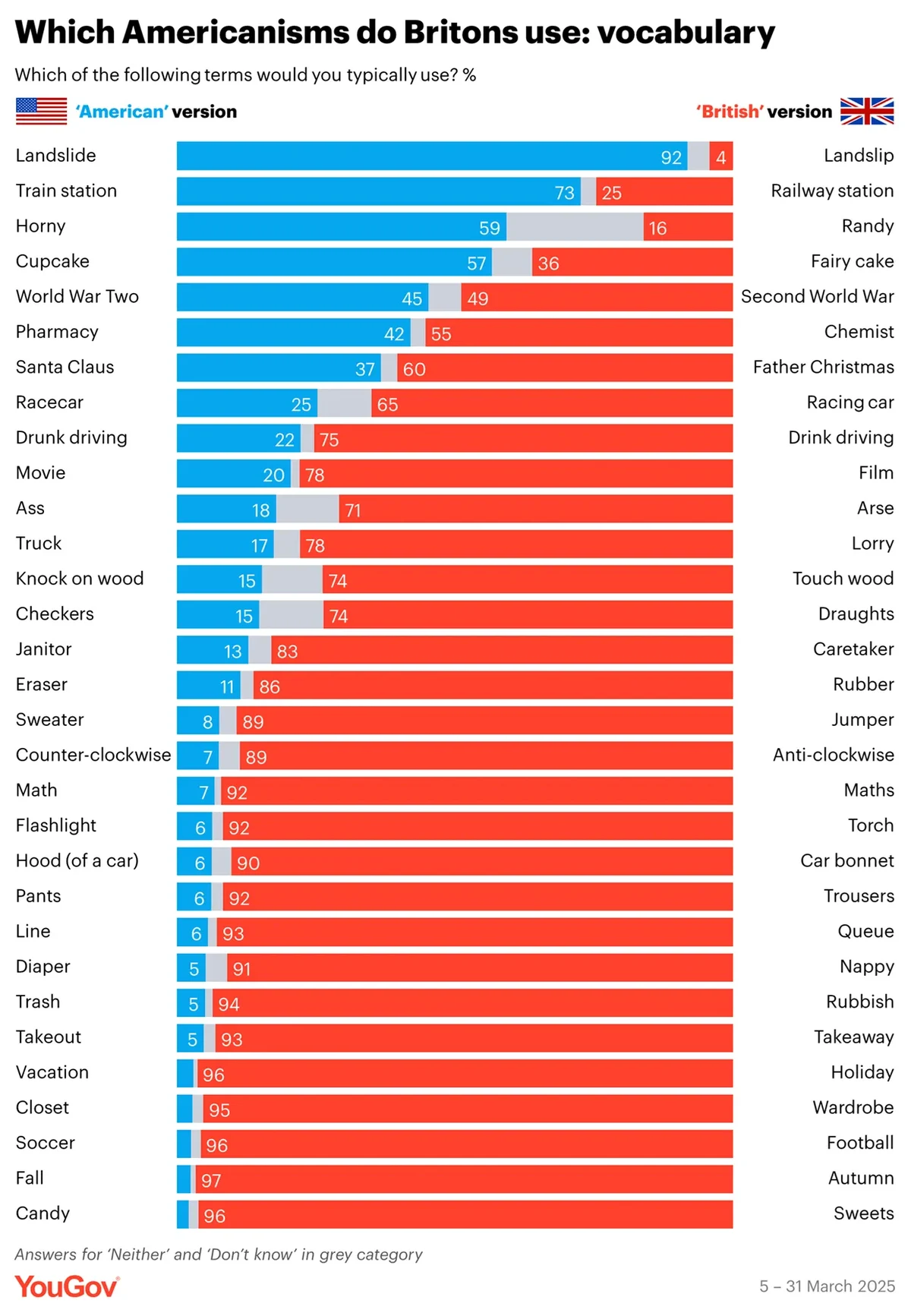
DANIEL: I guess that makes sense. Well, let’s go around and see what’s going on in England. This was a study from YouGov, study of British people. The study was looking at did they do the American thing, or did they do the British thing? And the ones where people most often did the American thing were the following, landslide, 92% versus… Does anyone know what the British version of a landslide is?
HEDVIG: Landslide? I don’t know.
BEN: A Pete shift? I don’t know.
DANIEL: It’s a landslip. That one’s on the way out for sure.
HEDVIG: Oh, my god. I just don’t think my husband would ever say landslip. He’s British.
DANIEL: Okay, well.
BEN: He’s not old enough.
DANIEL: Then, he’s one of the 92%.
HEDVIG: Notes for Steve.
DANIEL: What about horny versus randy? Does that-?
BEN: Ooh.
DANIEL: Yeah, that one.
BEN: Horny must be bigger, surely.
DANIEL: Horny is bigger, 59% to 16% randy. The rest, who knows? Now, zee and zed. In England, zee is 12%. 77% say zed, interesting. Or at least they claim that they say zed.
BEN: Oh, yeah, true.
DANIEL: Mm-hmm. The expressions least likely to skew American, soccer, 96%, to football. Fall, 97% compared to autumn. And candy… Oh, sorry, yeah, they’re skewing. They’re saying football, autumn and sweets instead of candy. But younger people are using Americanisms more. And then, Magistra Annie, who is not with us because North America. There was a study here, a link on the show notes for this episode. If you are 55 plus, 79% likely to say zed. But if you’re 30 to 54, down to 57% likely to say zed. And if you’re under 30, only 39% likely to say zed, so there is definitely a drop-off.
BEN: It’s shifting.
DANIEL: Yeah, it is. If you ask the people the same question, 1972, it’s going to be about 70% zed across the board. And what about Australia? I haven’t found any good survey results for Australia, but Ben, do you get a sense?
BEN: I think we must be ahead of the curve that you just described. If I had to guess, I would say that we are saying zee more than Britain would be, and probably in each of those chunks. Not by heaps, though, probably like maybe a 5% bump in each of the demographic cohorts.
DANIEL: Mm. Okay, I have had occasion to ask this to various audiences, and when it’s an older audience, it’s pretty uniformly zed. And my uni students, pretty uniformly zee.
BEN: I feel like surveys are a bad way. You alluded to it earlier. I reckon espoused adherence and actual adherence would be different for sure.
DANIEL: I think you are definitely right.
BEN: Especially in a group. A group of old Australians where you’re just in a room and you’re like, “Who says zee?” No one’s fucking putting their hand up for that. Shit, no none is going to be like, “I, sir, say zee.”
HEDVIG: I think this is very important because I think people are aware of the zee/zed thing. I have a friend who really cares about the Oxford comma. And the other day, I tried her on, like, I am taller than… She is taller than, is it I or me? And she was like, “Oh, me.” And I was like, “Okay. A lot of prescriptivist says I.” She’s like, “Oh, I’m a prescriptivist. I should say I.” And I’m like, she wasn’t even aware of it.
DANIEL: That’s not the purpose of this.
HEDVIG: Right? She just like. She’s like, “Ah, I didn’t know that’s the more correct one. I should start doing that.” And I’m like, “No, no, no. I’m trying to illustrate this thing but like you’re not…”
DANIEL: But it was too late.
HEDVIG: And she was like, “Oh, okay, well, I better change.” So…
DANIEL: Mm-hmm. So, that’ll be interesting to watch that rolling across. By the way, the reason we have zee instead of zed, well, it’s because of that song. There’s a very strong tendency for that to happen. But there are other names for that letter, including izzard, which I think is something like S hard, or just zard. I guess…
BEN: Wow.
DANIEL: …you can find people from a long time ago who said, let’s see, izzard from 1669, okay. You can’t find those old people. But izzard, archaic and dialectic from the 1700s.
BEN: I’ve got a fun, really obscure Related or Not now, izzard and gizzard.
DANIEL: I love it. Let’s throw it in.
BEN: [LAUGHS]
DANIEL: If I remember. Oh, by the way, since PharaohKatt is mentioning, “My mom taught me a version of the A-B-C song which has zed slant rhyme with M.” Interesting.
BEN: M?
DANIEL: M?
BEN: Zem?
DANIEL: Like the letter, M? I guess M comes at… M is letter 13. Z is 26. I don’t know. I like, the wiggles are W, X, Y, zed or zee, so they managed to work them both in.
BEN: Fence sitters. Take a side, ya pansies.
DANIEL: And then, we know about the band, Regurgitator, how they did a foray into children’s music.
BEN: I did not know that.
DANIEL: Yeah, that’s interesting.
HEDVIG: No.
BEN: Oh, that’s fun.
DANIEL: They did their own alphabet song, and it was “W, X, Y, and zed. I said A,” and then back to A. So, I thought that was rather neat. Okay, cool.
HEDVIG: Can I chime in a short other languages thing?
DANIEL: Hedvig. Please.
HEDVIG: This letter occurs in writing systems for other languages, and you often find something like säta or zed or sometimes zee. So, I think that the American and British one are… They’re all cognates, right? So, it’s just whether you have dropped it. So, a lot of other languages have a T at the end.
BEN: Oh, the T to the D. Yeah.
HEDVIG: British has D at the end, and then American drops even the D. But there are other languages that also drop it. So, I think Portuguese, it’s ze. In Swedish, it’s säta. Danish is zed. Yeah, a lot have zed, something like that. Or even if you’re adventurous, you can even have a vowel after that.
DANIEL: Is it the last letter in those alphabets or not?
HEDVIG: Not necessarily. Not in any of the Scandi ones. We put our own homemade ones last.
BEN: Oh, your funky vowels?
HEDVIG: Yeah. That’s why it’s very… All this like A to zed, I’m like, you’re almost there.
DANIEL: It’s A to Ä.
BEN: Now I’ve got a, I mean, burning question. Do you follow that in terms of alphabetical order? So, does A with an umlaut come after zed, if you are organising people alphabetically by last name?
HEDVIG: Of course, yes.
BEN: Oh, okay. That of course to me, like that’s just… [LAUGHS]
HEDVIG: It takes me effort to remember that A and Ä share something in common.
BEN: Right. Despite the fact that they’re obviously vowels.
HEDVIG: Well, it’s like telling you that, like, “Oh, an M is an N with an extra leg,”
BEN: Which, to be fair, is exactly how I conceive of it anyway.
DANIEL: What?
HEDVIG: Okay.
BEN: Well, because mm and nn, they’re like similar mouth stuff, and they’re right next to each other in the alphabet.
DANIEL: They’re both nasals.
BEN: Yeah, exactly.
HEDVIG: Yeah.
BEN: Anyway, sorry, that was just really interesting to me. So, you’ve got just like a whole bunch of vowels at the end of the Alphabet. Does that sound funny, when you do the alphabet? Do you just end up by going like [ONOMATOPOEIA]
HEDVIG: Ae-o or… Now you got me all, because they do it differently. Norwegian does it differently as well, Å is the last one. It’s like omega, that’s in Greek, so it’s like all [UNINTELLIGIBLE 00:26:04] is the last.
BEN: I just love the fact that all of the Scandi alphabet songs would just finish like in a sing-songy classroom A-B-X-Y-Z [ONOMATOPOEIA]
HEDVIG: Æ Ø Å.
DANIEL: [ONOMATOPOEIA]
HEDVIG: Æ Ø Å. Yeah, it’s easy.
DANIEL: Yep. There you go.
BEN: You’re right. Yeah, it’s great. Moving on.
DITTA: Can I say something about…
BEN: Oh, Ditta. Ditta’s got a…
DANIEL: Ditta.
DITTA: It was just about the… Because the Danish alphabet song, it just actually squishes a lot of it together, so it gets the Æ Ø Å, and then it actually goes on to mention how many letters are in the alphabet. And that becomes a problem now because we have so many English load words, so it doesn’t usually include the W. So, it says there are 28 letters, but then all the kids nowadays, even me when I was a kid, it’s like but what about the W that we know exists and where does that fit?
BEN: I love the idea that the Danish alphabet song now finishes with a little coda that’s just like, “And a fuzzy indeterminate number of letters.”
DITTA: Maybe when I was a kid I actually tried to see if I could make up my own version that fit better, that Ill include…
BEN: Well, that’s what we’re doing today for English, I think. Aren’t we, Daniel? Aren’t we teaching English today?
DANIEL: No, not quite.
BEN: Ah, dude.
DANIEL: Something else. Thank you, Dieta. Let’s hear from Diego. We got a story from… I think we have time for one from Diego. Hi, Diego. Great to see you.
DIEGO: Hey, great to be here. Yes, so, looks like fairly recently the OED, the Oxford English Dictionary, added 66 new Spanish words to the dictionary as part of quarterly updates.
BEN: Represent.
DIEGO: So, it includes words like órale, güey, and boricua. So now, there’s over 2,000 words of Spanish origin in the OED. And this update draws particularly from the largest Hispanic US, Spanish-speaking community. So that’s Mexican Americans, Cuban Americans and Puerto Rican Americans. So yeah, the list just keeps on getting longer.
DANIEL: Rad. But now I’m going to need you to tell me what those three words were again and define them.
DIEGO: I can’t. I don’t speak any of those varieties. My family is from Argentina, but growing up in California, I definitely have learned a lot of other dialects of Spanish. So, órale is pretty much like wow or okay or like go on, go for it. I’m pretty sure that’s Mexican Spanish. Just like güey, which is like guy, man, dude pretty much. And then, boricua is what Puerto Ricans kind of used to call themselves, comes from the Taino or the Indigenous people to the island.
BEN: Ooh.
HEDVIG: Nice.
DANIEL: Wow.
DIEGO: Yeah. But a lot of the words are food items too. A lot of food items being added. [LAUGHS]
DANIEL: That always seems to be the way, doesn’t it?
BEN: Yes.
DANIEL: Mmm.
DIEGO: Yeah.
DANIEL: Well, you know what, Diego? I just like to thank you for all these stories that you bring, because every once in a while, you’ll just drop a gigantic load of stories on us in the Discord, and it’s really fun to sort of go through them. And of course, we do our Diego shows at least once a year, don’t we?
DIEGO: Yeah, yeah. My pleasure.
HEDVIG: Yeah. Can I ask about the new words? Because Spanish has letters that English doesn’t have, like the Ñ.
DIEGO: Right.
DANIEL: And Ë with the diaresis, as in Güey. [CROSSTALK]
HEDVIG: So, number one question, in the Spanish alphabet, do you say… No, I’m not very good at it? Am I…
DANIEL: Eñe.
DIEGO: Eñe. So, I would say a few years ago, they were still counting the CH and the LL and the eñe as their own letters. Nowadays, I think, counting them as digraphs, nowadays, I don’t think they count the CH or the LL or the LR for that matter, as their own letters. It’s been a while since I’ve seen what the official ruling is.
DANIEL: Wow. No more erré? That seems useful. Gosh.
DIEGO: Yeah. Just because they’re like… and you can just say LL, RR, but in terms of an alphabet song, I think they’re being dropped. They used to be like a, be, ce, de…
HEDVIG: That’s kind of fair because that’s true for the Scandi ones as well. The SK combination is a different phoneme, but we don’t say it separately in the alphabet song.
DANIEL: Mm. Yeah.
HEDVIG: If you can make it up. But if it’s like the Ñ, then I… Anyway, thank you very much, Diego.
DANIEL: Thank you, Diego. That’s great. And now, it’s time for Related or Not. And it’s time for me to share a song. Let me just make sure.
BEN: Oh, is it a fresh one? Do we have a fresh hit?
DANIEL: This one was generated once again by Adam, our friend, Adam, with Suno AI. Let’s hear it.
[LATEST RELATED OR NOT THEME]
DANIEL: Thank you.
BEN: Who needs Coachella? That’s what I want to know. Not me, that’s for sure.
DANIEL: Thanks, Adam, for that one. All right, our first one comes from me. It’s callous, meaning unfeeling. How could you be so callous? And callous, hardened skin. Now, you can vote right now, but I don’t think you can change it after you voted. So, does anyone want to listen to us gassing on about it before you make your vote? Should I start?
HEDVIG: I don’t even because I feel like I know this.
DANIEL: Yeah?
BEN: I have a feeling that it has nothing to do with linguistics and is entirely to do with Daniel Midgley psychology.
DANIEL: Now, you know that I arrive… These things arise for me just when I don’t know the answer, and I haven’t gone to any lists or anything. Comes to me in my life sometimes from my daughters. They’re like, “Dad, what about these words?”
HEDVIG: Yeah, they did for me too.
DANIEL: …I’m like, “Damn.”
HEDVIG: And then sometimes, I send them to Daniel.
BEN: I think this is a red herring.
DANIEL: Okay.
BEN: I feel like this is one that looks so obviously related.
DANIEL: I’m never playing.
BEN: Yet not related.
DANIEL: I’m never playing you.
BEN: You liar. [LAUGHS]
DANIEL: That’s our audience.
BEN: Yeah, true.
DANIEL: They might. They definitely would. Well, okay, but I want some linguistic reasons, not psychology based. Is it just vibes? Come on, give me a non-vibes answer.
BEN: A non-vibes answer. Oh, look, the vibes answer is that it would be thoroughly related.
DANIEL: Mm-hmm.
HEDVIG: Yeah, just unfeeling and hardened skinned, I don’t know, like…
BEN: Yeah, like it’s…
HEDVIG: If you have harder skin, you feel less. I don’t… it’s…
BEN: Definitely.
HEDVIG: [LAUGHS] I don’t know how to say it.
BEN: You want calluses when you shovel hay or whatever, right? You want them to form so that your hands stop hurting. Yeah, from a purely semantic point of view, it just seems… But again, this is why I think it’s not because it’s so obviously yes that it’s no.
DANIEL: Okay, okay. My guess was no. I thought callus looked really, really Latin, but callous with an O-U-S looks French. And who knows what happened along the way?
BEN: Good news. Latin and French, entirely unrelated languages.
DANIEL: Ah, I know.
HEDVIG: Have you met the fifth… Is it the fifth declension in Latin that ends with -ous like manous, etc.?
DANIEL: Yes, I have. And I failed to memorise it.
BEN: [LAUGHS] I remember it now that you brought it up.
DANIEL: Why are you bringing back this memory for me? Are you saying this is relevant?
HEDVIG: I’m just saying -ous endings occur in Latin.
DANIEL: They do. They do. They do. Well, that’s what I mean. I mean, the -ous ending here is… I think the hard skin is definitely Latin, but I said no. So, Ben says no for…
BEN: I did say no.
DANIEL: Yep. Out of spite.
BEN: For psychological gamified reasons only.
DANIEL: That’s it. I said no for linguistic reasons. Hedvig, what was your answer?
HEDVIG: I said yes.
DANIEL: All right.
HEDVIG: I don’t understand the question.
DANIEL: It’s time to vote. Done. Let’s share the results. You said 60% related, [CHUCKLES] 40% not related. If you thought… If you were one of the not related, did you think that were messing with you?
BEN: Yes, 100%.
DANIEL: Put it in chat. Put it in chat.
BEN: Yes. Definitely, yes.
DANIEL: Okay, time for the answer. Oh, they’re so related. They’re extremely related. It’s simple as that. Latin, callus, the hard skin just is a Latin word, callum, hard skin. And that’s exactly where callous, unfeeling, comes from. Etymonline says the figurative sense of unfeeling was in English by the 1670s.
BEN: Okay. It’s still pretty old word.
DANIEL: It’s a pretty old word, but it took a really long time for us to get that unfeeling meaning. Okay, cool. Now, let’s go to the second one.
HEDVIG: It’s a valuable trait in Crusader kings.
BEN: [LAUGHS]
DANIEL: Why? What are you required to do?
HEDVIG: If you have the callous personality trait or… Well, if you have the callous personality traits, you don’t mind being cruel to people, which, to be fair, when I play, it is actually a problem because I want to be nice to people, but then I have to be like, “Oh, but I’m callous.” And then, I get a penalty for acting against my personality.
BEN: I have spent my entire gaming life saying to myself at the start of any kind of game with role-playing elements, like, “This game will be the game that I am a bastard. I’m going to be out there for myself. I’m going to screw people over.” 30 minutes of gameplay into that, and I’m like, “Oh, look, a puppy. I’ll help him.”
HEDVIG: Yeah, yeah. Or like, it would be advantageous for me to murder my nephew, but no.
BEN: Who could do that? Okay, Daniel, what’s the next?
DANIEL: I raised him from a whelp. This one is from Eleanor, who says “Hello. Greetings from the UK from a former linguistics student and current linguistics geek. I’ve been enjoying your podcast for years, having stumbled upon it, looking for podcasts on minority and endangered languages. Would love more content related to that. Here’s a Related or Not. Testament, test, and testicle.”
BEN: Okay, okay, okay.
DANIEL: “Thank you for the entertainment and language geekery, Eleanor.” So, you’ve got five choices. They’re all related, none of them related. Testament is the odd one out. Test is the odd one out. And testicle is the odd one out.
BEN: I have submitted answer straight out of the gate, bam, but I’m now thoroughly doubting myself.
HEDVIG: You can all agree that -icle is small?
DANIEL: Yes. Okay. Well, is it?
HEDVIG: Popsicle. Icicle. It’s long. No, wait. Testicles aren’t long. They’re…
BEN: Well, I mean, like on a hot… Anyway…
HEDVIG: Right, on a hot day, maybe they are longer than otherwise.
DANIEL: The funny thing about icicle was that an icle was an icicle. So, when you say it’s an ice-icle… I’m sure Heddwen knows this one. No? Oh, I thought I read this on your news thing. Yeah, so an icicle is actually an icy-ice thing. It’s a double.
BEN: Okay, so I’ve got…
HEDVIG: Oh, what is a testicle?
BEN: I’ve got a thing to throw in here. Yeah, what is a testicle?
DANIEL: What is a testicle?
BEN: I’m wondering if the end of testicle is more related to article than it is to icicle potentially.
DANIEL: Okay, but we’re not really worried about that.
BEN: No. I know, I know, I know.
DANIEL: I’m happy to say that -icle is probably a diminutive. Sorry, guys.
BEN: Okay. So, my idea here was that test is the odd one out because I’m sure a lot of people in this room have heard that great pub trivia note that we called them testicles because you would stake your testimony in the days of Rome upon your balls. I feel so strongly about this, may you take my nether regions from me, should I be wrong or vice versa.
DANIEL: Or you had to grab somebody’s balls when you were testifying or something.
BEN: So, either we call them testicles because we testified, or we call it testify because we were putting our testicles on the chopping block kind of thing.
HEDVIG: So, women could just lie their asses off.
DANIEL: Hey, women can have big testicle energy.
BEN: My understanding was… My extremely limited historical understanding was that Rome did not necessarily feature a lot of women of power.
HEDVIG: I bet you should watch HBO Rome, anyway…
[LAUGHTER]
BEN: Notoriously historically accurate account.
HEDVIG: Oh, I should rewatch then, anyway.
BEN: So, I thought test was the odd one out for that, but I Immediately after I clicked that button was like, “Wait, is that just a dumb folk etymology that I’ve believed my entire life for reason? I bet it is.” [LAUGHS]
DANIEL: We got 15 votes, and that’s as many as we had last time. Hedvig, your answer, please. And then, I’ll give mine.
HEDVIG: Based on Ben’s, I was going to say they’re all related, because I feel like putting your testicles on a chopping block is a test. And then, we go to test.
BEN: That’s a test, you’re right.
DANIEL: All right, you found the… Yeah, you found the thing. I said all related as well kind of for the same reason. I thought, “Well, I can see a unifying sense between them.” Okay, I am going to… We’ve got a lot of votes here. Let’s close this off. I’m going to again…
BEN: What was the breakdown?
DANIEL: The breakdown, nobody said testament was the odd one out. Everyone thought that… A lot of people thought that testicle is the odd one out. That was the most common at 38%. And they’re all related, second most common at 31%. But nobody thought the testament was the odd one out. All right, the answer, test is the odd one out. Okay.
HEDVIG: [GASPS]
BEN: Get amongst it.
HEDVIG: 25% of people were right.
DANIEL: Yep. Nice going.
BEN: I am in good company.
DANIEL: Testament and testicle both come from probably testis, meaning witness. The unifying sense for testicle is, and this is according to Barnhart, it’s a testimony or a testament to one’s manliness or one’s male virility.
BEN: Okay.
DANIEL: Okay. Whereas test comes from Latin testum, which was an earthen pot. You see, time was when you did metallurgy, you put things in a pot, and that was a testum. That’s where you tested the materials you were working with. So over time, the meaning jumped from the name of the pot to the name of the trial, and that was a test. So…
BEN: Whoa.
DANIEL: While they might be, ain’t none of them related, it’s possible that we’ll come to that eventually, but right now, as far as I can tell, testament and testicle are usually regarded as related, probably.
BEN: Can I ask then, Daniel?
DANIEL: Yes.
BEN: By the etymology of test, were the Romans using test in the sense that were using it now? So, they started with testums, and then they were like, “Oh, we’ll just… when you test things, this is what it is.” And if so, does that mean test is like a proper ancient word?
DANIEL: It does. I mean, what is ancient? We have a lot of Latin words, but yes, it does go back to Latin. Oh, by the way.
BEN: But used in exactly the same way, right? T-E-S-T, like test?
HEDVIG: Yeah. He’s asking if the testum part to abstract this is a test happened in Latin, like Mid French or like when?
DANIEL: I could check that by going to Oxford, but I feel…
BEN: No, no, no. It’s okay.
DANIEL: …I feel like moving it along. Oh, also, that story about testifying with your hand on somebody’s balls, groundless modern inventions according to Etymonline.
BEN: Yeah, okay. But not a true folk etymology though, right? As in, they are related linguistically, testicle and testament.
DANIEL: It seems that way.
BEN: Yeah, okay. But the whole like, “I stake my balls on it, sir,” that’s the puppycock.
DANIEL: Thank you to Eleanor for that one. Now, this one involves a bit of a Latin root knowledge. The Latin root mit or mis means send, as in transmission or transmit. Which one of these English words is using the M-I-T, the mit root from Latin. Is it hermit, limit, omit, or vomit?
HEDVIG: And only one of them is what you’re claiming?
DANIEL: And only one of them actually takes part in that mit or mis Latin root, but which one?
BEN: Okay. Go ahead.
HEDVIG: Well, hermit has to do with Hermes, the god. I don’t know why it ends with -it because he’s Hermes, but…
DANIEL: Could it be that Latin thing like exit or he leaves? Just a guess.
HEDVIG: There must be like an agentive or something -it ending or something, the persons who follow Hermes are hermits somehow.
DANIEL: Mm-hmm.
HEDVIG: Vomit, if I remember correctly, has first to do with people exiting an arena, right?
DANIEL: Oh, the vomitorium.
BEN: The vomitorium.
HEDVIG: Yeah, but that is still go out, but it’s not really send.
BEN: I picked that because I figured from the building, when you… It got its name from people going out of the building.
HEDVIG: Uh-huh. But you’re not sending them out, they’re going out.
BEN: Well, I feel like those two concepts are semantically close enough. I’m calling it the same.
DANIEL: They could spew forth, you know.
HEDVIG: I think it’s limit.
BEN: Okay.
DANIEL: Limit? M’kay.
BEN: Interesting.
DANIEL: Yeah, very interesting. I said vomit. I think that’s the best example I can think of sending something out into the world. Okay, I need you to vote. So, we’ve got… Okay, we’ve got nothing but I think we’re going to end this poll, three, two, one, doot, all right. Screenshot for the video and share. Here’s what everybody said. Most people said vomit.
BEN: Oh, yeah.
DANIEL: Mm. Omit was the second most likely at 19%. 69% for vomit, 19% for omit, permit and limit, one person picked those at 6%. The correct answer, well, it wasn’t vomit.
BEN: Oh.
DANIEL: Vomit was its own word, frequentative of Latin, vomere, which goes back to Proto-Indo-European *wemh-, to spit or to vomit. And I’m sure that the vomitorium, vomit doesn’t come from the vomitorium. It’s the other way around. [CROSSTALK]
BEN: It’s the other way around. Okay, gotcha.
DANIEL: Vomit to come forward.
BEN: Okay, well, now what needs to happen, is it needs to not be limit so Hedvig doesn’t win over me.
DANIEL: Well, it’s not limit.
BEN: Okay, good.
DANIEL: That one is probably related to limen or liminal, like a boundary or a threshold or something like that.
BEN: Oh, is it omit?
DANIEL: It’s omit. If you said omit, you were correct. So, this is omittere, to let go or to send. And O, the O, it’s ob. Etymonline, says here perhaps intensive. Like you’re not just sending, you’re sending sending, like there you go. So, omit means to let something go. To really, really let it go. And then finally, hermit was from a Greek word, erēmos, which is just the word for a desolate waste, which is where you’re likely to find a hermit, if there are any around.
BEN: I wish O Tim had joined us in this chat so we could see another… We were like, “Hey, look, O Tim. The O in omit is doing exactly the same thing. It’s just intensifying the Tim.”
DANIEL: I guess you’re right. Hedvig, you have a concern.
HEDVIG: Also, it’s an anagram.
BEN: Yes, it is.
HEDVIG: What did you say about hermits? Because I’m very confused, because there is a god, Hermes.
DANIEL: Not related.
BEN: I think you might have a… Yeah, folk etymology there as well.
HEDVIG: What?
DANIEL: Mm-hmm. Now, if somebody…
HEDVIG: Because he has very esoteric followers that do weird stuff.
DANIEL: They do. But what’s… So, if anybody could please drop the… Oh, yeah. Yep, solitary, thanks, Diego. But what’s the etymology of the god, Hermes? If somebody could drop that in chat, that’d be awesome.
BEN: Ooh, that’s fun. He was the messenger, right? Was that his role?
DANIEL: The messenger god, the one that sent flowers.
HEDVIG: He was later, and this me, but he was something else bigger before… I can really recommend the Let’s Talk Religion… Yeah, Let’s Talk Religion podcast and YouTube channel. He has a great Hermes episode.
BEN: Okay.
DANIEL: Thanks, John, who says it is of disputed meaning and origin. You never want to hear that, possibly bind or to put together.
BEN: Like, everything that comes after that is just academic version of…
HEDVIG: Also, [UNINTELLIGIBLE 00:47:49] I think Ariaflame is correct.
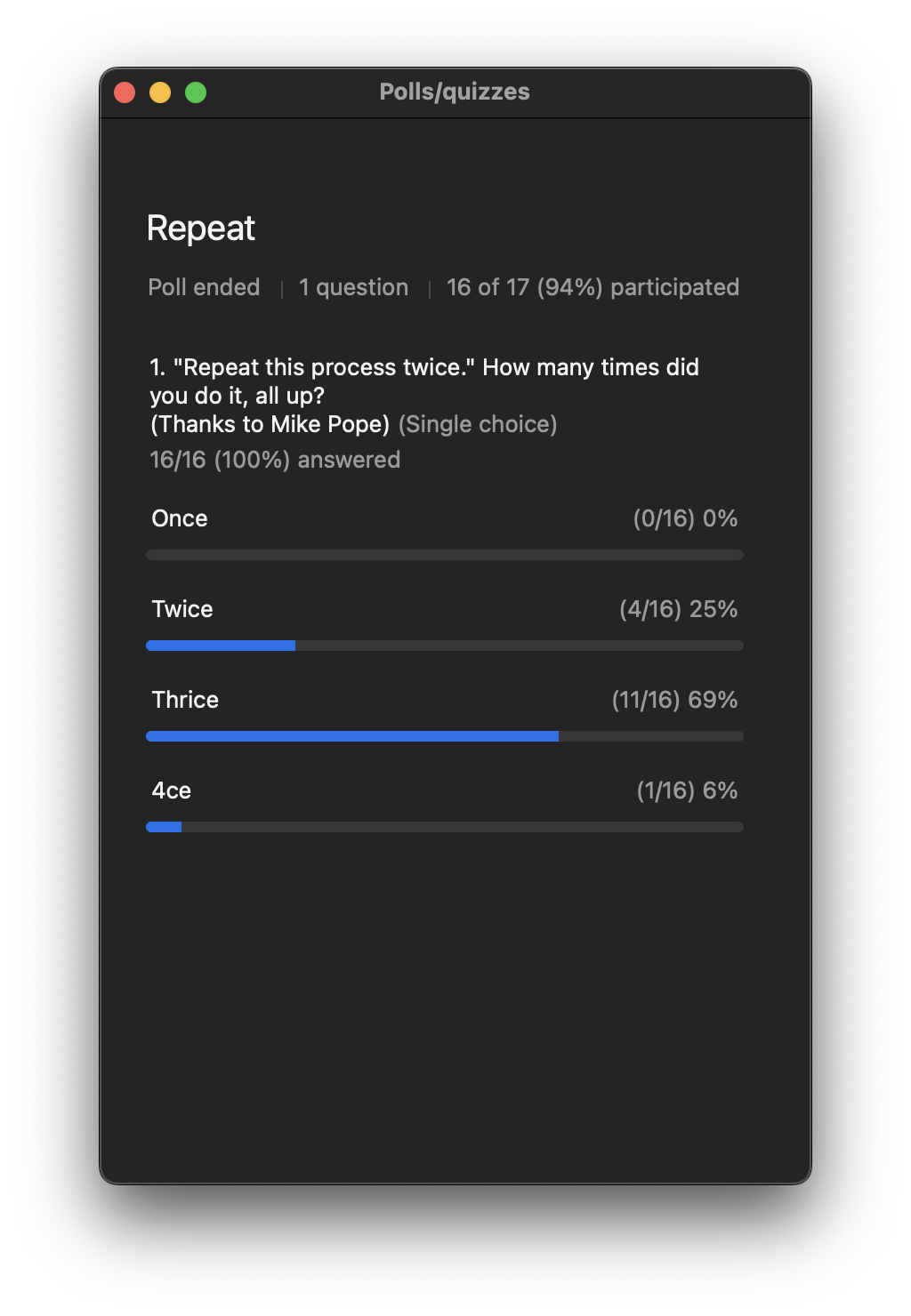
DANIEL: Well, thanks to Eleanor, thanks to Adam for our theme, and thanks to all of you for voting. This was a lot of fun. And I guess I’m just going to keep that poll quiz thing up because now it’s time to vote on all the language problems. And, boy, do we have a few? I’ve been hunting these down and asking people, “Can I use this on the show? Would that be all right?” And so, thanks to everybody who has contributed these. This first one comes to us from Mike Pope. Repeat this process twice. If you repeat a process twice, how many times did you do it all up?
BEN: Oh, right.
DANIEL: You’ve got some instructions. You do a thing and then you repeat it twice. How many times? Once, twice, thrice, or fource? Why do we not have a word for 4’s?
BEN: We probably did back in the day. Well, we do have a word for fource. It just happens to be another word.
DANIEL: So, the argument here is that repeat it twice, the repeat is acting like an intensifier a bit. But then, you could say “No, if you repeat it twice, that means you do it again, so you’ve done it for a third time.”
BEN: I’m actually going with fourths.
DANIEL: Why are you doing that? That was a distractor answer.
BEN: Really? Well, because repeat this process twice. So, if the process is repeated and you do it twice, that’s four times.
DANIEL: It’s like squared. It’s going exponential.
BEN: Yeah. 100%
DANIEL: Oh, my gosh. This reminds me of that computer science joke, “Why did the computer scientists die in the shower?”
HEDVIG: Why did the computer…
DANIEL: The shampoo bottle said, lather, rinse, repeat.
BEN: All right, I thought that was going to be something to do with a cascade failure in there.
DANIEL: Or a fence posting error or something. Okay, does anybody else want to weigh in?
BEN: Okay, there we go. But I want to be clear, although I voted on that, I’m trying to imagine the scenario where a person said something that semantically ambiguous and I’m not able to ask a follow-up question where I go, “Hang on, how many times in total? Can you tell me how many times in total I have to do the thing?”
HEDVIG: This is like when we talked about biweekly. It’s all of these.
BEN: Yeah. Yeah.
HEDVIG: We’re all confused. Have you guys heard about the… Steve told me about a famous forum thread with bodybuilders, try and decide what… If you say that you’re going to exercise every other day, how many minutes do you exercise in a week?
BEN: Oh, okay. Hold on, you’re jumping ahead.
DANIEL: We’re getting there. Okay, I should have put that one next, shouldn’t I? Well, I could do it next.
BEN: You’re in control, Daniel. You can do it.
HEDVIG: You’re in control.
DANIEL: I’ll do it next. Okay, but I think what I’m going to do next is I’m going to end this poll.
BEN: I saw a lot of people nodding.
DANIEL: Okay, so it is thrice. If you repeat it twice, that means you’ve done the whole thing three times. Any arguments?
BEN: So, you do it and then you repeat it twice. I can see the logic there. I do. I concede.
DANIEL: Okay, great. Let’s now do…
BEN: Lord Mortis has accused me of being contrary and I take umbrage, sir.
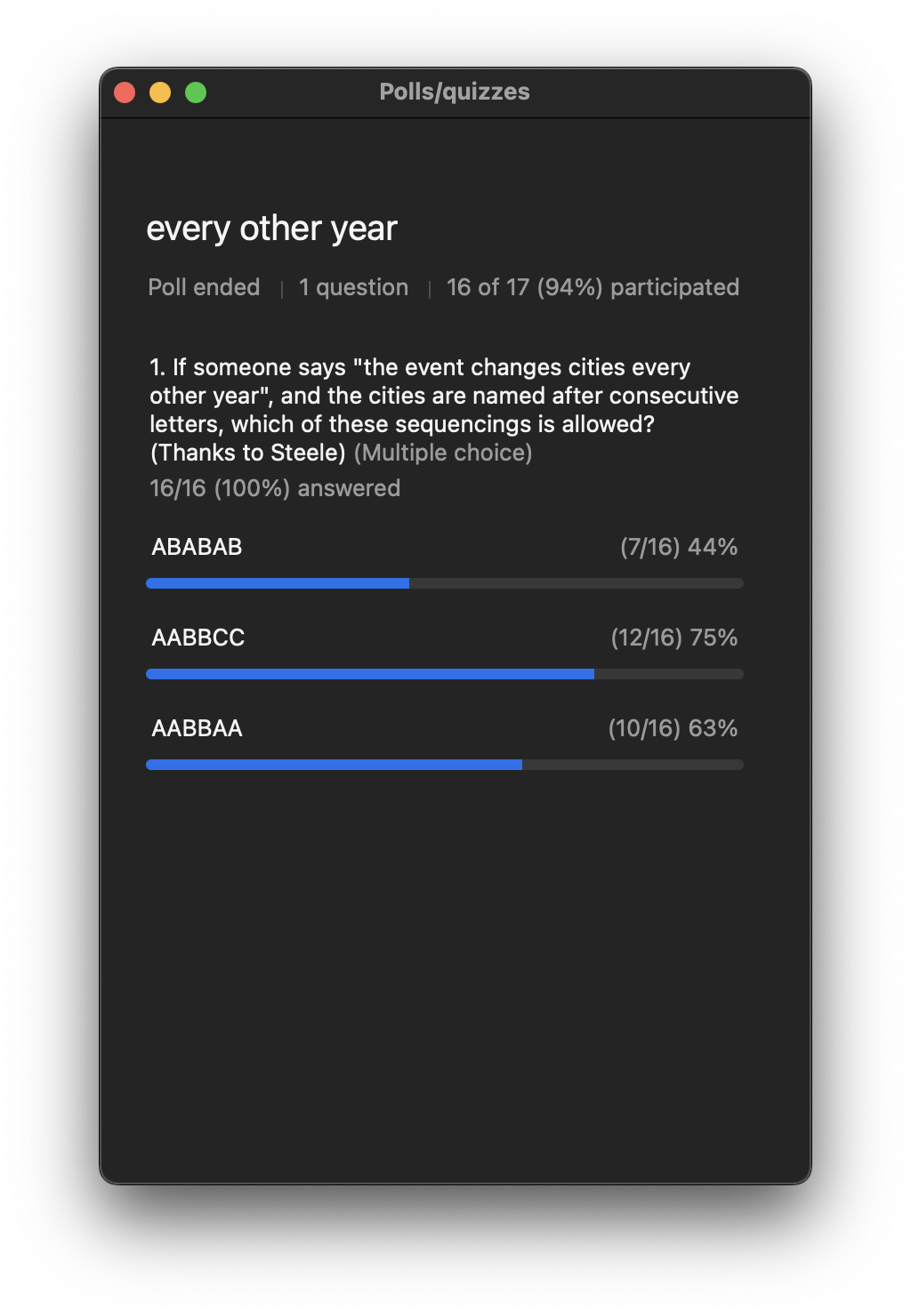
DANIEL: This one comes from Steele. If someone says… Now this one, you can vote for multiple ones. You don’t have to choose just one. You can vote for any that you think are correct. If someone says the event changes cities every other year, and let’s just say that the cities are named after consecutive letters, which of these sequencings is allowed? Does it go city A, city B. City A, city B. City A, city B? Does it go city A, city A? City B, city B? City C, city C? Or can it go city A, city A, City B, city B, City A, city A? Which one of these is possible if you’re saying the event changes cities every other year?
HEDVIG: Oh, and A-B-C, A-B-C, A-B-C-D-E-F-G.
BEN: [LAUGHS]
DANIEL: That would have been possible, but I feel like that’s subsumed under A-B-A-B.
HEDVIG: We’re only doing these.
DANIEL: Yeah, I feel like—So, my first intuition was, well, it changes every other year, that means, this one year, that one year, this one year, that one year, but then… Not possible?
BEN: Mm-hmm. I don’t agree. Well, if it had been that…
DANIEL: So, contrarian.
BEN: …why would you not say it changes every year?
DANIEL: So, but it’s like other.
BEN: It feels like the most obvious way to explain an event shifting cities every calendar year is to say the event changes cities every year. If you have said the event changes cities every other year, it suggests to me that you are deviating from that default system in some way. Now, the way in which you deviate, sir, I have very poor conceptual handholds to direct you, but deviate it does.
DANIEL: Maybe that’s why A-B-C-D-E-F wouldn’t work, because that doesn’t change every other year. But when it changes back from A to B to A to B, there’s something about that other.
BEN: Oh, okay.
DANIEL: It changes cities every year. It changes cities every… What if I said…
BEN: Fringe. I’m calling that fringe.
DANIEL: It is.
HEDVIG: This is where natural language gives out, and this is why people have programming languages and math. Because if you’re at a building site and you try and express any kind of meaning like this, you’re going to try and do it in some sort of standardised format because it’s too likely to be misunderstood. Like, if you asked me how to express this in a programming language, I would have no doubts.
BEN: Yeah, okay.
DANIEL: Okay. Well, I’m going to end this poll, so get your votes in, everybody. Now, the numbers will add up to more than 14. Oh, it’s more than 16. Three, two, one, end. Okay, let’s see. The most acceptable was A-A, B-B, C-C.
HEDVIG: What?
BEN: Yes. Yeah.
DANIEL: Considered the most acceptable. Ben, you feel confident about that. I guess…
BEN: Well, what I’m saying to you is that is the one I clicked on and so I feel good about lots of people agreeing with me, Daniel. That’s all that’s going on there.
DANIEL: How does that differ from A-A, B-B, A-A?
BEN: It doesn’t significantly. But for me, without some sort of signaling that it was changing, only between two cities, if you take the sentence on face value, no further contextual clues, what it’s saying to me is every other year it switches to a new city, full stop.
DANIEL: Mm-hmm. Fascinating. Okay.
BEN: Every second year, because I can’t use the language in the statement.
DANIEL: Okay, these are binding. Now, this next one is a sandwich question, but it’s not the sandwich debate that you might be expecting,
BEN: Because we’ve settled that, obviously.
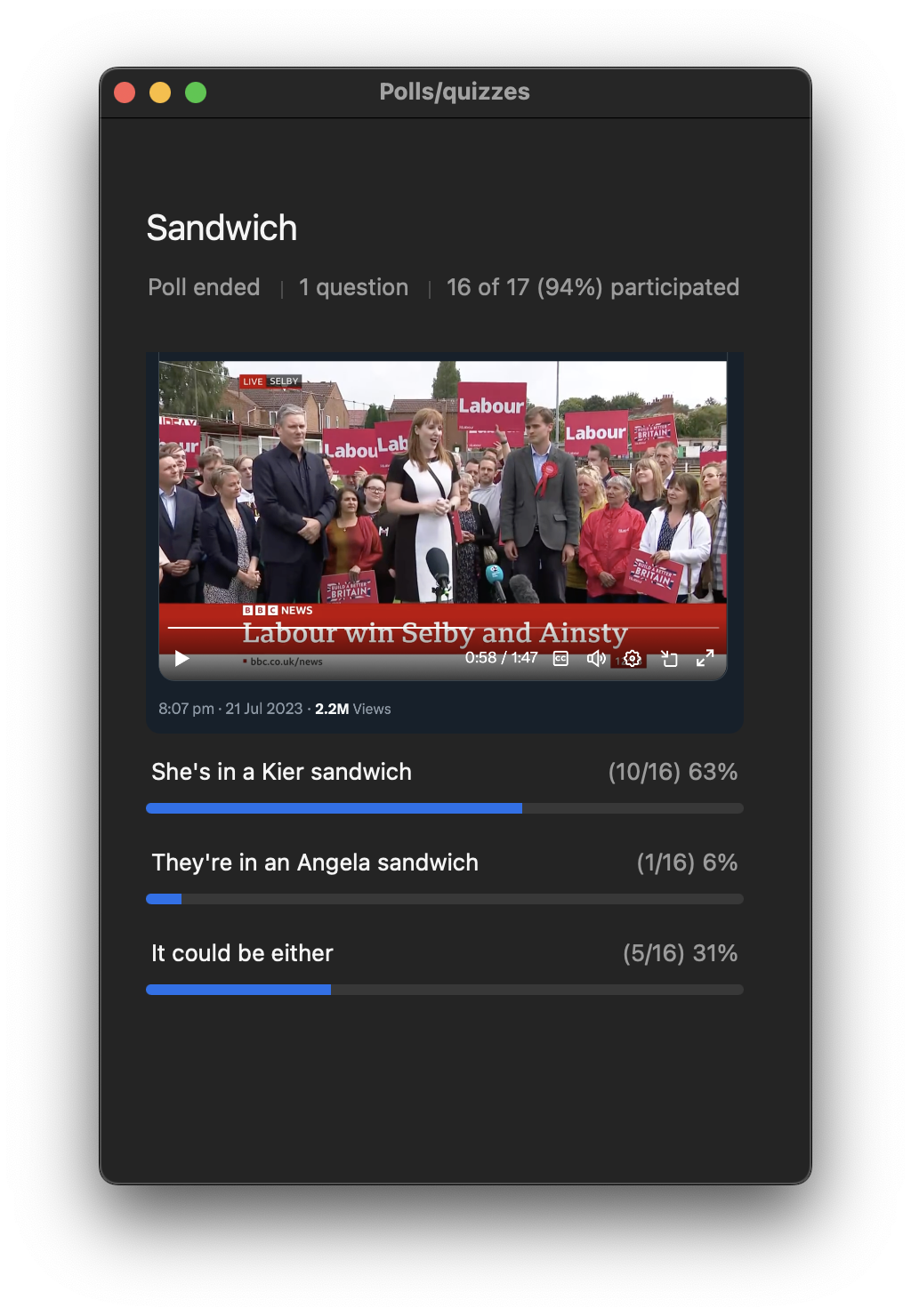
DANIEL: I’ve got a photo here of UK Labor Deputy Leader, Angela Rayner, standing between PM Keir Starmer and MP Keir Mather, member for Selby, and she says, “It’s great to be in a Kier sandwich.” Does that seem…?
BEN: I have a question.
DANIEL: Yes.
BEN: I have never in my life, until encountering the new British PM, encountered the name Kier before ever.
DANIEL: Me neither.
BEN: And yet, there’s a second one in British Parliament.
DANIEL: They made a second one.
BEN: Good Lord.
DANIEL: So, the choices are she’s in a Kier sandwich. The other possibility, they’re in an Angela sandwich.
BEN: Oh.
HEDVIG: Oh, a ham sandwich is named for the thing that is in between, not the bread that’s around, but a rye bread sandwich could be anything in the middle.
DANIEL: A pumpernickel sandwich has bread. Yeah, you’ve made a good point there. The definition of sandwich, does it strike you wrong if we say it’s a Kier sandwich?
BEN: What’s interesting here, I think, is the fact that the metaphor becomes really loosey-goosey when we use it. When we’re talking about it in reference to food, it’s actually quite… I know we’ve talked about what constitutes a sandwich, but when you’re talking about two flat pieces of bread with stuff in the middle, the semantic notion of a sandwich is fairly bolted down, I think, in a lot of ways. And yet, when it comes to applying things that are not a sandwiches. I don’t know about everyone else, but my brain is just like, anytime stuff is between stuff, metaphorically, you can call that a sandwich. And however you want to denote that sandwich, that metaphorical sandwich, eh, it’s all good. When I read this thing and it’s like, “She’s in a Kier sandwich,” I was like, “I completely understand what you’re talking about.”
DANIEL: Yeah, yeah. That makes sense.
HEDVIG: I think that when we talk about food, we’re most interested in the protein and the sauce and the things. So therefore, we say ham sandwich, cheese sandwich, peanut, butter, jelly sandwich, etc. I think that when two people are standing next to us, let’s take the situation where Angela Rayner is just standing next to one of the Kiers, that is not a sandwich, right?
DANIEL: That is not a sandwich.
HEDVIG: That is just them standing next to each other.
BEN: And it would be weird if you were like, “I’m standing in an open face kier sandwich.”
[LAUGHTER]
HEDVIG: That would be very weird. But when the second Kier comes along, it is the Kiers that are making it a sandwich because it’s unusual to have two people that are the same in a group.
BEN: Highly unusual first name, remarkably unusual first name.
HEDVIG: So, we’re picking up on the most important part. So, the thing that makes it a sandwich in this case is the presence of two Kiers, not the presence of Angela. She could be anyone.
DANIEL: Oh, that’s interesting. Yes, yes.
HEDVIG: And the thing that is making most breads is sort of the same, but the thing that makes the difference between sandwiches is the thing that’s in between. So, we’re just picking up on the thing that’s important.
BEN: I would also say that it would not be an Angela sandwich. I don’t think any English speakers would refer to it that way. And for the simple reason that if you were to, you would say, “Angela is being sandwiched by Kiers.”
DANIEL: She is. She is.
BEN: And I think that just speaks to exactly what Hedvig was sort of talking about in terms of how we sort of conceive… So, yeah, I reckon the Angela sandwich thing is just dead wrong.
DANIEL: Well, it’s true that we typically describe sandwiches by what’s in them. Like, if I had a ham sandwich, I wouldn’t expect ham on the outside.
BEN: Food, Daniel, food.
DANIEL: But once you… It’s all good. But once you put all the stuff on, then it’s all in the sandwich. The bread, the fillings, the mustard, the mayonnaise. So, yes, she’s in a Kier sandwich. They’re in a Kier sandwich.
HEDVIG: Lord Mortis.
BEN: [LAUGHS]
DANIEL: I’m going to end this poll. Thank you all. And quick pick.
HEDVIG: Lord Mortis has the… If I had a nickel for every time a politician was named Kier, I would have two nickels, which isn’t a lot, but it’s weird, it happened twice. That is true.
DANIEL: [LAUGHS] Good point.
HEDVIG: I feel like Australians might know Kierans.
DANIEL: Oh, there’s a lot of Kierans, related or not.
BEN: Yeah, yeah, true. Okay.
DANIEL: Most people said, “Yeah, she’s in a Kier sandwich.” The definition of sandwich can include anything that’s prominent. And the Kiers are very prominent because there’s two of them. I will say that when my young one climbs in between her mom and me, she says, “I’m in a mummy and daddy sandwich.” So, this is intuitive for children as well. Prominence once again. Now, let’s go. Ooh, are we…? Oh, we’re getting there. We’re getting there.
Next one is about the word, perfect. And this one comes from Dave Nelson, grammar geek, who said it was okay to use this. Dave is a good follow. “Dear recipe writers, are you sure this is the ‘perfect’ dinner for a busy weeknight? Because I made three of those last week and surely, they…
BEN: Oh.
DANIEL: …can’t ALL have that distinction.” Dave is having a bit of fun. “Which one comes closest to your view about the meaning of ‘perfect’? Many dinners can be the perfect dinner, only one dinner can be ‘the perfect’ dinner, or many dinners can be a perfect dinner, but only one can be ‘the perfect’ dinner.
BEN: Oh, I see. I’ve got strong feelings about this, Daniel.
DANIEL: Oh, would you get very angry about them?
BEN: No, no, not at all. This is me being like the cook of my family for a long, long time. And also just really, really, really enjoying cooking and being in the kitchen and that sort of thing. Many dinners can be the perfect dinner…
DANIEL: Interesting.
BEN: …is my definitive bolted down answer.
DANIEL: The perfect dinner.
HEDVIG: Is that because you have different [UNINTELLIGIBLE 01:00:42] after them?
BEN: Yeah, basically.
HEDVIG: Okay.
BEN: To suggest that there is A situation that A dinner can work for in all instances, regardless of context, is crazy. It’s not possible, which means there must be many perfect dinners for many different situations. So, many dinners can be the perfect dinner depending on the context of when you eat the food. And the great news is we do it like three times a day, unless you’re one of those weird people who eats all your food in one sitting, but three times the amount, which is super bizarre, but I have met them.
HEDVIG: Snake meal.
BEN: Yeah.
DANIEL: Mm-hmm.
HEDVIG: Ben, please consider this question. But every time Daniel has written “dinner – insert for a busy weeknight after.” So, I want you to choose between many dinners can be the perfect dinner for a busy weeknight. Only one dinner can be the perfect dinner for a busy weeknight. And many dinners can be A perfect dinner for a busy weeknight, but only one can be THE perfect dinner for a busy weeknight.
BEN: I suspect what we’ve seen here is a semantic shift on perfect, or at least that’s how it’s working in my head.
DANIEL: Yep.
BEN: I do not think “perfect” means singularly excellent at the exclusion of all other things.
DANIEL: Yep.
BEN: Which is why I’m sticking with many dinners can be the perfect dinner.
DANIEL: Okay, I’m going to end this poll, so get those votes in. Oh, people getting off the fence, here we go.
BEN: Sorry, sorry. That was me. I clicked it and then I hadn’t click, clicked it.
DANIEL: All right.
HEDVIG: Me too. Exactly.
DANIEL: Three, two, one. All right. Okay, most of us would say many dinners can be the perfect dinner, although… that’s 63%. Although closely followed at 31% by many dinners can be A perfect dinner, but only one can be THE perfect dinner. One thing that happens with these supposedly binary on-off adjectives, like, unique, people will give Mark Gibson of the ABC Radio hassle because they’ll say, “It’s very unique.” “No, it can’t be gradable. It’s either unique or it’s not.” But lots of things have been considered. This is a bit of a grammaticalisation path. Things start out as being binary on-off, and then they go towards some sort of continuum. And we have seen this with correct, with true, with wet and dry, with unique. We’ve seen it with…
You can find old grammar guides from the 1800s where people said, colours, you can’t have a thing that’s bluer than any other thing. So, it’s interesting to see perfect continuing this trend. And some people might say, “No, that’s the one thing that can’t go on that continuum,” but nah, that’s how words do…
BEN: What I would suggest here is that this isn’t actually particularly new either. So, famously… Not famously, for certain people of certain sort of persuasions, there’s a fairly famous podcast called More Perfect about the US Supreme Court and that gets its name from, I think, a very old piece of language in American political history of a more perfect union in terms of the birth of America and all that kind of stuff. So, people were gradiating perfect like 200 and something years ago, so, I don’t think it’s particularly revelatory.
DANIEL: I completely forgot about that usage. And yeah, this is not a new thing. Mm, okay, I think we’re down to our last one.
HEDVIG: You can be gradable but still have one being the…
DANIEL: Prototype.
BEN: [LAUGHS] True.
DANIEL: Mmmm. I’m going to think about that one.
HEDVIG: Anyway, anyway.
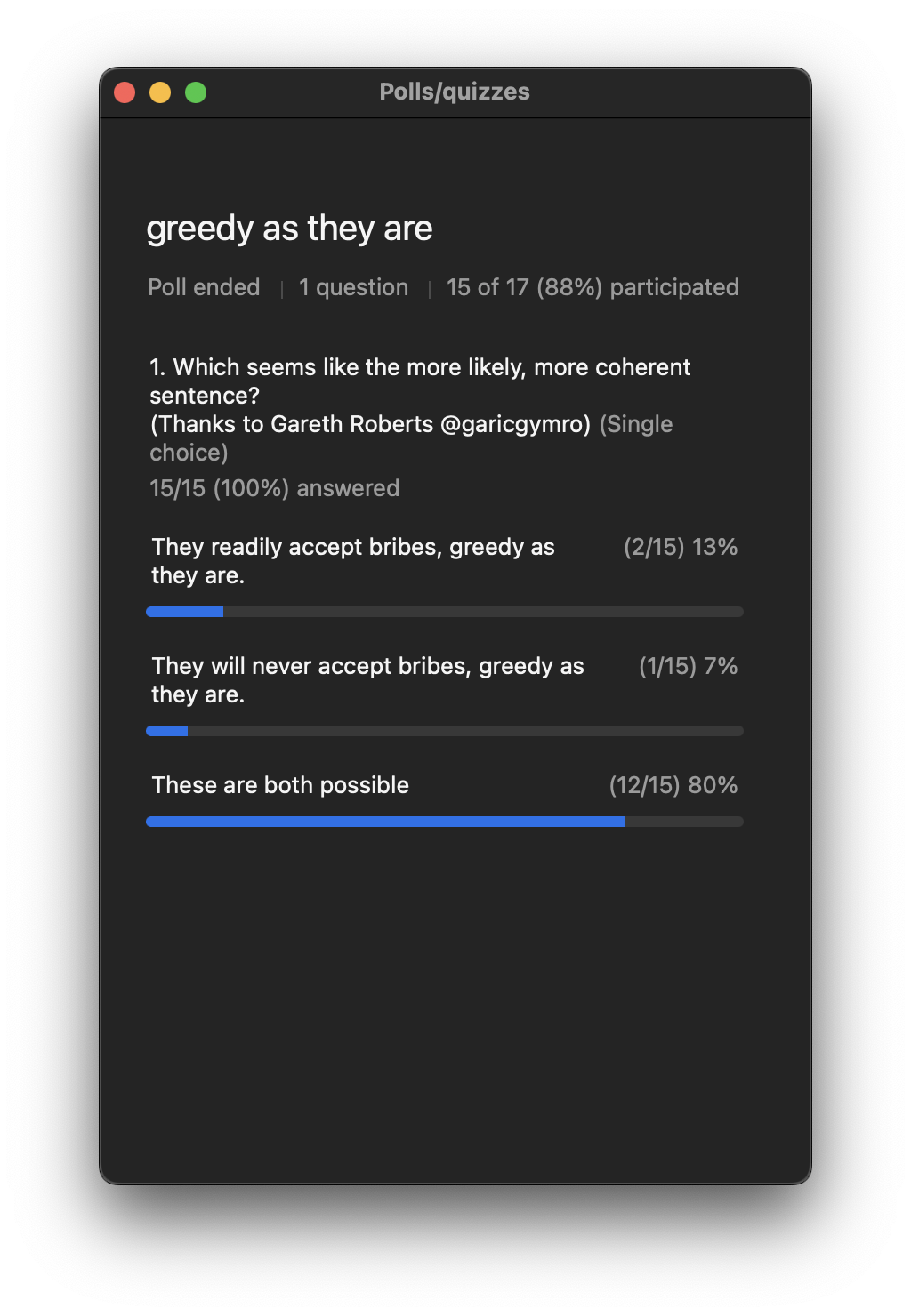
DANIEL: This one comes from Gareth Roberts, which one seems like the more likely, more coherent sentence? They readily accept bribes, greedy as they are. They will never accept bribes, greedy as they are. Or, these are both possible. If you’re not familiar with this construction this might be a little bit tricky. They readily accept bribes. What does “greedy as they are” mean? Does that mean they are greedy? Or does that mean even though they’re greedy, they won’t do the thing?
BEN: Okay, so what we’re sort of looking at here, if I’m understanding right, because the second one immediately read wrong to me, but that’s because I wasn’t understanding the second, like, everything that comes after the comma. They readily accept bribes, comma, or they will never accept bribes comma. And then, the same ending unit, which is greedy as they are. So, one of those two versions is saying because they’re greedy, and the other one is saying they have a level of greediness inherent to them, and the thing that comes before the comma is telling you what that level is, right? So, they will never accept bribes, greedy as they are is a way of saying…
HEDVIG: Despite.
BEN: Yeah. No, as in like they will never accept bribes, greedy as they are, because their level of greediness is very low.
DANIEL: Oh, that’s not my reading at all, at all, at all. I thought…
BEN: Well, then how would that second sentence make any grammatical sense in any other way?
DANIEL: Well, it would be like this. Though they be greedy, they’re not so greedy as to accept bribes. And in fact…
BEN: That’s not what that sentence says because they didn’t use all of the words that you used.
DANIEL: Well, you’re right, it’s a different sentence. And in fact, if I were rewriting this sentence to say, “They’re greedy, but they’re not that greedy,” I would reword the second sentence to, “They will never accept bribes, greedy though they be.” I would just use an adjunctive.
BEN: Right, so you need something that kind of basically says “despite them being greedy.”
DANIEL: Mmm, mmm.
BEN: Okay. But again…
DANIEL: No.
BEN: …that doesn’t say that because it doesn’t have those words.
DANIEL: [LAUGHS] Okay, yeah, we’re talking about this as they are construction. Okay, I’m going to close it off pretty soon to keep things moving. In five, four, three, two, one. Oh, there we go. We got clickers. Great to see ya. Doot. All right, let’s share those results. The most common answer, yeah, they’re both possible. 80% of us said, yeah, I got no problem, say whatever you want. We’ll do the work of sorting it out through context, which is very language actually. We frequently offload the word.
BEN: Metallic taste in my mouth from how much I’ve had to bite my tongue, sir.
DANIEL: [LAUGHS] Surprised that the second one was judged as least acceptable, 7%. Whereas that’s the one that, according to my familiarity with this “as they are” expression, that’s the one that seems to me the most like consonant, but I’m cool with both. I will say that when Gareth did this on his own on Twitter back in the day, it was pretty much deadlocked 36% to 35%, A and B. Mm-hmm.
BEN: I’m just so flabbergasted so many people can be so wrong.
DANIEL: I know.
HEDVIG: I’m just flabbergasted that we all walk around… every time we have these episodes and vote on these things, we have one of these which is like, or it can mean the opposite. And I’m like, “How are we walking around? I’m continuing [CROSSTALK]
BEN: Yeah. How is anyone holding that meaning in their head? How can we see the same world?
HEDVIG: How does scheduling work? How does the stock market…? I don’t know, I think…
BEN: How have we built skyscrapers if we can’t even do this?
HEDVIG: Yes.
DANIEL: It’s amazing.
HEDVIG: And it’s very impressive. And to me, that says that we do so much work that isn’t visible in the linguistic signal of being like, “I heard what came before, I heard what came after. I know Ben. I know what he probably thinks. I’m going to be generous in my interpretation.” And sometimes, we do get it wrong, but generally that helps us so, so, so much, which means we can have a shitty infrastructure that has all of these like… yeah or the opposite. What was that one we had with like the journalists were in the free speech zone, they were… How was it? Do you remember we had this one on another live episode?
BEN: I do not remember this one.
HEDVIG: I think Daniel probably does.
DANIEL: Maybe, but I’m making a poll for you, Hedvig, we’re doing one for you.
HEDVIG: Yes.
DANIEL: All right.
HEDVIG: I asked Daniel if we can make a poll.
DANIEL: Go ahead.
BEN: There we go.
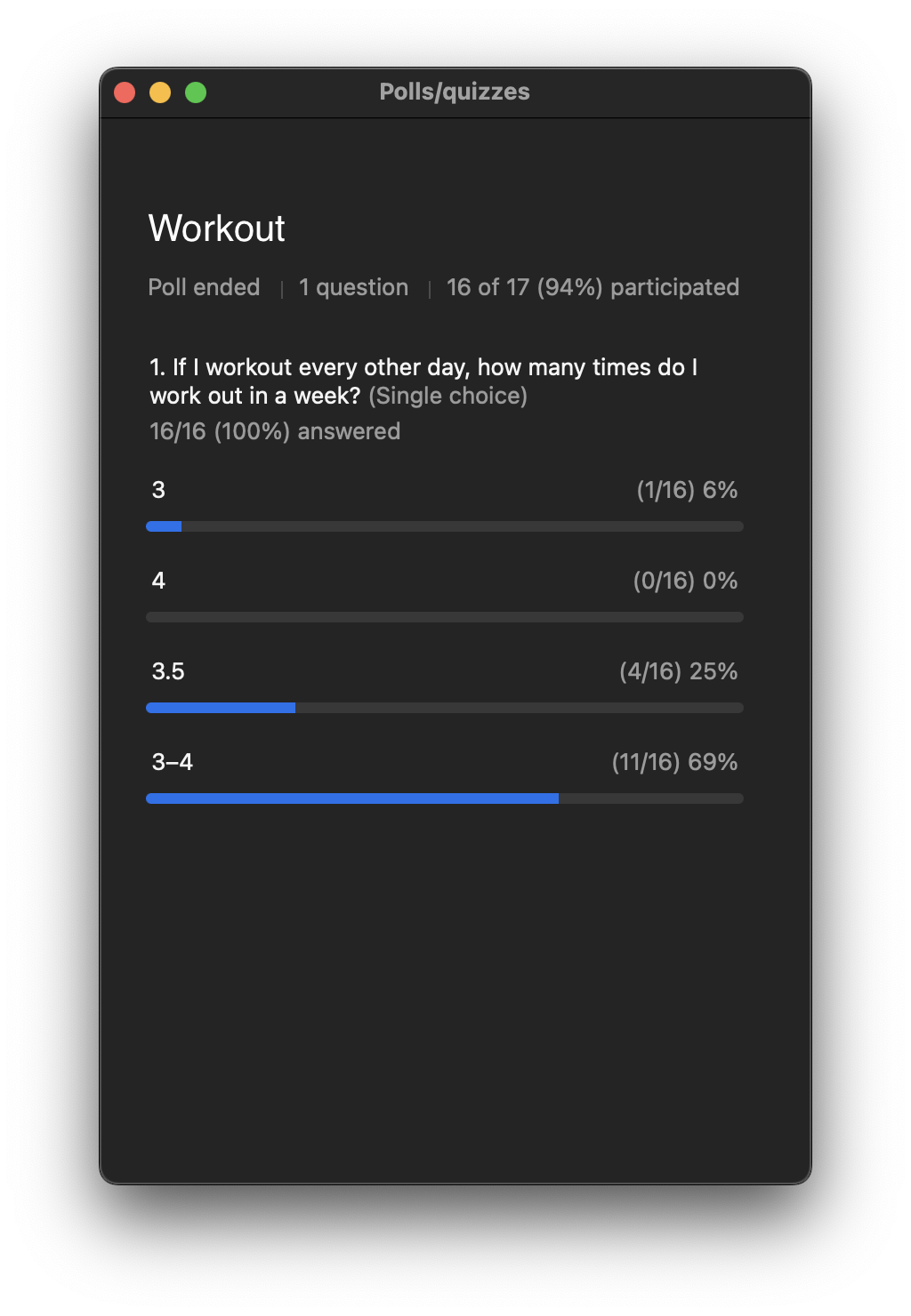
HEDVIG: I heard about this. Bodybuilding.com had a very long, long form thread about how many days there are in a week. And it is very funny because it’s all these bodybuilding people being obsessed about their workout routine and everything and having discussions about language. So, the question is, full body workout every other day. If you do something every other day, how many times in a week do you do it? Do you do it 3, 4, 3.5, or 3 to 4?
BEN: I feel like three to four and three and a half are the same answer in a slightly different guise.
DANIEL: Depends on how hardcore you are.
BEN: Yes. I went with 3.5 using the law of large numbers, right? So, if you exercised every other day for a calendar year, how many times would you have done it per week? 3.5.
HEDVIG: I should tell you some of the nuances of their discussion. One of the discussion points is whether Sunday is a real day. [LAUGHTER] Another one is whether a week actually has seven or eight days, because some people were counting like Sunday to Sunday and made like a week have eight days.
DANIEL: Oh, there’s your fence [UNINTELLIGIBLE 01:10:14] error.
BEN: Does that mean that other weeks have six, like how’s that…?
HEDVIG: Unclear.
BEN: Okay. [LAUGHS]
DANIEL: I think we know what we’re dealing with here. We are talking about… I’m just going to shut that down. No, man, Sunday to Sunday, eight days, count them. [LAUGHS] No, bro.
BEN: Okay.
DANIEL: Okay, I’m ending this. This is fun.
HEDVIG: It has been called the dumbest argument in the history of the internet.
BEN: [LAUGHS] Oh, that is a very low bar to dig under.
DANIEL: Mm, excuse me, but I have searched for the dumbest questions and presented them before you. And if you don’t think we found it yet, I would like to know. So, the most common answer, 69% three to four. The next most common, 3.5, because you’re diligent about working out every single day, alternating every other day, and then you bathe your face in a bowl of ice, and then you eat it, and then you raw dog a flight, and…
BEN: Oh, god. And then, you inhabit the grind set.
DANIEL: That’s right, man.
BEN: Yeah.
HEDVIG: Yeah.
DANIEL: Okay, so what did we learn from this?
HEDVIG: That it’s the most funny.
DANIEL: Were you surprised? Mm-hmm.
HEDVIG: I think it’s funny that weeks are seven days because they don’t need to be. And during the French Revolution, people wanted to take the metric system even further and have ten days in a week and make it all be just metric and beautiful. And I just think it’s funny that we have this leftover seven days because it means that stuff like this, you can’t do… but I mean, a lot of medieval people would say, well, Sunday is the day for rest, it’s not a day when you do stuff. So, in that sense, three is the correct answer because you shouldn’t be working out on Sundays.
DANIEL: Yeah.
HEDVIG: But the question didn’t include that. So, most people said 3.5 or 3 to 4, which I think are all rational answers. No one said four, which makes sense.
BEN: How hard would it be to either remove or add a day of the week? I’ve never considered this before, and I imagine…
HEDVIG: Very, very, very hard.
BEN: …incredibly hard, like, biblically hard.
DANIEL: I have wished for 28-day months. 13 months, 28 days. The calendar just stacked, but seven, seven, seven, seven so that the 15th of the month is always a Sunday, and then…
HEDVIG: Yeah, yeah.
DANIEL: And 13 times 28 gives you 355 days. The last day is not a Monday, it’s not a Tuesday, it’s not anything. It’s just a day. It’s a massive holiday. I want that…
HEDVIG: That’s what…
DANIEL: …and I’m never going to get it. Never going to get it. I’m never getting Daniel Day.
HEDVIG: I think a lot of those of us who have periods and 28 is a pretty common cycle, though not like the most common, probably the most common, would love a 28-day month, because then we can be like, “Oh, it’s on the 11th.”
BEN: Yeah, it’s the tenth.
HEDVIG: “That’s when things happen.”
BEN: Yeah. Yeah.
DANIEL: Always the same. No long months. No short months. Sam says, “We just need to outlaw the ‘every other’ construction.” Yes, yes. That is what…
BEN: That’s actually a good point. Yeah, maybe we just need to ban it. Like guns in Australia, where we just go, “You know what? We can’t be trusted.”
DANIEL: Don’t do that.
BEN: We can’t be trusted.
DANIEL: Thank you, everybody, for those votes. Your answers have improved English immeasurably, which means so small, it can’t be measured. [BEN LAUGHS] And now it’s time for Words of the Week. And our first one comes from Heddwen. Heddwen, when you ready to unleash.
BEN: We’ve got some music contribution.
DANIEL: Hang on, we got to talk about who you are. Heddwen writes the newsletter, English in Progress, which is really a good read. Heddwen has been very cool about finding out about us and promoting us, so we’re very grateful. Welcome to the show, Heddwen, for your first appearance.
HEDDWEN: Yes. And, Hedvig, I also get confused about our names.
HEDVIG: Yes. It must be the same first root for sure.
HEDDWEN: No, it’s not. My name’s Welsh. It’s not related. [SINGING] Related or Not. [LAUGHTER] It’s like the first word.
Heddwen It’s white peace in Welsh. So, the wen is white and the hedd is peace. And yeah, it means white peace. It has nothing to do with Hedvig, any of the Hedvigs, any Germanic Hedvig’s, nothing to do with me.
HEDVIG: That’s so funny because Hadoo and head is a fight. It’s battle. [LAUGHS]
DANIEL: Yes, you are. And the vig is also fight, isn’t it? It’s like…
BEN: Fight. Fight.
DANIEL: Fighty fight girl.
BEN: Fight. Fight.
DANIEL: Fight. Fight.
HEDVIG: And you’re like white peace.
HEDDWEN: So, I’m white peace and you’re fight fight, that’s brilliant.
HEDVIG: Yes.
DANIEL: All right. What’s the word, Heddwen?
HEDDWEN: It is… Am I allowed to swear?
DANIEL: Of course, yes. Fucking…
HEDDWEN: [LAUGHS] You wouldn’t have invited… I was on the Grammar Girl podcast, and I was instructed to keep it family friendly.
BEN: Boo.
HEDDWEN: And I just go through my newsletter and go, “Okay, not that, not that.”
DANIEL: [LAUGHS] Oy vey.
HEDDWEN: There was no politics and family friendly, and it was really, really hard. Anyway, so…
HEDVIG: Oh, that’s…
DANIEL: We do that too. We absolutely do both of those things.
HEDDWEN: My Word of the Week is TYPE SHIT.
BEN: TYPE SHIT.
DANIEL: TYPE SHIT.
HEDVIG: Oh, TYPE SHIT!
HEDDWEN: TYPE SHIT. And the way people are using this Gen Z, those crazy young people, they are using it kind of to mean something like excellent or cool or yeah, [AUDIO CUT]??? something like that. So, you say something like, I bought a new bike. And then the other person says, “Whoa, type shit.” It just means cool.
BEN: What? Because is there any logical rationale? Is it because that person who has just done a cool thing will type it out and put it on blast kind of thing? Is that the…
HEDDWEN: So, this is the whole… I have been on this whole journey, Ben.
BEN: Take me, take me, I am yours. [DANIEL LAUGHS]
HEDDWEN: So, I first encountered it as answer in a text message. So, I also thought it had something to do with the verb, to type, as in to type something, and that maybe they were saying, “This is so cool that I am just going to type random shit.”
BEN: Okay. Okay.
HEDDWEN: And instead of typing random shit, I’m going to say type shit. That was my very first intuition. I was completely wrong.
BEN: Good. I’m glad we shared that.
HEDDWEN: [LAUGHS] It is, of course, like almost all slang from African American English. And I have not been able to find out definitively. Like, I have not been able to find proof where it is from, but I’ve gone back in time and I have definitely found that in the early days, it was black Americans saying this. So, for that reason, I feel quite certain being able to say that it is from African American English. And my theory is that it is an abbreviated form of, “This is the type of shit I’m talking about.”
BEN: Ah, okay.
HEDVIG: Yeah, and that’s what I was saying.
HEDDWEN: But I have not… I mean, Hedvig is nodding like she knows. If you have proof, Hedvig, please let me know.
HEDVIG: No.
HEDDWEN: Nodding like… That sentence morphing into the other thing, I’ve not been able to find it.
HEDVIG: I don’t have proof, but it was my intuition. Who has a comment? Sorry.
DANIEL: Termy does. I’d have used something like, “That is some ninja type shit.”
HEDVIG: Yeah, exactly. That was the one I thought it was.
HEDDWEN: That’s another usage. And I feel like they started out separately and now they’re morphing back together again. So now, I just did some more research yesterday because I do my homework and Daniel invited me onto the show, and I thought why shouldn’t I do my homework? [BEN LAUGHS] So, I had another look and I can see that it is still very popular. But I can also see that this, “Oh, this is some ninja type shit,” that usage and the type shit, this is cool usage, they are now sort of conglomerating and becoming one thing. I think they started out separately.
DANIEL: That’s great.
HEDVIG: I love this category of changes where it’s like there’s a whole phrase and something falls off. Like, in Australia and New Zealand, you can say sweet ass, and the ass is sweet as a peach, but they just drop the second part entirely. And these are some of my favorite categories of when things just fall off.
BEN: Okay. And they’ve trimmed on both sides as well. That’s what I really like. They’ve gotten rid of “this is.” And they’ve gotten rid of whatever came after, and they were just like this core unit is all that’s required.
HEDVIG: Yeah.
DANIEL: I’m keeping track of expressions that get trimmed. The latest one, I saw a thing, it was an ad for a store, and it said, “Come to the snooze-you-lose sale.” Because it’s you snooze, you lose. But of course, if you can guess it from context, then you don’t need to say it. And the ‘you’ is now being truncated in some places, snooze, you lose.
BEN: When will we see it be like, come to the snooze-lose sale.
DANIEL: Sno-lose.
BEN: Yeah, the slooh sale, the slale.
DANIEL: Sno-lose. Okay, Heddwen. Thank you so much. And how can people find you?
HEDDWEN: English in Progress on Substack. Google it, you’ll find me.
DANIEL: Awesome. Thank you for that. All right, next one from Mr Bobby Hunt. This one is elbows up. Do you want to tell us about this one, Fiona?
FIONA: Yes.
DANIEL: Tell us about elbows up.
FIONA: Obviously, it started because of the annexation threats and the tariff threats from the United States. This came back up in the beginning of March, at which point there were tariffs on Canada and on Mexico, but it started to look like it might just be us and no tariffs on the whole rest of the world. And so, the tariffs were put in place at the beginning of February and dropped and then put back at the beginning of March.
DANIEL: Almost as though there’s no plan.
FIONA: Which is when Mike Myers, who is a Canadian comedian, went on Saturday Night Live and he was wearing a shirt that said “Canada is not for sale.” And then at the end credits, he kind of put his elbow up to shoulder height and tapped it and mouthed the words, “Elbows up,” and then put it off to his side.
BEN: That has to be hockey, right? That has to be a hockey reference. [LAUGHS]
FIONA: Yes, yeah. I’ll admit it’s actually a term I was not familiar with until two months ago, but it is… So, drop the gloves means I’m going to start a fight right now. Elbows up is kind of one step before that.
BEN: Right.
FIONA: So, you can’t elbow somebody in the face, that’s a penalty. But if you put your elbows up at face level, then… [CROSSTALK]
BEN: it’s the classic Simpsons defense. I’m just going to kick the air and if some part of you gets in that air.
FIONA: And so, it’s really a reference to Gordie Howe, who is well before my time, he retired from the NHL in 1980, but he was really known for just keeping his elbows up near face level and that the idea was to stop people from hassling him too much.
BEN: Okay, okay.
FIONA: Gordie Howe is also… So, a hat trick in hockey is just like in many other sports where you score three goals in one game. But there is something called a Gordie Howe hat trick, which is a goal, an assist, and a fight, which tells you something about what kind of player he was.
DANIEL: Okay.
BEN: So, just as a clarifying thing, Mike Myers saying elbows up is sort of his way of evoking, “Look, guys, we’ve got to get ready to play hard. It’s not like we’re going to fight straight away, but it’s like we are going to progress from this point forward. Not playing easy, not playing nice. We’re going to play as mean as you can play,” basically.
HEDVIG: We’re not going to roll over.
FIONA: Yeah. We didn’t start the fight.
BEN: Yeah, yeah, yeah.
FIONA: We’re not dropping the glove.
DANIEL: Let me get some clarification from Magistra Annie, who sent me an email. She says, “Let me be clear. Elbows up is seen as a dirty tactic in hockey. The meaning behind this term is that when we are backed into a corner, we are willing to do what it takes, fighting dirty if necessary, to defend ourselves. I may get a penalty, but you are sure as hell going to hurt for it too. So, Canadians have been using this term in response to Donald Trump’s threats to Canada, including tariffs and annexing us to be the 51st state. Canadians are saying, ‘If you are coming at us. We are putting our elbows up, digging in our heels, and we’ll do what it takes to defend ourselves.’” Thanks, Magistra Annie.
BEN: I really hope that becomes a productive and prolonged… It sounds like it maybe it was a thing that had died out largely. Like, Mike Myers is pulling from his youth because Mike Myers is pretty old now. I hope that comes back, that younger Canadians moving forward whenever there is a situation where it’s like, “Oh, let’s go,” it’s like, “All right, boys, elbows up.”
HEDVIG: Yeah.
FIONA: Or yeah, maybe just something that I personally was not familiar with. Certainly, drop the gloves is quite common, but we’re not starting the fight. We’d like them to leave us alone…
HEDVIG: Yeah. Exactly.
FIONA: …and maybe buy some aluminum. But we’ll defend ourselves if it comes to it.
DANIEL: Fiona, Laura wants to know, “Is that a hand knitted sweater? It’s gorgeous,” says Laura.
FIONA: Oh, yes, it is. Thank you.
BEN: That’s so sweet.
HEDVIG: This is an interesting gray area for me in a lot of sports where there are gray areas where, yeah, you have your elbow up, someone is very close to you, and you know they’re about to be even closer to you, did you hit them or not?
BEN: Yeah, is it a foul?
HEDVIG: They have the force impacting you, but you put it up like it’s a gray area. And in roller derby, you get fouled regardless if you intentionally trip someone or not. If you were clumsy and someone tripped on you, that’s still your fault [BEN LAUGHS] because they don’t want this gray area to develop.
BEN: That was my tactic in all of contact sports. I just flung my body at their legs, hoping that my corpse would entangle them as they trot over me.
HEDVIG: Right. You would still get penalised for that in roller derby. So, being an incompetent player or accidentally being in the wrong place doesn’t get you out of getting a penalty, which makes for some interesting play, but I think it’s kind of broadly a good rule, but hockey doesn’t play like that.
BEN: I think hockey will be one of the last sports to adopt such a clarifying system.
DANIEL: [LAUGHS] Hey, Fiona, thank you so much for coming on and telling us about that. I appreciate that. All right, next one comes from Diego. Do you want to give us the next one? Are you ready?
DIEGO: Yes. Not my favorite person to talk about, but the American president, Donald Trump, has invented another potentially nonsensical word along the lines of covfefe. And the word is panican. He pretty much came out to say… or, yeah, in one of his speeches saying “A panican in is a new party based on weak and stupid people.” So, people have been debating what it means that, it could be a portmanteau of panic and Republican or panic and American. And one US representative even tweeted saying that he thought it was a combination of Panama and Canada, and that the President was referring to our intention to invade those two countries.
DANIEL: My understanding was this was in response to him crashing the global economy or having a really good go at it. And what happens is that people… The dollar goes down, people are selling their shares, the market is going down, people are trying to get something before the whole thing goes down. And I thought he was trying to say, “Look, folks, don’t sell your shares. Don’t be a panican, and don’t make the market crash,” blaming…
BEN: What’s the… So a panicking American in that situation?
DANIEL: Good question.
HEDVIG: Yeah. I guess that’s the question.
DIEGO: He hasn’t come out to clarify what exactly he meant. So, people are kind of drawing their own conclusions. So, yeah, one of the possibilities is, yeah, calling Americans who are panicking, but also Republicans who are panicking, so people within his own party who aren’t in agreement with what he’s doing.
DANIEL: Perhaps, panic plus generic nation suffix.
BEN: Maybe.
DANIEL: I’m a citizen of the nation, Panic.
BEN: Shakespeare, this guy is not, let’s be honest.
HEDVIG: The part of the idea of saying things like this or like misspelling a word like covfefe and never addressing it again is that he wants people to discuss the word and talk about this. We are a language podcast, so that makes sense for us. But broadly, he’s never going to clarify it because it’s much more good for him if people sit around discussing what the word means than what he’s done to the global economy. You know how people say, like, in the Olympics, you should get an amateur to run the race beforehand to see how hard it is? I feel a little bit like there’s a lot of random people who are like, “It’d be great if we just increase the tariffs to China,” and we are just getting a run of like what happens if people just get to do that at the global level. [BEN LAUGHS]
DANIEL: We should leave panican as we go on. Thank you, Diego, for that. Okay, let’s finish up with pebbling. This one is suggested by Liz.
LIZ: Hi, this is a message from Liz calling from Autumnal Canberra in Australia. I have a Word of the Week for you, and the word is pebbling. I haven’t used this word in the wild, but I do actually pebble, which means to send an image or a video on social media to someone, usually without any content or context as a way of showing that you’re thinking of them. Apparently, the word was initially adopted in autistic communities to describe a form of gift giving. And it comes from the practice of penguins who present pebbles to their mates to help with building a nest. I found out about this word on Australia’s ABC News website, and I think it’s cute and positive. I hope you enjoy it.
HEDVIG: I enjoy that so much.
BEN: That is very cute.
HEDVIG: Thank you so much, Liz.
DANIEL: Let’s all pebble. I realised I do this. I’ll send something to my mom or a teacher that I had a long time ago.
BEN: I do not do this.
HEDVIG: Yeah. I do it a lot.
BEN: I think this speaks volumes about who you are and who I am.
[LAUGHTER]
DANIEL: Well, it’s a low stakes way of maintaining connections. Connection, connections. Just a little bit of electricity, little bit… You’re not leaving it. I actually think of a couple of people that I need to pebble.
BEN: Yeah, yeah. So, you’re like, “Oh, I should pebble this person. I should pebble this person. Pebble this person.” I’ve got to ask Hedvig this, because if I was to pebble, I know what would happen. And I’m assuming, Hedvig, you do the same thing.
HEDVIG: What? I’m going to be like, “Are you about to die?”
BEN: Do your friends have a tsunami of cat photos coming their way?
HEDVIG: Oh, yes. Oh, I do randomly sometimes send people, “There’s my cat.” Yeah, yeah.
BEN: Yeah. I scrolled back through my just camera recently, and I’m like, I would say a whopping 60% of all of my photos are just my cat.
HEDVIG: Yeah, for sure.
BEN: Yeah.
HEDVIG: But I was wondering, so the pebble definition, what exactly can a pebble be?
DANIEL: A funny bit of video or a meme or…
HEDVIG: Okay.
DANIEL: I feel like pebbling is kind of graphic, like a graphic image. I don’t feel like it’d be some text.
HEDVIG: Okay.
BEN: I’m also hearing that it’s kind of it has to be a bit divorced of context, because if it has context, then it’s probably not pebbling, it’s just you doing normal friendship maintenance, like, “Hey, how are you going?” and that sort of thing.
HEDVIG: Oh, okay.
DANIEL: I wouldn’t send a message because then that could lead to another turn where they feel like they have to say something, and I don’t have time right now, but I can send a meme or, “Oh, I thought of you, and this was funny.” Yeah, I like that.
HEDVIG: Then, I’m not sure I do pebbling as much because… Yeah, I don’t know. I like to buy little gifts instead.
BEN: Hedvig, let me ask you this. I didn’t think I was a pebbler, but is sending people funny TikToks pebbling?
HEDVIG: Ooh, you got me there, I do do that.
BEN: Because I do that a lot, and I certainly do not require response. It’s just, to use military parlance, broadcast in the blind, right? Like, I’m just sending it out there and wherever it lands is where it lands.
HEDVIG: Which some people, as you might have noticed Ben, complain about, they’re like, “Oh, I wake up in the morning and I have five out-of-context TikToks from you. What is this?”
DANIEL: It’s pebbling? I’m a penguin. I’m a penguin. I’m cute.
BEN: If they don’t love my penguin self, then they don’t love my full self.
DANIEL: So, type shit, elbows up, panican, and pebbling are Words of the Week. Let’s get a comment from Alan. In our last episode with Gabe Henry about English spelling, we mentioned that one of the reasons you might want to keep English spelling the way it is because it preserves etymology. The words contain their history, which is sometimes cool or helpful.
Alan emailed and said, “I just finished listening to episode 116, Enough is Enuf with Gabe Henry. In the part about the disadvantages of simplifying English, I totally agree with you. I just wanted to clarify and/or strengthen the rebuttal to the lose etymology item. Nothing is lost because the only people who know that there is etymological information in words are linguists or etymologists and curious people, like listeners to Because Language. These are the people who have other ways to find out the etymology if needed. If others were told that there is etymological information in words, they both wouldn’t care and could never see it because that requires education and work. Having etymological information embedded in words does not help communication and it imposes a burden. Thank you for the education and the chuckles, Alan.”
HEDVIG: I agree.
BEN: I strongly agree with Alan. This is great.
HEDVIG: Yeah.
DANIEL: Well said.
BEN: Yeah.
DANIEL: Thanks to everybody who gave news, words comments. Thanks to you for turning up, especially if you’re in the north and South Americas. Thanks to SpeechDocs and thanks to you great patrons for our support.
BEN: If you like the show, there’s some stuff you can do. You can follow us, we are @becauselangpod just about everywhere, mainly BlueSky now where we are in fact @becauselanguage.com, slight difference, but you can still find us if you search for becauselangpod. You can send us ideas on SpeakPipe. We heard people’s voices all through this episode, which was a bonus episode for our patrons, but we usually end up releasing it later if Daniel can remember. And so, you might be hearing this as a member of the general public and you can send us your voice on SpeakPipe or you can send us an email, hello@becauselanguage.com. But most importantly of all, tell a mate be like, “Hey, I listen to this cool thing. It has two really cool people and this other guy.” You should do that to the people that you know so that we get more listeners. And Because Language just goes… It becomes the ultimate form, the mega evolution as my 10-year-old Pokémon-obsessed incest son would say.
DANIEL: Who’s the other guy?
BEN: We know the other guy, Daniel. We know who the…
HEDVIG: I just love that if guy is masculine, then I am always cool.
BEN: Yes. I felt like what I said was very semantically unambiguous.
DANIEL: No, I think that’s right.
HEDVIG: I feel that way too. Now, it’s my turn. And this is a bit awkward because this is the Patreon spruiking, but everyone who is on here is a supporter on Patreon, so it’s a little too [CROSSTALK] to do, but…
BEN: Look into their eyes the whole time.
HEDVIG: …it might also be broadcast into the wider feed as well. If you listen to this and you feel like you had something to say about some of the things we talked about, but your voice wasn’t heard because you heard this weeks after we recorded and you weren’t invited to this very special gathering, you could be invited to the next one. If you go on patreon.com and find Because Language and become a supporter, you can choose your own level. You can choose a super low level. I believe, if I’m not mistaken, that everyone who’s on a paid tier gets invited to the show.
DANIEL: Free as well.
HEDVIG: Free as well?
DANIEL: Mm-hmm.
HEDVIG: Oh, my god, we are…
DANIEL: Everybody got in.
HEDVIG: [UNINTELLIGIBLE 01:36:07]. Oh, that means my mom could have gotten in. Interesting.
DANIEL: Mine too.
HEDVIG: I will talk to her about that. It’s Easter Sunday, so she probably has other things to do. Anyway, you can get stuff. You get little mailouts. You get invited to live shows. You get more episodes. We record more episodes than the one that comes out in the free feed. And if you’re a Patreon supporter, you get access to a special link that you can put into your podcast receiver and then you get more episodes. You also get shoutouts and you get access to our Discord where we discuss different things. You can submit topics for us to discuss. It happens quite often that people send in words or news items or something else that we enjoy discussing, Diego being a particularly prominent supporter there. With the support you give us, the monetary support, we do various things, like we pay the bills. I do need to talk to Daniel, and I keep forgetting about a new mic stand.
DANIEL: Send me an email. [LAUGHTER]
HEDVIG: I know, I know. I just forget about it because we record…
DANIEL: I’ll get to it with all the others.
HEDVIG: …and then I forget about it. And then, we record again, and I’m like, “I need a new mic stand, Daniel.” And then, I forget about it. I’ll figure it out. I’ll figure it out. We also pay our guests who come on the show a small fee that they can either choose to get into their own pocket or donate to a charity of their choice. And we also pay people at… not SpeakPipe…
DANIEL: SpeechDocs.
BEN: SpeechDocs.
HEDVIG: [UNINTELLIGIBLE 01:37:32] transcribers are called? SpeechDocs, there we go. We also pay the people at SpeechDocs to make transcriptions of our episodes so that we can find things and that people can easily search when they’re like, “When did they talk about bodybuilding.com? And then, you can like [ONOMATOPOEIA] and you find it.
Now, we’re going to do a shoutout to our Patreons at the Supporter level. And as usual, Daniel has selected a novel way of ordering the names. This also started because someone said, “I’m tired of the basic order we had,” and now it’s all wild stuff.
BEN: What I love is that what Hedvig was really saying there was, “Hey, listener who said this to Daniel? Fuck you. I hate this.”
HEDVIG: Fuck you. No. I do like it. He comes up with such… This is such an innovative outlet.
BEN: What is it, Daniel? What’s the way today?
DANIEL: This one’s boring and derivative. I just did pig Latin. Pig Latin.
BEN: You’re going to have to explain what that is. That is one of those things of I don’t know what it is, and I’m too afraid to ask.
DANIEL: As you know, you take someone’s name, you pop off the first group of consonants off the name, pop those consonants on the back, and then add A. So, Daniel would be Anielday.
HEDVIG: Is that what pig Latin means?
DANIEL: That’s all pig Latin is.
BEN: Would that then make me Enbe?
DANIEL: You would be Enbe. Hedvig Would be Edvighey. And if there’s no consonants in front of your name, just say the name as it is and then add “vey” to the end. That’s how you do pig Latin. Really, it’s just as simple as that. And then I alphabetise that. So, we start out with 0hntr0yjay, achelray, achray, ackjay, adhgtay, æ̃msay, aldoway, alyssaway, amaryengray, amesjay, amirway, amyway. Andyfromlogophiliusway but then, I thought maybe Andy from Ogophiliuslay. Andybway, annyarchercay, anstay, anúmay, araohkattphay, argarethmay, ariaflameway, arrylay, asrinnay, athykay, auralay, auxfrenchiefay. Like that, that was fun to say. Ayeshaway, eelestay, eithkay, elenhay, elíasway, elicityfay, ené-ray, eredithmay, ermytay. Is anyone experiencing a king of weird semantic time…?
BEN: I’m losing all sense of reality at this point.
HEDVIG: Yeah.
DANIEL: I like this, this is…
BEN: I am seeing sounds. I am smelling colours.
DANIEL: evinkay, iegoday, igelnay, ignacioway, ignonmay, ikolinay, inguisticchaoslay, ionafay, islchray, istoferkray, iswchray, itneywhay, oannajay, odgerray, olfdogway [HOWLS], olleencay, ollydeemay, onicsnejhogsay, [BEN LAUGHS] onytay, ordmortislay, I like that because it sounds like slay at the end, that’s very good. otimway, uislay, ydneysay, yssalay. Thank you. I got through it all. Hedvig, back to you.
DANIEL: Who’re our newest free patrons, Hedvig?
HEDVIG: Oh, yes. I forgot to say that earlier. We have a couple of new supporters on the free-tier Patreon. They are Marten, Caitlyn, Jordan, Lassie, Ian, Milly, Sarah Anne, ajota, and Dave. Thank you to all of our patrons.
BEN: Who we can actually thank in right now because they’re here. Thank you, patrons.
DANIEL: Thank you.
HEDVIG: Yes. And thank you to especially Termy’s dogs.
DANIEL: And Termy’s dogs.
BEN: Oh, no. Termy’s dogs had been playing so… This is something that people who were only listening to this will not appreciate. They were playing so adamantly. I’ve never seen two dogs more adamantly play. And they did it for a while, and then they all slept. They calmed down. They just chilled out. And now at the end of the podcast, they’re back at it. It’s so good.
DANIEL: Awesome.
HEDVIG: Yeah. And I think it’s the same two dogs all the time.
DANIEL: I’m trying. I’m trying to wrap this up.
BEN: Oh, sorry, Daniel. Sorry.
HEDVIG: Okay.
DANIEL: Our theme music was written by Drew…
HEDVIG: Our theme music was written and performed by Drew Kraplijanov, who also performs in Ryan Beno
HEDVIG and DANIEL: [in a race to the finish] and Didion’s Bible. Thanks for listening. We’ll catch you next time. Because Language.
BEN: [LAUGHS] You guys need to leave that in as is, please. That has to be how it ends.
DANIEL: I gave up for a while, and then I said, “No, I’m finishing.”
BEN: No, no, I do not yield.
DANIEL: Thank you, everybody. That was fun. Okay, I’m going to stop reco-
[BOOP]
HEDVIG: How are you, Ben?
BEN: I am well. I am shorn, I’m feeling aerodynamic.
DANIEL: Oh, shoot. I didn’t even…
BEN: I have been salvaging an hour a day minimum from the reduced drag coefficient upon my body. [MAKES REVVING SOUNDS]
DANIEL: Yeah. Nice.
BEN: It’s been great. I like it. I’ve been wanting to shave for a long time, but then I had to wait for the charity thing. It was a whole thing.
DANIEL: Oh, right. They’re taking your beard hair and they’re giving it to people who need some.
BEN: I really hope that’s not the case. [DANIEL LAUGHS] I didn’t even want it. Yeah, it was gross. One of the things that I’ve learned is that…
HEDVIG: I can hear you, but I’m going to go get an allergy pill because I started itching.
DANIEL: Oh, no.
BEN: Yeah, no, this is crucial stuff that you want to hear. Beards are a really effective sweat sponge, I have subsequently learned, because now that I don’t have one, boy, oh, boy, there’s a lot of sweat on my face.
DANIEL: The bacterial trap. Mm.
BEN: Mm. My partner, who is a doctor, was like, most men’s beards have E. coli. That’s just a thing that they have. It’s in there, so…
DANIEL: I believe it.
BEN: …there you go people who kiss people with facial hair. Just have that sitting in your mind.
HEDVIG: I have a question about E. coli.
BEN: Yeah?
HEDVIG: Because every now and then I’ll get these videos of like “Did you know how far water splashes out of your toilet everywhere?” or something.
DANIEL: I lower the lid now.
BEN: The plume.
DANIEL: All the time.
HEDVIG: No, but… Or like, they like to differentiate, but I’m like, isn’t there a little bit of E. coli everywhere? We’re not dying from cholera all the time, right?
BEN: Yes.
DANIEL: I go for the principle, it’s the dose that makes the poison. A little bit is… like savory, it’s like seasoning in my life, but I don’t want to have an entire meal of it.
HEDVIG: Right. So, I think that flushing your toilet without closing the lid is probably fine.
BEN: Look, I did use to think your way, Hedvig. Like, I was…
HEDVIG: Oh, no, I hate this.
BEN: Yeah, yeah.
HEDVIG: I hate this beginning.
BEN: There’re terrible things coming. So, I started working in my school’s boarding school this year. And one of the things that I have come to realise is, yes, individually, for you and me and other people, it’s like, “Oh, there’s probably a little bit of stuff on everything.” I have observed it on multiple occasions now, something like gastro or some other virulent pathogen, just burn through the boarding house. So, if one kid gets COVID, that entire space gets COVID. And they could avoid it. I want to be very, very clear. I walk around that place being like, “Huh, you guys lick a lot of things that have been on the ground just randomly, like babies. You mouth things to investigate them. That’s weird.” So, yes, I used to think your way, and then I realised, like, no, you can give it to people. I’ve seen it. It’s gross.
HEDVIG: To be fair, I kind of thought that, yeah, prisons and camps and boarding houses and dormitories, I kind of thought that in those places you need more, but I share my house with one other human and he’s very clean.
BEN: Yeah, I know. Yes, he is. No, he’s not the problem in your house, we know that.
[LAUGHTER]
DANIEL: As exhilarating…
BEN: No one was… Yeah, we should probably get on with the show.
DANIEL: As exhilarating as this is…
[BOOP]
DANIEL: Hello, and welcome to this special live episode of the Because Language… of the Because Language? What was that? How is that in my notes? I say this every week.
[BOOP]
DANIEL: Hedvig, is that something outside of your…?
HEDVIG: That is my husband brushing his teeth. Should I stop him?
BEN: [LAUGHS] It sounded like there was a fire down the road.
DANIEL: I thought it was a convoy of trucks going by.
HEDVIG: No. He has one of those supersonic new ones that are very loud.
DANIEL: It certainly does. I’m going to have to noise-reduce that one. No, it can’t go on forever, yes.
BEN: Two minutes, twice a day.
HEDVIG: He’s very thorough. He’s very clean, as previously discussed.
DANIEL: Let his oral hygiene be a model for all.
HEDVIG: I can mute myself.
BEN: In the words of Sam from The West Wing, teeth are your very best friend.
DANIEL: Yeah, luxury bones. That’s what they are.
BEN: [LAUGHS] Luxury.
[Transcript provided by SpeechDocs Podcast Transcription]